
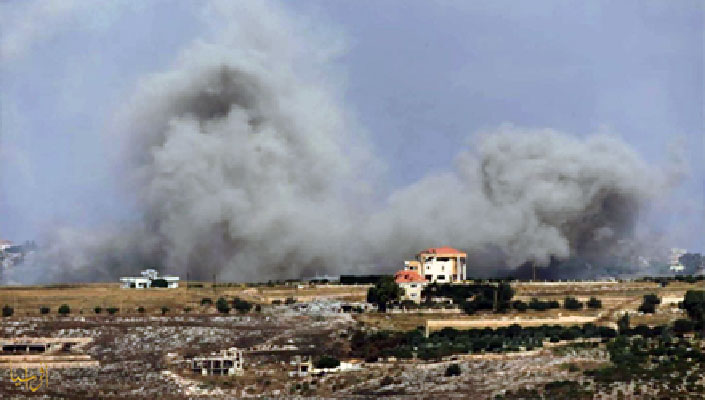
Afrasianet - Fears of rising tensions in Syria have escalated after an Israeli raid targeted Abu al-Duhur military airport in rural Idlib. The raid came in light of the continuation of Israeli operations inside Syrian territory, and Damascus condemned it.
This came amid US warnings that the escalation does not serve regional stability, which opens the door to questions about Israel's goals of the strike, its messages to Syria and Turkey, and the limits of Washington 's ability to contain tension in the region.
In this context, academic and expert on Israeli affairs Muhannad Mustafa said that Israel is acting out of several motives, most notably rejecting the existence of any military posture it considers hostile to it in Syria, pointing out that Tel Aviv , which has targeted the Iranian presence in Syria over the past years, does not currently want any Turkish military position in the country.
Speaking to the "Beyond the News" program, Mustafa said that Israel is dealing with the threats it sees in the region according to a military approach, especially after the events of October 7, instead of waiting for political settlements, considering that targeting an airport close to the Turkish border carries a direct message to Ankara about the military influence it may establish in Syria.
The strike is also part of a broader regional struggle for influence between Turkey and Israel, he said, noting that official Israeli assessments now view Turkey as a strategic, military and economic "threat."
Eye on Damascus
Writer and political researcher Ahmed Mazhar Saado said the raid was a direct warning to Turkish influence in northern Syria, and could be a message to the Syrian government about any attempt to rehabilitate airports and build military capabilities.
He pointed out that the strike came after Syria's moves to rebuild its capabilities, including the air force and air defense, and after the first sorties of the Syrian air force in a while, which may have raised Israeli concerns.
He pointed out that the timing of the raid is of additional importance, as it came after the US envoy to Syria met with the Syrian foreign minister in Ankara, and after a call between the Turkish and American presidents, considering that this makes the strike a challenge to the US trends calling for de-escalation and reaching a new security agreement between Syria and Israel.
Washington in the middle
Carolyn Rose, senior director at the Soufan Center for Studies in New York, said the United States sees the attack as destabilizing and destabilizing Syria, stressing that Washington does not want friction between Israel and Turkey or a new conflict in the region.
She added that Israel may have informed the United States of the strike in advance, but the issuance of a US position criticizing it reflects Washington's desire to de-escalate, noting that there is American resentment of Israeli operations, although it does not always appear in the form of direct condemnation.
She explained that the United States is trying to maintain balance in its relations with Turkey and Israel, while stressing the need to respect Syria's sovereignty and territorial integrity, and that it may play a role in mediation to reduce tensions.
Muhannad Mustafa stressed that Israel is gradually testing the Turkish reaction to its operations inside Syria, noting that Turkey's military and economic power and regional influence make Israel cautious in dealing with them.
He said that the United States remains the main factor limiting the expansion of Israeli operations in Syria, but in his estimation, it has not been able to force Israel to withdraw from southern Syria or the security buffer zone.
Washington's inability to force withdrawal or de-escalation has also appeared in the files of Lebanon and Gaza, giving Israel space to continue its military operations and then rearrange its relations with the US administration, he said.
War between Turkey and Israel?
Saado stressed that the Syrian government does not want to enter a war with Israel, and continues to work to reach a new agreement to disengage or update the previous agreement, in parallel with maintaining balanced relations with regional powers, especially Turkey and Saudi Arabia.
However, he stressed that Damascus is also seeking to prevent the loss of more of its territory, in light of the continuation of Israeli operations inside Syrian territory, considering that rebuilding Syrian military capabilities has become necessary to defend the country.
On the other hand, Saado ruled out the outbreak of a direct war between Turkey and Israel in the foreseeable future, citing Turkey's membership in NATO and its strong ties with the United States, as well as the Turkish approach that, in his estimation, avoids a direct military confrontation.
The Abu al-Duhur military airport is located about 5 kilometers from the Syrian-Turkish border, and Israel has not officially claimed responsibility for the strike. The Syrian Foreign Ministry called the attack a flagrant violation of the country's sovereignty, while US envoy to Syria Tom Barak called the strike "an unnecessary provocation and escalation" and said it did not contribute to regional stability.
________________
Source: Al Jazeera
________________
