
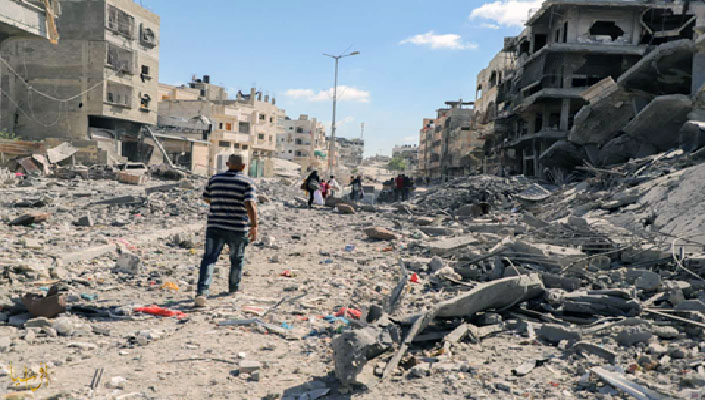
Gazans are waiting for an end to the war and stability, but Israeli intransigence and the complexities of implementing the agreement preclude optimism about an imminent breakthrough.
Afrasianet - Ahmed Abd Al Rahman - In the Gaza Strip, crushed between the Israeli war machine on the one hand, and the helpless and indifferent Arab and international attitude on the other, the Palestinian population is trying to cling to any glimmer of hope, even if they know in advance that it is just a mirage that will soon disappear.
During all the stages of the crazy war that continues to this day, the residents of the Gaza Strip were looking for any opportunity to catch their breath and get closer, even remotely, to their lives that they were living before the outbreak of the war, or even part of it, even though that life was also difficult and harsh, and it was not similar to what the rest of the world's population is living, even those who have suffered complex and sustainable crises as is the case in some Third World countries For example.
In pre-war and post-war Gaza, life seems more adventurous than anything else, as its citizens need to take the path of danger in order to secure a small part of their children's sustenance, those children who wander around every morning to get a few crumbs from worn-out takayas, or to treat the sick and wounded, and many of them, who can hardly find a suitable bed to throw their weak and worn bodies on.
In the forgotten Gaza Strip, as many of its residents believe, people are closely following all the news, all the information that is circulated, and even all the rumors and fabrications that are deliberately promoted, and they are looking for everything that calms their fears, compels their thoughts, and even everything that can give them a glimmer of hope for what is to come.
In recent weeks, the idea of a complete end to the war of aggression and the transition of the situation to the square of security and stability has dominated the minds of Gazans, especially after what they heard about the consensus that took place in the Egyptian capital, Cairo, which witnessed the reaching of the fifteen-point agreement, which was strengthened by the meetings that took place last Sunday and in which the son-in-law of the US President Jared Kushner and the Executive Director of the "Peace Council" Nickolay Mladenov participated, which spread an atmosphere of unprecedented optimism among the citizens of Gaza.
Those who believed that this agreement would put an end to their suffering for almost three years, during which they tasted the horrors of war as never happened with any other people, during which they paid heavy prices that exceeded all that they had paid during the past seventy-eight years of occupation.
Despite Israel's declared rejection of this agreement, and the announcement of the continuation of killings and control of territory, as has happened during the past ten months of the ceasefire agreement, optimism remained the prevailing among the residents of the Gaza Strip, who bet and continue to bet on the efforts of the intermediary and guarantor countries, and still hope for the success of the pressures of those countries on the Zionist entity, which has never before, as experience indicates, to obey pressures of any magnitude, and even managed His back and hit the wall with everything that was agreed upon on previous dates and occasions.
However, aside from what is in the minds of the people in Gaza, and regardless of the reassurances issued by some quarters, the likes of which we have heard a lot in the past months, the data and indicators do not allow for much optimism in the coming weeks, at least, especially in the period leading up to the Israeli parliamentary elections.
We can point to some observations to prove this point of view, which some may think is pessimistic and lacks realism, and this can be true, but our experience during the three years of this criminal war always pushes us to deal with all the developments that are taking place with great caution, and even to look at them with suspicion and suspicion, especially if we know that the other side has no intention of stopping the aggression, and that its positions during the long months of the war have been It is characterized by evasion, lying, breaking promises, and even renegating many of what was agreed upon without paying attention to anyone, even if he is the president of the largest and most powerful country in the world.
The first observation that prevents us from being overly optimistic relates to the declared and clear Israeli position on what was recently agreed upon in Cairo, a position that is completely consistent with its position on all previous understandings, even those that it signed, and declared its commitment to them, as was the case during the agreement of January 19 last year, or the agreement of October 10 of the same year, which witnessed clear and flagrant Israeli violations, the latter of which resulted in about 1,300 martyrs. and hundreds of wounded and wounded, and the expansion of the areas of Israeli control to nearly seventy percent of the Gaza Strip.
In all the Israeli statements that followed the recent Cairo Agreement, there was no doubt that the Zionist entity opposed it, rejected it in its entirety, and even emphasized the continuation of the aggression in all its forms, especially the continuation of the crimes of targeting citizens by drones, or through the shooting operations and artillery shelling that do not stop at night.
On the ground, this position has been translated in all its details, and the killings with incendiary rockets have become a daily occurrence that does not require condemnation or condemnation from the international community, or by the sponsoring and guarantor countries, which did not dare to issue a statement condemning the Israeli aggression until after obtaining permission from the American side, as happened two days ago.
According to all the facts on the ground, and the ongoing construction of new Israeli military sites near the Yellow Line, in addition to the approach of the Israeli elections, in which the war criminal and fugitive from the face of international justice Benjamin Netanyahu is in dire need of making achievements to get more votes from the Israeli voters, the escalation will remain the master of the situation for the next two months at least, with the possibility of some progress on the issue of humanitarian aid only, which will be a drop in the ashes in Laayoune to ease international criticism, and to cover up the continued killings and land grabs.
A second observation that leads us to be very unoptimistic is the lack of clarity regarding the implementation of some points of US President Donald Trump's plan, which seems to have carried many mines and was deliberately filled with many thorny files.
The first and most complex of these points is the issue of disarming the resistance in Gaza, which has now become the most important point of the ceasefire agreement, and has exceeded all other points in its importance and the need to implement it immediately, even those mentioned in the first phase of the agreement and denied by the Zionist enemy, and did not commit to implementing the largest part of them.
On the issue of disarming the resistance, there are two views: the first is adopted by the resistance and is based on the fact that heavy weapons should only be stored with a reliable Palestinian party, and that this weapon should not be handed over to the Israeli enemy or any external party, no matter how reliable it is, and that this should be done in the light of internal national consultation over which Israel has no influence from near or far.
The other view adopted by the Israeli enemy, its American ally, and some members of the Peace Council points to the need to disarm in all its forms, whether heavy or light, in addition to the weapons of families, and to ensure that this weapon does not pose any significant "threat" to the security of the Hebrew "state" in the future. which was mentioned in the maps of the armistice agreement ten months ago.
A second point that we also see as complicated, especially in light of Israel's intransigent position regarding the deployment of the international "stabilization force" , which many countries are not yet emboldened to engage in, at least, in addition to the Palestinian fear of its future role in light of its political reference, which does not bode well, and the possibility of it becoming an occupying power instead of a force for resolving disputes, or providing security for Palestinian citizens.
In this matter, there are complexities regarding the deployment of the force, the number of its personnel, and the roles assigned to it, in addition to its ability to carry out its duties in light of the presence of the occupation "army" near its positions.
A third point, no less important than the previous ones, relates to the entry of the Technocrats Committee to carry out its tasks in managing the affairs of the sector, and providing the necessary necessities of life and living for the citizens, most of which were absent during the months of war, in addition to – and most importantly – the start of the process of removing millions of tons of rubble and reconstruction, which seems to be the most difficult task of this committee with modest capabilities and limited powers.
So far, the Israeli enemy has prevented this committee from entering the Gaza Strip and is clearly blocking its chance to take over the reins there, and in doing so, it seeks to prolong the crises, some of which have become worse, and to tighten the noose on the residents of the Gaza Strip to push them to lose hope for any future breakthrough.
Other observations include the American position that is biased towards the Israeli enemy, which was reexpressed by Kushner and Mladenov in the Cairo meetings two days ago, and the loss of any pressure cards by the guarantor and intermediary countries on the occupation, in addition to the dark shadows cast by the continuation of the internal Palestinian division on the entire Palestinian scene.
In any case, the coming days and weeks seem to be very important in terms of the emergence of signs and indications that all the residents of the Gaza Strip are waiting for, and are eagerly awaiting their occurrence, which many see as possible and possible, but the data on the ground do not indicate that this could happen soon, at least, and it may require a greater effort, and broader efforts, to force the enemy to make real concessions and fulfill the bulk of its commitments that it agreed to in October. Year 2025.
________________

