
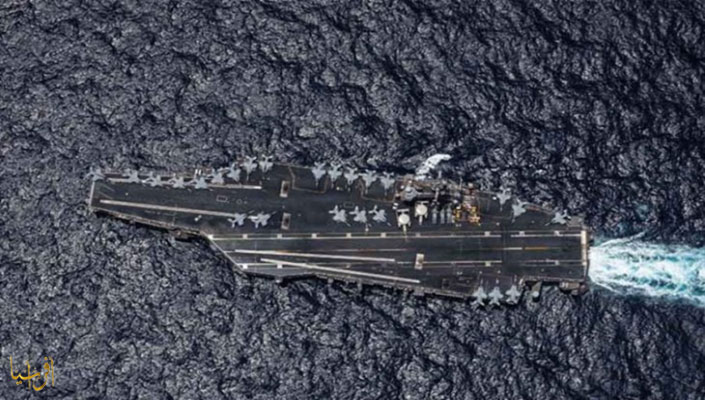
Afrasianet - Mohamed Noon - The war clashes between the US and Iranian navies in the Strait of Hormuz have intensified the prevailing militarization due to the war that broke out on February 28, 2026, and subsequently paralyzed this strategic strait vital to energy security in the world, making it almost impossible to pass through it except with Iranian approval after prior coordination. Iran's response was swift with a direct targeting of these naval vessels, followed by U.S. attacks on Iranian targets.
Mutual bombardment in the Strait
The confrontation between the United States and Iran was renewed on Friday in the Strait of Hormuz, with the US military announcing that it had targeted two Iranian oil tankers, coinciding with Washington's announcement that it was waiting for an imminent response from Tehran to its proposal to stop the war. Iranian military officials told local media that his country's navy had "responded to the violation of the ceasefire and US terrorism with strikes", adding that after "the exchange of fire, the clashes have now stopped".
U.S. Secretary of State Marco Rubio stressed that Iran should not control the Strait of Hormuz, where the exchange of fire took place, and noted that Washington expects a response from the Iranians on Friday to the U.S. proposal to end the war, saying, "I hope it's a serious offer, I really hope so."
"It is still under study, and once a final decision is reached, it will definitely be announced," according to the ISNA student news agency.
Amir Saeed Iravani, Iran's representative to the United Nations, accused the United States of violating the ceasefire through attacks on Iranian oil tankers, in a letter addressed to the UN Secretary-General and the Security Council.Iran's Tasnim news agency reported that Foreign Minister Abbas Araghchi, during a conversation with his Turkish counterpart, expressed doubts about the seriousness and commitment of the United States At the same time.
Qatari Prime Minister Sheikh Mohammed bin Abdulrahman Al-Thani on Friday called for the resumption of diplomatic efforts to reach an agreement with Iran, when he met with US Vice President Jay de Vance in Washington.
However, those clashes in the Strait of Hormuz led to Tehran's slowness at the political level to give its response to the American proposal to end the conflict, as the Iranian side believes that it is not in a hurry to respond after the United States of America did what Araqji described The Iranian foreign minister said that it was a military adventure that coincided with diplomatic efforts.
What further intensified the Iranian position was that Trump quickly retracted his plan to open the Strait of Hormuz by force, as the US president said that he does not see the need to continue the "freedom project" related to the passage of commercial ships through the Strait of Hormuz, pointing out that there are "alternative routes." alternative options" in Washington, without disclosing them. He noted that Washington could return to the "freedom project" if things don't go well, adding:
"Then there could be the freedom project and other additional things." Trump said the course of talks with Iran was "going well" and that Washington would receive a response from Tehran "very soon" to a proposal to end the war.
On Wednesday, Trump announced a temporary suspension of Monday's "Freedom Project" aimed at removing the ships of "neutral" countries stranded in the Strait of Hormuz, claiming that there was "significant progress toward a comprehensive agreement" with Iran.
Two Saudi sources confirmed to AFP on Friday that the kingdom had refused to grant permission to US forces to use its bases and airspace in the Hormuz operation.
In early March, Tehran closed the Strait of Hormuz against the backdrop of the war waged by Israel and the United States against it, in a move that observers saw as an attempt to raise the cost of confrontation regionally and globally, leading to disruptions in food supplies and rising energy costs globally.
It was not immediately clear why the oil spill was spotted off the west coast of the small island.Khark Island is a vital artery for Iran's oil exports, with about 90 percent of its crude exports passing through it, according to a report by the American bank JPMorgan.
The New York Times quoted Orbital EOS, which specializes in monitoring leaks, estimating that the area of the spill Oil has exceeded a square kilometer as of Thursday.
Trump distancing himself from allies
Coinciding with Trump's involvement in a state of no war or peace with Iran, and in light of the complexity of the scene in the Strait of Hormuz, the US president's recent steps threaten to deteriorate relations with key allies, including Germany, after Trump issued his decision to withdraw a large number of US troops from Germany, his threats to reduce many forces in other parts of Europe, and his downplay of the latest Iranian attacks on an important partner in the Gulf, the United Arab Emirates.
The United States may not be reliable for future crises, as Trump's words and actions have stoked fears among Washington's longtime friends from Europe to the Middle East to the Indo-Pacific.
In response, some of the United States' traditional partners have begun to hedge in ways that could lead to long-term changes in relations with it, while adversaries such as China and Russia seek to exploit these strategic opportunities.
But most analysts believe that his volatile approach since his return to the White House, which has severely damaged the rules-based world order, will further undermine Washington's alliances, especially as Trump continues to pour his anger on NATO for its considerable resistance to his wartime demands.
Strategic consultancy "Situation Room" said that "Trump's recklessness regarding Iran is leading to some radical shifts. The credibility of the United States is at stake."
Tensions between Trump and the Europeans have escalated since the United States and Israel launched a surprise attack on Iran on Feb. 28, and Iran's response by closing the Strait of Hormuz has led to the biggest shock ever in the global energy sector that has made European countries the biggest economic losers from a war it has never sought.
Even before that, Trump upset his allies by imposing sweeping tariffs and pushing for the seizure of Greenland from Denmark (a member of NATO and the European Union) and aid cuts The rift widened when Trump announced last week that he would withdraw 5,000 of the 36,400 U.S. troops stationed in Germany, after German Chancellor Friedrich Merz angered him by publicly saying that the Iranians were insulting the United States.
The Pentagon then scrapped plans to deploy Tomahawk cruise missiles in Germany.Trump, who has long questioned whether the U.S. should remain in the NATO alliance it helped create after World War II, said he was also considering reducing the number of U.S. troops in Italy and Spain, after the leaders of the two countries disagreed with him over the war.
Dispute with the Allies
The move followed Trump's accusations to allies that they had not done enough to support the United States in the war, and his suggestions that this meant that Washington may no longer be bound by Article 5 of NATO's founding treaty on mutual defense, and that an attack on any member state would constitute an attack on all members.
"President Trump has clearly expressed his disappointment with NATO and other allies," White House spokeswoman Anna Kelly said, noting that some Requests to use military bases in Europe in the war on Iran have been rejected by host governments.
The Pentagon has raised the prospect of punishing NATO members who are believed to have failed to support U.S. operations against Iran, with options such as suspending Spain's membership and reviewing U.S. recognition of Britain's sovereignty over the Falkland Islands.
European governments have responded by stepping up efforts to increase cooperation among themselves, and to endurance more A European diplomat described Trump's threats as a clear signal for Europe to increase investment in its security, but said leaders had succumbed to the need to adapt to the situation for now.
At the same time, as part of their efforts to placate Trump, European officials have quietly stressed that many of their countries are allowing U.S. forces to use bases on their territory and airspace during the campaign against Iran.
Hopkins said that, while German Chancellor Mertz appeared to impress Trump during previous meetings, he is now "not trying to hide an assessment critical of what the United States has inserted itself into."
The European diplomat believes that Europeans are also aware that Trump, who is barred by law from running for president again, may give himself free rein to "do what he wants" on the world stage before he leaves office in January 2029.
As some European leaders sound the alarm over the future of NATO, Polish Foreign Minister Radosław Szikorski said at a conference in Warsaw that there is no need to panic as long as Europe keeps its promise to increase military spending, which is what it is When Iran last week launched missile and drone attacks on the United Arab Emirates, a close U.S. ally, Trump and his aides appeared to turn a blind eye, fueling concern among Gulf Arab states, which are already suffering greatly from the war.
Closing schools. Even after other attacks later in the week, he insisted that the ceasefire, which went into effect a month ago, was still in place.
According to a Reuters report, Trump entered the war against the advice of some Gulf allies but quickly lined up in solidarity with him, and some now fear that he will strike a deal that would leave them facing a neighbor that remains a threat, in their view.
Asian partners worried
The war has also raised concerns among Asian partners, many of whom rely heavily on oil that flowed unfettered through the Strait of Hormuz before the war.
Countries such as Japan and South Korea have already been concerned about Trump's high tariffs and his disdain for traditional alliances.
Some may now wonder whether Trump's apparent vulnerability in the face of domestic economic pressures, such as rising gasoline prices, may mean he may hesitate when asked to help in a conflict with China, such as invading Taiwan.Takeshi Iwaya, who served as Japan's foreign minister at the start of Trump's second term, told Reuters: "What worries us most is that trust, respect and expectations for the United States — the key partner in Japan's most valued alliance — are shrinking Yasutoshi Nishimura, Japan's former trade minister, said Tokyo's response to changing world power interactions had become more important by forging closer ties with "like-minded middle powers" such as Britain, Canada, Australia and European countries.
Experts warn that Trump's use of brute force in an optional war against Iran, launched a few weeks after a U.S. operation in Caracas to arrest Venezuela's president, could encourage China and Russia to intensify coercive measures against their neighbors.
Beijing may have learned lessons from the United States' forced relocation of military assets from the Indo-Pacific to the Middle East, and how the world's most powerful military has sometimes stood helpless in the face of asymmetrical methods such as Iran's cheap drones.
But Victoria Coats, Trump's deputy national security adviser in Trump's first term, said Beijing would have a hard time using the U.S. war against Iran "as an absolute mandate to go around the world and say we're a destabilizing force."
