
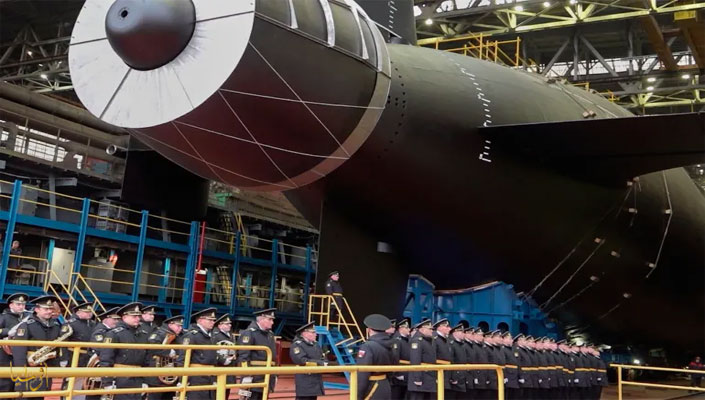
Khabarovsk nuclear submarine appears during launch operations at shipyard
Afrasianet - The world is facing a new phase of nuclear deterrence after Russia sent the Khabarovsk submarine capable of carrying a "doomsday weapon" to the sea.
This is the first practical launch of the submarine since construction began in 2014, the website explained, noting that it can carry up to 6 "Poseidon" torpedoes equipped with a nuclear propulsion system.
The Russian website considered that this event represents a qualitative leap in the development of the Russian naval nuclear triad, given that the giant torpedoes carried by the ship are capable of delivering a crushing retaliatory strike from the depths of the ocean.
The system is one of six strategic weapons unveiled by Russian President Vladimir Putin in 2018 as part of Moscow's efforts to develop a nuclear capability to overcome modern missile defense systems.
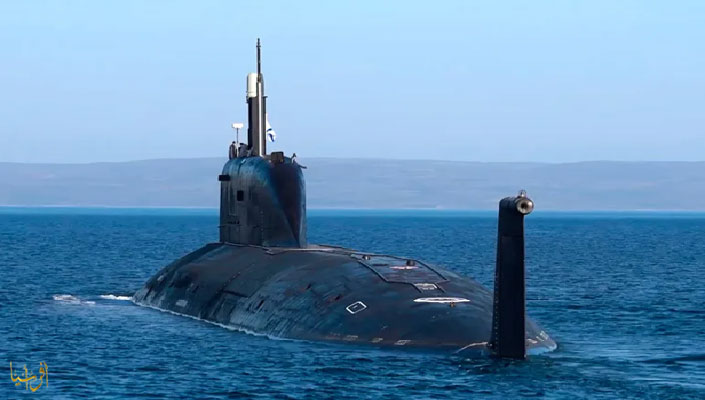
Russian nuclear submarine at sea during joint military exercises between Russia and Belarus
Doomsday weapon
Russia's launch of this submarine provides an additional strategic deterrent because it operates in the water column rather than in a ballistic trajectory, and where each torpedo has a range of 10,000 kilometers.
Russia has dubbed the submarine's torpedo "Poseidon" (Doomsday Weapon), which is strategically flexible and is among the most destructive weapons in Russia's arsenal.
The "doomsday weapon" is a self-driving intercontinental vehicle operating in the deep sea, equipped with a nuclear engine, capable of moving at great depths at speeds of between 60 and 100 knots, and traveling distances of thousands of kilometers, exceeding conventional missile defense systems.
The website explains that the publication of "Khabarovsk" came about 6 years later than scheduled, which reflects its complexity and unique design, as well as the difficulties and shortcomings of the Russian military-industrial complex.
At the same time, the website believes that this event shows that Russia, despite the severe economic crisis, has made remarkable progress in strengthening its defense capabilities.

Putin attends naval flag hoisting ceremony aboard nuclear-powered ballistic missile submarine Knyaz Bozarsky (Reuters)
Guarantee of excellence
The website considered that this event would cause concern in the United States, which was explicitly and directly referred to by the magazine "American Military Monitoring".
According to the magazine, the design of the submarine's stern, propulsion system and rudder assembly clearly indicate a deep technological continuity of the development of the capabilities of the Russian defense industries in the field of long-range underwater robotic systems.
Tsargrad asserts that the main goal of this nuclear-powered system is to ensure Russia's absolute superiority and provide an alternative delivery system for lethal warheads, noting at the same time that the US Navy plans to acquire at least four submarines of this type in the future.
The submarine, in addition to its autonomous vehicles, has a superior lightning capability and can carry three types of cruise missiles, as well as long-range Kalibr missiles, Onyx anti-ship missiles, and hypersonic Tsirkon missiles, which no current NATO air defense system can intercept.
These weapons are designed to change the landscape of the continent and impose the rules of the game in global conflicts, but the main weapon remains the Poseidon missile, which has a warhead of up to 20 megatons, thus surpassing any ballistic missile.
When a submarine capable of wiping entire coastal areas off the map with a single hit enters a combat mission, there is no doubt that adversaries only have the option to seriously consider the consequences.
It is time for Russia's enemies to realize that the time for impunity is over, and that they now have good reason to fear, otherwise they should not listen to the tsunami news, but can watch it live.
Destroy NATO
In this context, a report published by the British newspaper iPepper on its website revealed that Russia has entered a new phase in the naval nuclear arms race with the launch of the Khabarovsk nuclear submarine, which is specially designed to carry the Poseidon torpedo, which experts describe as a "doomsday weapon."
Isabella Benguichea, the paper's deputy head of international affairs, explained in her report that the submarine, which began construction in 2014, is designed to operate in complete silence, making its tracking subject to highly advanced technological capabilities. It is one of only two submarines in the world capable of carrying this torpedo, along with the Russian submarine Belgorod.
"The nuclear-powered Poseidon torpedo can carry a nuclear warhead of up to two megatons, and is capable of generating devastating tidal waves that reach the coast, sink entire cities or emit a long-range radiation cloud".
________________
A paradigm shift
According to the newspaper, this development is a paradigm shift within the Russian nuclear doctrine. The 135-metre-long submarine represents an entirely new model, unlike the previous Russian submarine Belgorod, which was modified to carry the torpedo Poseidon.
The Khabarovsk submarine has been designed for this mission from the start, making it part of the development of a new arm for Russian nuclear deterrence outside of the ballistic missile framework.
Nick Childs, a researcher at the International Institute for Strategic Studies, said the submarine enhances Russia's ability to carry out a "second nuclear strike" in the event of a first nuclear attack, because Poseidon operates underwater and is not affected by anti-missile defense systems.
In his view, this means that even if a first strike destroys Russian nuclear sites, Poseidon, which has been operating underwater for long periods and without a crew, can carry out a crushing attack.
The nuclear-powered Poseidon torpedo can carry a nuclear warhead of up to two megatons, and is capable of generating devastating tidal waves that reach the coast, sink entire cities or emit a long-range radiation cloud.
Poseidon Features
No Western country has a direct counterpart to this system, and the Poseidon torpedo has the added advantage of bypassing Western missile defense systems, which are designed to intercept ballistic and winged missiles, rather than autonomous underwater torpedoes.
So far, little is known about the Khabarovsk submarine's role in Russian naval doctrine.
But William Freire, a national security researcher at the Center for Geostrategic Research, suggests that the submarine could leave Russian waters to search for large NATO ship groups — such as aircraft carrier groups — or play a role similar to nuclear ballistic missile submarines by "adding a new arrow to Russia's nuclear deterrence."
However, NATO — especially the United States and Britain — still excels in anti-submarine warfare, even though its focus in the past decades on counterterrorism has led to less investment in this area than the Russians.
"Atlantic Fortress"
Britain has recently begun the "Atlantic Fortress" project to monitor the North Atlantic Ocean with modern frigates equipped with AI-powered acoustic detection systems and unmanned aircraft and submarines.
The British government also announced an investment of £2 billion ($2.6 billion) in autonomous submarine technology and new attack submarines as part of the AUKUS program, which aims to boost naval capabilities against Russia and China.
________________
