
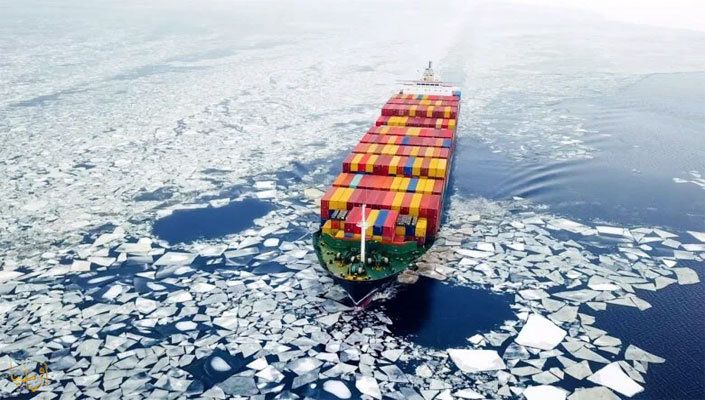
The Silk Road has become a strategic corridor for trade and energy amid competition between China, Russia, the United States, and Europe.
Afrasianet - Shaher Al Shaher - The Arctic is no longer a peripheral region in international calculations, as climate change and technological advances have become factors that are reshaping its economic and strategic value. Melting ice is not only expanding navigation, but also adding to the competition for energy, minerals and infrastructure a new space where the interests of Russia, China, the United States and Europe intersect.
For China, the importance of this shift is directly related to trade security. An economy with a foreign trade volume approaching $6 trillion a year cannot ignore the risks surrounding sea lanes, from the Strait of Malacca to the Suez Canal and the Bab al-Mandeb.
Therefore, the "Silk Route" is part of a broader policy to diversify trade and energy routes, and reduce reliance on choke points that can turn into geopolitical pressure tools in times of crisis.
The North Pole: From Geographic Margin to Geopolitical Center
The Arctic is as important as its location. It is located at the confluence of Asia, Europe, and North America, and any change in its accessibility is directly reflected in transportation, energy, and security calculations.
The figures illustrate the direction of the shift. At the end of the summer of 2025, sea ice area had decreased by about 28% compared to 2005 levels, while the old multi-year ice had declined by more than 95% since the 1980s.
These developments do not mean that the pole is open for navigation year-round, but they do mean that the natural conditions that have kept the region isolated for centuries are changing significantly.
At the heart of this transformation is the Northern Sea Corridor, which runs along the Russian coast, which connects the Atlantic Ocean to the Pacific Ocean via polar waters.
The distance between East Asia and Northern Europe via this route is shorter than the route through the Suez Canal, and under the right conditions, the journey time can be reduced from about 40 or 50 days to about 20 days.
For global trade, the difference is not technical; time has become a factor in cost and competitiveness.
But distance alone does not make a trade route. Arctic navigation requires specialized ships, ports, rescue and communications services, and faces higher insurance and operating costs than traditional routes.
Therefore, the real economic question is not: Is the road shorter? Rather: Can it become regular, predictable, and commercially viable?
China's interest is clearer. Beijing does not need the Arctic Corridor to compete with the Suez Canal in order to benefit from it; there is an additional route to expand the margin of movement for an economy that relies on maritime trade.
This is even more important with the Strait of Malacca, which is one of the hotspots in China's trade and energy movement.
The Arctic Corridor does not eliminate the "Malacca Dilemma", but it does add another option. This is the main strategic value of the project: "diversifying the paths rather than betting on a single path".
China cannot control international corridors, but it can distribute risks through a network that includes sea routes, trans-Eurasian railways, Central Asian corridors, and the China-Pakistan Economic Corridor, along with the Arctic Route.
In this sense, the pole is transforming from a natural barrier to a potential part of the trade network. Its value increases because the sea lane is simultaneously linked to energy, minerals, infrastructure, and communications, i.e., to the elements that have become the core of contemporary geoeconomics.
But harsh climates, seasonality, poor infrastructure, and navigation risks will remain real constraints, unless technology and investments can turn geographic potential into stable economic activity.
China, Russia, and energy.. When geography meets economics
Russia has the geography through which the bulk of the Northern Corridor passes, while China has a huge market and extensive financial and industrial capabilities. In addition, the Russian Arctic is rich in oil, gas, and minerals, which makes the trade interests between the two countries deeper than just cooperation in the field of transportation.
But intersection does not mean a vision match. Moscow views the pole as part of its national security and sovereign domain, so it wants to retain the main role in managing the corridor and developing its infrastructure. Beijing is focused on accessing and using the road within its trade and energy network with Europe and Asia.
The energy sector is the most visible area of this cooperation. The Yamal LNG project represents a practical example of the integration of Russian resources with Chinese investment and Asian markets, and reveals that the importance of the pole is not just about transportation; the region can become part of the reorganization of the energy map between Russia and Asia.
After the war in Ukraine, this equation has gained additional weight. Western sanctions and the decline of Russian energy's presence in European markets have pushed Moscow to direct a larger portion of its exports to Asia, while China has become a major market for Russian energy and an important partner in a number of energy and infrastructure-related projects.
The Northern Corridor thus gained a function beyond the connection between China and Europe. It also became part of the reorientation of Russian resources towards Asia, and its importance in the transportation of oil and gas increased.
In 2024, the volume of shipping through the corridor was about 37.9 million tonnes, an important figure for an emerging polar route, but still small compared to the volume of global maritime trade.
A distinction should be made here. The use of the corridor for the export of Russian resources has become a commercial reality, and its transformation into a regular global container route between Asia and Europe is still in the testing phase.
Chinese companies have already begun to experiment with more regular services for transporting containers through the North, and success in bypassing climate and logistical restrictions could give the route a greater role in Eurasian trade.
But companies don't just choose the shorter route. Stability, predictability of costs and timelinesses are critical elements of modern trade, which is why specialty vessels, insurance, ports, telecommunications, rescue services, and seasonality remain the most significant constraints to commercial expansion.
Infrastructure in particular is a crucial test. Ports and logistics in the Arctic are still much less developed than ports in northern Europe and Asia, and dealing with a major accident in an area far from population centers and maritime services raises risks and costs. This makes investing in the road a long-term strategic project, not just an investment in a shipping lane.
China has the financial and industrial capacity to contribute to the development of ports, ships, and services, while Russia has the location, resources, and expertise in the polar environment.
But Western sanctions remain a factor in finance, technology, insurance and services, meaning that the economy alone will not determine the future of the project.
This is where the limits of partnership come in. Moscow needs capital and Asian markets, Beijing needs Russian resources and corridors, but the two sides do not start from the same calculation.
For Russia, sovereignty is the starting point; for China, accessibility is the priority. The relationship therefore looks more like a deep partnership of interest than an integrated polar alliance.
From a sea route to a new strategic network
It would be a mistake to present the Ice Silk Road as a ready alternative to the Suez Canal. The Suez Canal has an integrated system of ports, services, insurance, and navigation, while the Arctic Corridor is still in the process of developing its core capabilities.
The strategic value of the corridor is shown when traditional routes are disrupted. The Red Sea crisis provided a clear example; the high risks at Bab al-Mandab prompted shipping companies to change routes around the Cape of Good Hope, which increased flight times, fuel and insurance costs. Experience has shown that corridor security has become part of trade security.
For China, the lesson goes beyond the Red Sea itself. Production and export capacity is not enough if there is no capacity to deliver goods and energy to markets under changing conditions. Beijing is building a multi-channel network that includes sea lanes, trans-Eurasian railways, Central Asian corridors, and the China-Pakistan Economic Corridor, with the Arctic Route as a northern extension of this network.
This is not a strategy to replace one path with another. The idea is simpler and more realistic: "Reduce dependence on any single route." If one corridor is hit by a political, military, or environmental crisis, Chinese trade can partially shift to other routes. Even if the Arctic Route's share of global trade remains small, its existence as an additional option carries strategic value beyond its direct trade volume.
But economics leads to politics here. The expansion of commercial activity in the Arctic raises its security importance, Russia has strengthened its military presence and strategic infrastructure in the region, and the United States and its allies are monitoring Russian and Chinese activity from the perspective of competition for influence.
Ports, energy, and telecommunications are no longer completely neutral economic projects when they are located in a region that has become part of the competition between major powers.
This is one of the paradoxes of the project: the commercial success of the road may increase its political value, and thus make it more competitive. As the corridor becomes important to China, Russia, and Europe, its presence becomes part of the broader security calculus at the pole.
Climate change adds another paradox. It expands navigation opportunities, but it makes economic activity more sensitive in one of the world's most fragile environments. Any oil or maritime accident in the region will be more complicated to deal with because of distances, climatic conditions, and poor infrastructure.
This is why the IMO Polar Code came to regulate ship design and equipping, crew training, search and rescue requirements, and environmental protection.
But the rules do not eliminate practical risks, especially as the number of ships rises and commercial activity expands in an environment that is still difficult to operate.
So the real question is not whether the Arctic will defeat the Suez Canal? The most important question is: can the corridor become a stable part of the global trade network, used by companies when economic and security conditions are right?
If this happens, the pole will have moved from a geographically isolated region to an economic corridor with weight in Eurasian trade. China will be among the biggest beneficiaries, not because it wants to control the route, but because it has a direct interest in diversifying trade and energy routes, as well as the financial and technological capabilities that help it invest in infrastructure.
Russia will try to transform its geographic location into a long-term source of economic and political power. Europe will face a more complex equation between taking advantage of the route and security considerations associated with Russia, while the United States will treat any significant Chinese expansion of the pole as part of the broader balance of power.
Ultimately, the success of the Silk Road should not be measured by the number of ships passing through it. The most important criterion is its ability to become a reliable part of the network of corridors through which trade and energy move between Asia and Europe.
China is not looking for a single route to European markets, but a network that allows it to change trajectories when circumstances change. In an international system where trade has become tied to sanctions, energy, maritime security, and great-power competition, the ability to move and redirect economic flows has become part of the power itself.
The Arctic may not become a replacement for the Suez Canal, and container traffic may remain limited for years, but turning it into a usable option is a game-changer. A country that can access markets by more than one route is less susceptible to pressure than a country that relies on a single corridor.
Hence the real value of the Silk Road. It is not redrawing the global trade map all at once, but rather gradually pushing it toward a more multi-corridor system, less dependent on bottlenecks, and more concerned with the resilience of trade networks to geopolitical shocks.
In this sense, the future of the road is not just about ice. "It is about the form of economic power in the twenty-first century, where control of markets is no longer enough, and the ability to protect and change access routes where necessary has become an essential part of international power."
The Ice Silk Road may not be the largest trade route, but it may become one of the most important routes in risk management calculations.
________________
