
Afrasianet - Suleiman Haj Ibrahim - Contrary to what some may think is just a sports organization that oversees the affairs of the Round Witch and its laws, FIFA is a transnational geopolitical and economic entity, whose interests are intertwined with major capitals and global investment funds.
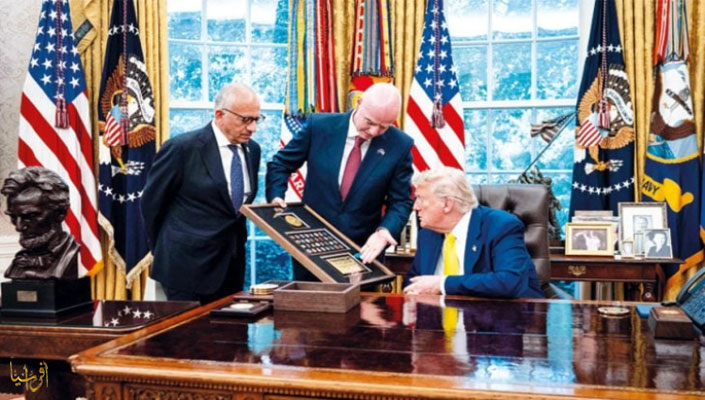
A proposed project put forward by its president, Gianni Infantino, to privatize part of the commercial nerve of the World Cup, was enough to ignite a political storm and a major international crisis that made headlines around the world and called for the public intervention of the leaders of countries of the size of US President Donald Trump to defend the throne of his ally in Zurich world.
With what is happening, the file of crisis governance is reopening for an organization that has historically been reproducing its crises and always living in the midst of storms and major international deals, as many reports and analyses have confirmed. In this investigation, we try to dismantle the crisis and delve deeper into its dimensions, as vast facts unfold that highlight the threads of the big game.
Kushner's curse!
The starting point and spark that sparked the crisis began with a project called "FIFA Forward Enterprise" (FFE), a plan to separate FIFA's business activities – including the men's and women's World Cups, broadcasting, sponsorship, ticketing and licensing rights – into a $20 billion subsidiary, with private investors owning up to 20 percent of it in exchange for an estimated $4.2 billion in immediate liquidity.
The lead goes directly to the lead investor, Thrive Capital, through its perpetual investment arm, Thrive Eternal, which is run by Joshua Kushner, the younger brother of Jared Kushner, the president's son-in-law.
Greg Maffei, the former chief executive of Liberty Media Group, and Apollo Sports Capital joined the investment group. Although FIFA has denied that Jared Kushner himself was among the direct investors, the mere fact of getting close to this sensitive U.S. political circle was enough to stoke widespread suspicion about the politicization of major sports tournaments.
As the Kushner family's name circulated, there was anger not seen in FIFA since the major corruption scandal of 2015: resignations, threats of boycotts, a rare public apology, and finally a complete retreat.
But the retreat did not end the crisis, but opened the door to a deeper question: Did Infantino survive a passing storm, or was his own legitimacy in question ahead of the March 2027 election battle?
From Leakage to Open Rebellion
The immediate reason that surfaced coincided with the 2026 World Cup, when British and American press reports began to reveal the details of the FIFA Forward Enterprise plan and the size of the deal estimated at $4.2 billion from the sale of about 20 percent of the commercial stakes at a total valuation of $20 billion.
Carlos Cordeiro, a former Goldman Sachs banker and senior adviser to Infantino, has resigned, declaring that he cannot stand idly by while FIFA contemplates selling a stake in the World Cup.
Around the same time, Kevin Lamour, FIFA's chief operating officer, issued a statement accusing Infantino's management of deceiving employees and lacking transparency in planning the deal for months.
Infantino tried to pass the bill through a financial lure to give each of the 211 member associations up to $20 million in one go. But he faced a decisive ultimatum from UEFA: either back down and resign, or face an emergency vote of no confidence.
The 55 European associations have united in threatening a blanket boycott of FIFA competitions if the project goes ahead, declaring in an official statement that football "does not belong to anyone to sell."
UEFA, the AFC and CONCACAF sent a joint letter calling for a completely independent review of the FIFA Forward Enterprise file, signed by UEFA President Alexander Ceferin, AFC President Shaikh Salman bin Ebrahim Al Khalifa, and CONCACAF President Victor Montalliani, rejecting the internal investigation by FIFA itself.
Donald Trump on the Crisis Line
US President Donald Trump went directly to Truth Social, writing that FIFA would make a grave mistake if it thought of replacing Infantino, describing him as a "great president" and stressing that the organization would not have achieved such success and profitability without him.
Infantino, while six Arab federations (Qatar, Egypt, Morocco, Lebanon, Mauritania, and Sudan) announced their support for the stability of the institution and its presidency. At the same time, Nasser Al-Khelaifi personally settled the controversy over his candidacy, assuring the RMC network of his adherence and happiness to continue as president of Paris Saint-Germain.
A multi-layered power struggle
When deconstructing the current scene, data emerge that the issue is more complex than a "with or against Infantino" dichotomy: a rift has emerged within the opposition camp itself: Sheikh Salman bin Ibrahim's signature on the joint letter put him in contrast to the dominant federations within his continent (such as Qatar), revealing that the "Asian Front" is not on the heart of one man, as Doha has officially demanded a written clarification on the consultation mechanism adopted before the statement was issued on behalf of the Asian Federations.
Behind the scenes of the "consensus candidate", as follower readings indicate that the next general assembly in March 2027 will be the real arena of the battle for survival, as the opponents seek to present a candidate who enjoys wide continental acceptance.
On the opposite front, Infantino is making strenuous attempts to repair his home front and launch a counter-offensive plan to escape the pressure of the opposition, as sources indicate that he is ready to put forward new projects to expand the championships to win the support of additional continents, amid analyses that put forward the hypothesis that his camp will resort to a "managed caliphate" from within His alliances (perhaps from South America with the support of CONMEBOL) should pressure on him intensify, to ensure that his approach continues without appearing broken in front of his European opponents.
Infantino's Loss and Profit Balance
When analyzing the situation of Infantino – the Swiss-Italian who is linked to a close family relationship with Lebanon – the positions differ sharply between the opposition and support fronts.
On the opposition front, Carlos Cordero described the idea of selling a share of the World Cup as an abandonment that cannot be tolerated. Kevin Lamor also accused the FIFA leadership of deceiving employees and lacking transparency.
UEFA has officially declared a complete loss of confidence in Infantino's leadership, stressing that backing away from the project alone is not enough to restore that confidence, and demanding binding structural guarantees.
Andy Burnham, the mayor of Greater Manchester, former British minister and current British prime minister, stressed that the World Cup is not a commercial commodity and has never belonged to someone to sell it.
Prince Ali bin Al Hussein also strongly criticized FIFA's management style and political and financial pressures to secure loyalties, calling for measures to ensure full integrity and transparency and the abolition of the secret ballot.
On the public front, fans of European clubs (including French club Lyon) held up sharp banners attacking Infantino's policies, in a sign of his public image cracking.
On the defence front, the executive board of the South American Confederation (CONMEBOL) unanimously expressed its full support for Infantino, praising his leadership of major tournaments.
The official FIFA administration confirmed that the president is democratically elected and continues to perform his duties under the mandate granted to him by the General Assembly.
A bloc of Arab federations has also issued explicit statements of support for maintaining the stability of the international sports system.
Ethical Files and Issues to the Forefront
In December 2025, the rights group Fairsquare filed a complaint with the ethics committee after Infantino awarded US President Donald Trump's FIFA Peace Prize, alleging that he had violated the principle of political neutrality, a complaint that resonated with European parliamentarians.
The current crisis is also reminiscent of Infantino's previous attempt in 2018 to pass a $25 billion investment fund to create new world championships, which UEFA aborted in the bud at the time.
The Lauber case
Regardless of the current 2026 crisis, Infantino has been under the microscope of the Swiss judiciary for years over his undocumented meetings between 2016 and 2017 with Michael Lauber, the Swiss federal prosecutor at the time, who was overseeing FIFA's corruption investigations.
Although the Swiss judiciary formally acquitted Infantino and closed criminal investigations related to suspected collusion, as well as the investigation into the use of a chartered private jet after the justifications for travel were proven, these cases have left a shadow of controversy over his "reformist era" slogan When he comes to power.
Blatter's fall: The regime is born out of a similar crisis
To understand the magnitude of the current impasse, one must go back to the most identical precedent: the fall of Joseph Blatter in 2015.
That year, Swiss police raided the famous Bor aux Lac Hotel in Zurich at the request of the U.S. judiciary, beginning the prosecution of bribery and money laundering cases that exceeded $150 million.
Despite Blatter's re-election for a fifth term, he had only four days before announcing his resignation under the weight of criminal investigations and the suspicious payment of Michel Platini (2 million Swiss francs), which led to their suspension combined.
The 2016 elections were held against his rivals Sheikh Salman bin Ebrahim Al Khalifa and Prince Ali bin Al Hussein.
The irony is that the two Arab figures who competed with him a decade ago are now once again at the forefront of the opposition scene or the proposal of alternatives.
Map of Candidates and Potential Alternatives
Although the official nomination for the 2027 elections has not yet opened, the name exchange is deliberating several leadership options.
Nasser Al-Khulaifi (Qatar) has been put forward as one of the most prominent European options thanks to his close ties with UEFA and his presidency of the European Club Association, but he has officially settled the situation by confirming his continuation in the management of Paris Saint-Germain.
The weight of Shaikh Salman bin Ebrahim Al Khalifa (Bahrain) as president of the AFC and first vice president of FIFA, and his signing of a memorandum demanding an independent review, puts him at the center of the balances, despite the need for Prince Ali bin Al Hussein (Jordan) retains his historical record as an outspoken reformist voice that rejects the logic of deals and financial extortion, making him a symbol of the corporate integrity camp.
Lise Klavinis (President of the Norwegian Football Association) is one of the most bold voices in the criticism of FIFA's current management structure, which has been widely praised for her principled positions.
FIFA and a Long History of Political Recruitment
At the 1934 World Cup in Italy, the fascist regime led by Benito Mussolini exploited the tournament as a platform for propaganda and to polish its image by naturalizing players and directing the organization to serve its political goals.At the 1938 World Cup in France, the tournament took place under the shadow of World War II and Nazi Germany expanded after the annexation of Austria, and the game continued to be used in the context of international conflict The stadiums were used to cover political violations and divert attention from detention centers.
On the issue of the representation of Palestine (1928-1998), the Palestinian Football Association was founded in 1928 under the Mandate and became a member of FIFA in 1929, but it was subject to Zionist administrative domination under the umbrella of the Maccabi organization with only one real Arab representation to pass the procedures, and after 1948 its name was changed to the "Israel Federation" while retaining the same seat, while the Palestinians waited until 1998 to obtain their recognized independent membership Officially in the name of Palestine.
These stations assert that FIFA has never been insulated from the balance of political power; what distinguishes the Infantino crisis today is not the essence of political recruitment, but its tool: instead of the tools of traditional conflict, the weapon raised is private equity funds, venture capital, and cross-border networks of influence between Zurich and Washington.
Hurricane Lasting Towards 2027
What began as an investment proposal turned within weeks into the most serious test of Gianni Infantino's legitimacy since his ascension to the presidency.
If the 2015 crisis spawned the Infantino regime from the womb of Blatter's fall, the aftershocks of the 2026 storm could be the beginning of a reshaping of the rules of the game within the corridors of Zurich.
Is football regaining its institutional balance and independence, or will it remain hostage to closed deals and investment funds?
The battle for the March 2027 elections now looks like the turning point that will shape the global football pyramid for the next decade.
________________
