
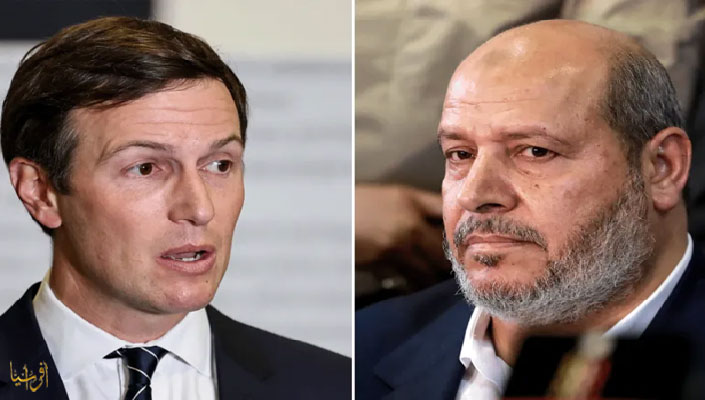
Afrasianet - The public meeting in Cairo between US envoy Jared Kushner and the delegation of the Islamic Resistance Movement (Hamas) and the Palestinian resistance factions opens a new file in US-Israeli relations, as it appears to be a strategic shift in the US position, reflecting a realization that the movement is no longer part of the problem, but has become part of the solution, in a development that puts the Israeli government in front of a widening gap with its major ally Washington.
In this context, Israeli affairs expert Adel Shadid explains that this meeting comes as a continuation of previous secret meetings, and points to a shift in the American position towards Hamas, whether due to the steadfastness of the Palestinian people and Israel's inability to eradicate the movement despite excessive American support, or due to the repercussions of the war on Iran, and the American intention to bring about a radical change in the Palestinian track, considering that this development is "very disturbing" for Israel, which treats it as an American recognition of a "terrorist organization" and granting it international legitimacy.
Shadid adds that the Israeli reading views this meeting as a step that will pave the way for additional Arab and Western recognition of Hamas, which will deepen the gap between the American and Israeli positions on all issues, pointing out that the Israeli government is currently evading announcing its official position, because Prime Minister Benjamin Netanyahu, who is wanted by the International Criminal Court, is not interested in embarrassing himself in front of a street that holds him responsible for this American openness to Hamas.
In the same context, Shadid highlights that the meeting itself represents a strategic development in the Israeli reading, because it means that Washington no longer considers Hamas the problem, but rather considers it part of the next political phase in the Gaza Strip, and this is in complete contradiction to one of the most important goals of the war, which is to eradicate the movement militarily, according to repeated Israeli statements after the Al-Aqsa flood.
Opportunities to transition to the second phase
For his part, Dr. Ahmed Atawneh, director of the Roya Center for Political Development, believes that Hamas and the resistance are in a good negotiating position after they were able to reach a roadmap, albeit in the interim and tactical, with the mediators (Egyptians, Qataris, and Turks), as well as with the American side, represented by Kushner and Steve Witkoff.
Atawneh pointed out that this roadmap gives Palestinian hope to move to the implementation of the second phase, as it stipulates that the Palestinian committee will be able to manage the Gaza Strip and ultimately lead to a full Israeli withdrawal, noting that the American side has agreed to this vision, and that the only remaining obstacle lies in the Israeli position, which does not seem ready to abide.
However, Atawneh rules out speaking optimistically about the Israeli position, due to several considerations, most notably that the current government is not ready to implement the road map or move to the second phase of the Gaza Agreement, and that the American side and mediators must exert great pressure, whether by persuasion or otherwise, on the Israeli government to oblige it to implement what was agreed upon.
On the other hand, Israeli affairs expert Suleiman Bisharat discusses Kushner's mission, which is focused on pressuring Israel to change its position on the road map, pointing out that the Donald Trump administration is facing great embarrassment in front of the mediators and regional and international support crystallized in the Arab countries' statement in support of ending the war on Gaza, which pushes Washington to pressure its ally to provide concrete steps.
He also believes that Kushner's meeting with the Hamas delegation will break one of Israel's core no's, which has refused to be governed by any Palestinian party, putting Israel in a position where it cannot return things to the way things have been in the Israeli discourse since October 7.
However, Bisharat points to the time factor as the only space in which Netanyahu may try to play with the US administration, hinting at the Israeli prime minister's ability to persuade Washington to postpone its current steps until after the Israeli elections scheduled for next October, in an attempt to buy time and confuse American and field calculations.
Kushner's advice
In clear contrast to this proposal, Kushner reportedly advised the Palestinian delegation not to pawn their calculations on the results of the Israeli elections, stressing that there is a consensus within Israel regarding the Gaza Strip, which tightens the noose on Netanyahu's options and puts him in a critical corner that may force him to respond directly to the US administration.
Despite Bisharat's reservations about the possibility of Netanyahu's response, he acknowledges that the Israeli prime minister is too smart to rule out options, pointing out that the state of escalation in multiple files and the attempt to move between them is one of the tools he uses to confuse the calculations, in addition to his continued reliance on the Israeli narrative that describes the Palestinian position as elusive and unworkable on the ground, a narrative that he is promoting to prolong the war period.
The overall analysis concludes that the US-Palestinian meeting in Cairo has caused a strategic rift in the US-Israeli relationship, and that the coming days will witness a real test of Netanyahu's ability to maneuver between the emerging American pressures and internal electoral entitlements, in a scene that reshapes the equations of the conflict in the Gaza Strip, amid expectations of more American moves to push the political process towards a comprehensive solution.
Cairo is witnessing an intense diplomatic movement on the ceasefire agreement in the Gaza Strip, with the arrival of US envoy Jared Kushner, and his meeting with the Hamas leadership, in the presence of mediators, in addition to holding talks with Egyptian President Abdel Fattah al-Sisi.
This move comes at a time when efforts to move to the second phase of the agreement are faltering, against the backdrop of Israel's rejection of the 15-point roadmap approved by the Peace Council, which includes Israel's withdrawal from the Strip, the introduction of aid and the start of reconstruction.
Kushner meets with Hamas leadership in Cairo. Why now?
The Egyptian capital Cairo witnessed an intensive diplomatic movement regarding the ceasefire agreement in the Gaza Strip, with the arrival of US envoy Jared Kushner, and his meeting with the leadership of the Islamic Resistance Movement (Hamas), in the presence of mediators, in addition to holding talks with Egyptian President Abdel Fattah al-Sisi.
This move comes at a time when efforts to move to the second phase of the agreement are faltering, against the backdrop of Israel's rejection of the 15-point road map approved by the Peace Council, which includes Israel's withdrawal from the Strip, the introduction of aid and the start of reconstruction.
The talks also coincide with Israel's resumption of its attacks in Gaza, after a relative pause of about 10 days, and the escalation of the Israeli army and settlers in the West Bank, especially in the town of Qusra, south of Nablus, where settlers have been besieging the homes of 3 Palestinian families for the past 8 days.
What happened in the meeting between Kushner and Hamas leadership?
A Palestinian source revealed on Sunday that Kushner's meeting with the Hamas leadership in Cairo lasted more than two hours with the participation of the High Representative of the Peace Council, Nickolay Mladenov, before the US envoy headed to Tel Aviv to meet with Israeli Prime Minister Benjamin Netanyahu.
The source said that the Hamas leadership briefed Kushner in detail on Israel's violations of the ceasefire in the Gaza Strip, and stressed the movement's rejection of any new steps that do not guarantee prior Israeli approval.
According to the same source, Kushner assured the Hamas leadership that US President Donald Trump is determined to move forward with his plan on the Gaza Strip, and stressed that the United States rejects any plans to displace the residents of the Gaza Strip.
However, the US envoy also indicated that Trump considers the disarmament of the factions "a fundamental step before any other steps in Gaza," and advised the Hamas leadership not to rely on the results of the Israeli elections, noting that Israel is united in its position on the Gaza Strip, according to the Palestinian source.
Kushner told Hamas that Washington would pursue a political path that would not exclude anyone in Gaza, but stressed that the group's integration into the political process would not be until the complete disarmament of Gaza.
Pressure on Hamas
Meanwhile, a diplomatic source told Reuters that the meetings in Cairo seek to move forward with the road map announced by the peace council late last month, which Trump blessed as a historic achievement.
Axios quoted informed sources as saying that Kushner's meeting with the Hamas leadership and Mladenov, which was also attended by former British Prime Minister Tony Blair, also a member of the Peace Council, came with the aim of pressuring the movement's leaders to "implement their commitment to disarm it" and turn the commitment into concrete and verifiable steps.
The US website quoted an informed source as saying that the Peace Council calls on Hamas to start dismantling weapons and military infrastructure, allow the deployment of the International Stabilization Force and facilitate the recovery and reconstruction of Gaza.
The source considered that the steps to maintain the ceasefire in Gaza include transferring the power of governance to a Palestinian technocratic government, and ensuring that Hamas has no role in governing Gaza in the future.
"There is no room for ambiguity," he said, stressing that Hamas must give up power and all weapons and military infrastructure.
Kushner is expected to meet with Israeli Prime Minister Benjamin Netanyahu on Monday to discuss the "corresponding steps" Israel should take, the source said.
Reuters quoted a senior Israeli official as saying that Israel is concerned about Washington's demand to stop the assassinations in Gaza, at a time when Hamas is rebuilding its forces.
Netanyahu had announced his rejection of the road map, adhering to the condition that the movement be disarmed before any Israeli withdrawal from the Strip.
What did Hamas say?
Following the conclusion of its meeting with the US president's envoy, Hamas said that during the talks, it called on the mediators and the "Peace Council" to carry out their responsibilities and oblige the occupation to implement all its commitments in the first stage.
According to a statement issued by the movement, it also called for an end to all violations, an end to killings and incursions, approval of the roadmap for the second phase of President Trump's plan, and the start of setting the timetable for implementation.
Hamas said that during the meeting, it confirmed its approval of the road map for the second phase of President Trump's plan, noting that this was based on the interests of the Palestinian people and the keenness to reach a permanent ceasefire, the full withdrawal of the occupation army from the Gaza Strip, the provision of urgent and permanent relief, the start of the work of the administrative committee, reconstruction and the rest of the agreed entitlements.
What is required of Israel?
Regarding Kushner's visit to Israel, the Yedioth Ahronoth newspaper, citing sources, reported that the US envoy is visiting Tel Aviv with the aim of "resolving matters," and not to hold a new round of negotiations, amid the growing feeling in the US administration that Israel is manipulating and seeking to buy time with regard to Gaza.
According to the Israeli newspaper's sources, Kushner is expected to present a series of steps that the United States is asking Israel to implement immediately, including stopping attacks on the Gaza Strip, withdrawing to the Yellow Line, and a significant increase in aid, in addition to allowing progress on reconstruction mechanisms and civilian rule in Gaza.
For its part, the Israel Broadcasting Corporation said that the security establishment is preparing for the possibility that Washington will ask for a halt to the raids on the Gaza Strip, and quoted an Israeli security official as saying that the meeting between Kushner and Netanyahu on Monday reflects Trump's desire to bring about a transformation in the Gaza arena in the coming months.
Sisi, Kushner discuss Gaza plan
On the other hand, Egyptian President Abdel Fattah al-Sisi and Kushner discussed the implementation of the ceasefire agreement, according to the Egyptian presidency, following a meeting between Egyptian officials and a Hamas delegation.
According to the Egyptian presidential statement, the meeting, which was held in the city of El Alamein in northern Egypt, addressed "the need for all parties to implement their obligations under the agreement to stop the war in the Gaza Strip, which was reached during the Sharm el-Sheikh peace summit in October 2025."
Hamas meets with the head of Egyptian intelligence
Earlier on Sunday, a high-level delegation from Hamas, headed by the head of its political bureau, Khalil al-Hayya , arrived in Cairo, on its first official visit to Egypt since assuming the presidency of the movement, Anadolu Agency quoted a source in the movement.
On Sunday, the head of the Egyptian intelligence service, Hassan Rashad, discussed with the movement's delegation ways to complete the implementation of the decisions of the Sharm el-Sheikh peace summit and the Trump plan.
The Egyptian News Agency quoted the Hamas delegation as praising the Egyptian efforts to promote stability and stabilize the ceasefire in the Gaza Strip.
The delegation also reaffirmed, according to the agency, the movement's commitment to implementing the Trump plan to end the suffering of the people of the Gaza Strip and begin the reconstruction process.
Hamas said its delegation, headed by al-Hayya, met with Rashad at the headquarters of the Palestinian Authority at the beginning of an official visit to Egypt.
In a statement, it added that the delegation reviewed all political and field developments in the Gaza Strip and the West Bank, including daily Israeli violations, its denial of the Sharm el-SheikhAgreement and President Trump's plan, and his rejection of the road map .
She pointed out that the delegation also touched on the Israeli violations against Palestinian prisoners inside prisons, considering that what the occupation is doing is a dangerous destructive policy that must be stopped in the region and at the international level.
In addition to al-Hayya, the delegation includes the head of the movement's Shura Council, Mohammed Darwish, the head of the movement's head abroad, Khaled Meshaal, the head of the movement in the West Bank, Zaher Jabareen, the head of the office of Arab and Islamic relations, Bassem Naim, and Ghazi Hamad, a member of the movement's political leadership, according to the statement.
Hamas spokesman Hazem Qassem said that her delegation's meetings in Cairo come within the framework of continuing contacts with mediators, putting them in the image of Israeli violations, and working to ensure that the occupation adheres to the road map agreed upon with the Peace Council.
Agree to implement the roadmap
On the other hand, the movement affirmed its adherence to the road map agreed with the mediators and the council, while Egypt stressed the need to implement all its provisions, foremost of which is the Israeli withdrawal and the entry of aid.
The Movement believes that the priority at this stage must be to ensure the implementation of the Agreement in all its stages and entitlements, leading to a full ceasefire, an end to the attacks against the Palestinian people, the completion of the Israeli withdrawal, the opening of the crossings, the entry of aid and shelter supplies, the start of the reconstruction process and the enabling of the National Committee for the Management of the Gaza Strip to carry out its tasks.
Egypt, on the other hand, adheres to the importance of adhering to all the agreed terms of the road map, foremost of which is ensuring the full, safe and sustainable entry of humanitarian aid and the completion of the Israeli withdrawal from the Gaza Strip.
On July 31, the Peace Council and US President Donald Trump announced that Hamas had agreed to a 15-point road map to implement the Sharm el-Sheikh protocol commitments, following the negotiations on the Gaza Strip held in the Egyptian city of El Alamein.
The road map includes the withdrawal of the Israeli occupying forces from the Gaza Strip, the confiscation and storage of Hamas weapons, and the assumption of the affairs of the Gaza Strip by an independent Palestinian administration.
Despite this, Israel continues its daily violations of the ceasefire agreement that has been in place since October 2025. These violations resulted in the death of 1,258 Palestinians and the injury of 4,139 others.
________________
Source: Al Jazeera + Agencies
________________
