
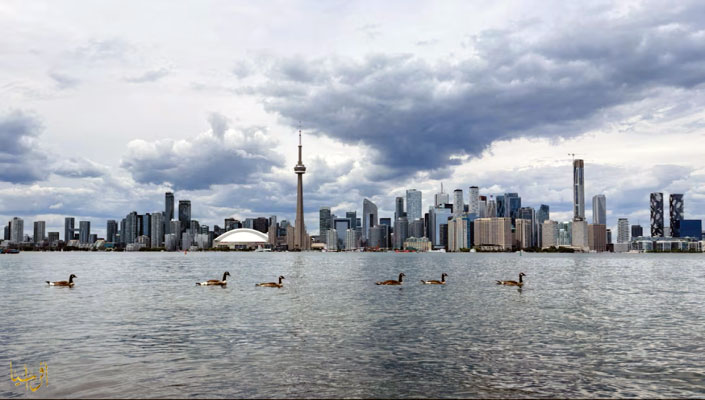
"Lake America." Why did Trump choose Ontario as a new "pressure card" on Canada?
Afrasianet - " We will not come to the negotiating table with a position that makes Canada dependent on the United States," Canada's prime minister said.
President Trump threatened to rename Lake Ontario to Lake America, in the latest escalation of tensions between the United States and Canada after trade negotiations between the two countries collapsed.
Trump wrote on Tuesday on Truth Social that the U.S. is "seriously considering" renaming Lake Ontario because it doesn't expect to "do a lot of business with it anymore."
Lake Ontario, one of the Great Lakes, runs along the U.S.-Canadian border. The northern part is in Ontario, while the southern part is in New York. Canada is unlikely to recognize the unilateral name change by the United States.
Last year, Trump signed an executive order renaming the Gulf of Mexico — which is bordered by the United States, Mexico and Cuba — to the Gulf of America. The change, which applied to federal publications and communications, is generally not recognized by other countries, including Mexico. He later said the Strait of Hormuz is U.S. territory.
What Trump is talking about is not delirium, but rather hidden desires that represent the mentality of a greedy businessman who wants to take over everything.
Trump said on Monday that the United States will impose 50 percent tariffs on Canadian cars and parts starting in January, as relations between the two countries deteriorate amid reciprocal trade measures.
After the collapse of trade talks over the weekend, Trump said the U.S. would impose separate 50 percent tariffs on nearly $20 billion worth of Canadian goods. Canadian Prime Minister Mark Carney confirmed that his country would respond, and on Tuesday, Canadian officials announced tariffs of up to 50 percent targeting nearly $20 billion worth of U.S. goods, including steel, aluminum, motorcycles and processed cheese, starting Sept. 8.
U.S. officials, including Vice President J.D. Vance and Treasury Secretary Scott Bisent, said Monday that the two sides could return to the negotiating table. But Carney said Canada would only resume talks if the Americans showed "the right position."
"We will not come to the negotiating table with a position that makes Canada a vassal of the United States," the prime minister said.
Carney presented a list of several alleged last-minute demands that his country would not agree to, including weakening Canada's protections for French language and culture.
Trump said on Tuesday that he would "never interfere in the affairs of French-speaking Canadians" and accused Carney of lying "in an attempt to gain political support, which he has completely lost, from the people of Quebec."
In a separate post, Trump said, "I deal with many countries, and Canada is undoubtedly the most difficult and intransigent."
Federal and local laws to protect the French language have long been criticized by the United States, including requiring product labels to be written in English and French, Canada's official languages. Carney said U.S. officials have also criticized a law requiring streaming platforms such as Netflix to promote and make it easier for users to access it.
Despite his insistence that the U.S. doesn't need Canada, Trump acknowledged this week that the U.S. sometimes relies on its northern neighbor. During a campaign rally Monday to support Oklahoma gubernatorial candidate Mike Mazey, Trump renewed his support for a proposed $4 billion aluminum plant in the state, saying, "Selfishly, we need aluminum in this country, we don't have it, and we import it almost entirely from Canada."
Trump and Mazey have announced their support for a proposed aluminum smelter outside Tulsa, Oklahoma, which would be the first facility of its kind to be built in the United States since the 1970s. Mazay's rival, Oklahoma Attorney General Gintner Drummond, has filed a lawsuit to shut down the plant, jeopardizing the project if Drummond wins the Republican nomination for governor on Tuesday.
Trump has directed his harshest criticism at Doug Ford, Ontario's premier known for his candor. On Monday, the president wrote on social media that Ford is "best known as the less charismatic and intelligent brother and, in general, the unimpressive brother of the late great Rob Ford." Rob Ford was the controversial former mayor of Toronto, who died in 2016 after being diagnosed with cancer.
When asked about Trump's post, the Ontario premier told reporters, "I'm not responding to a dictator like President Trump."
Why did Trump choose Ontario as a new "pressure card" on Canada?
Amid the escalating trade war between the United States and Canada, U.S. President Donald Trump has proposed changing the name of Lake Ontario to "Lake America," saying the United States does not expect a large volume of business with Ontario to continue.
The proposal came after trade negotiations collapsed and Washington imposed new tariffs on Canadian goods, bringing the proposed name closer to a symbolic political message in the context of the escalation with Canada, rather than just a geographical change.
Importance of Lake Ontario
Lake Ontario is one of the five Great Lakes in North America, located on the border between the US state of New York and the Canadian province of Ontario.
It is 193 miles long, 53 miles wide, and has an average depth of 283 feet, while the volume of water is up to 395 cubic miles.
According to the website of the "Great Lakes Commission", the importance of the lake goes beyond its geographical dimension, as it is part of the Great Lakes system, which constitutes the largest freshwater system in the world, and provides water for drinking, transportation, and irrigation, as well as being used for fishing, recreation, and supporting economic activities in the region.
Beaches and nearby waters provide opportunities for swimming and recreation, and coastal wetlands, amphibians and birds are rated well, despite continued pressures from coastal development and invasive species.
The lake's ecosystem shows some positive signs, as the interdependence between the tributaries and the lake is improving, the numbers of some species of fish are increasing, and the quality of groundwater is classified as moderate, while the population of the lake basin has increased by more than 60% in 50 years, with rapid urbanization.
On the shores of Lake Ontario, major urban and industrial centers are located, most notably Toronto and Hamilton on the Canadian side, while its basin is connected to the US state of New York.
Why did Trump propose to change the name of Ontario?
According to Trump himself, the reason for changing the name of Lake Ontario comes in light of the escalating trade dispute with Ontario and Canada, as negotiations have stalled amid mutual threats of new tariffs.
Trump said via Truth Social that Washington does not expect a large volume of trade with Ontario to continue, which directly links the proposed name to the economic dispute.
The lake acquires a special political dimension because it is a shared body of water between the United States and Canada, as the international border passes through it, while Toronto, Canada's largest city, is located on its Canadian shore, so Trump's proposal to change its name to "Lake America" came in a context that goes beyond renaming an American geographical landmark, to coincide with the escalation of the trade dispute between Washington and Ottawa.
According to the Economic Times, Trump's reference to Ontario is particularly significant because the province is Canada's economic powerhouse and home to a large share of its auto industry.
The U.S. and Canadian auto sectors are deeply intertwined, with vehicles and parts crossing the border several times during the manufacturing process, so the new tariffs could affect not only Canadian companies, but also U.S. manufacturers, suppliers, and consumers.
This makes the dispute over Ontario much more than just a rhetorical one, as the province is at the heart of the broader economic tensions that are currently driving the relationship between the two countries.
The real issue. Trade war
Trump's comments on Lake Ontario come in light of a more serious dispute, as trade talks between Washington and Ottawa recently collapsed, prompting the Trump administration to impose 50% tariffs on nearly $20 billion worth of Canadian goods on Saturday.
Canada responded to the United States on Tuesday by imposing retaliatory tariffs on nearly $20 billion worth of U.S. goods, including steel, dairy products and agricultural equipment and equipment, as the trade war between the two once-friendly neighbors escalated sharply.
The new tariffs extended to include goods beyond industrial goods, to include daily purchases such as seafood, cheese, clothing, cosmetics and toilet paper, with customs duties on some reaching 50%.
Canada's finance minister, François-Philippe Champagne, said Ottawa had not chosen the conflict, but would not accept the use of economic integration as a weapon against it, calling the situation an "unprecedented challenge."
Canadian Prime Minister Mark Carney also accused the US administration of trying to subjugate his country and destroy its key industries, and Trump responded by calling for "compliance" and threatening to impose new 50% tariffs on Canadian cars, parts and steel.
________________
