

Glasgow's housing crisis and pressures on social structure coincide with mounting anti-immigration anger
Afrasianet - Assia Ibrahim - Pressures on migrants are mounting in a number of European countries, as housing and public services crises intersect with rising anti-immigration rhetoric and associated policy tightening.
British reports are clearly monitoring these shifts in the Scottish city of Glasgow, where a housing crisis and pressure on social infrastructure have fueled anti-immigration protests, while the British government is moving to tighten rules for permanent settlement for migrants, a move that has sparked objections even within the Labour Party itself.
In Germany, the far-right Alternative for Germany (AfD) is on the verge of an "unprecedented victory" in the former East German state of Saxony-Anhalt, and its victory would be the first time a radical right-wing party has come to power in a German state since 1945.
Between housing crises, tighter immigration policies, and the rise of the far right, questions arise about the reasons for the mounting anger toward immigrants, how right-wing forces are investing it politically, and what their transition from influencing public discourse to exercising power might mean.
Record numbers of migrants leaving the U.S., and the Trump administration buys planes to deport them

U.S. government migrants arrive at Ramón Felida Morales Airport in Honduras
In the United States, according to official data, large numbers of migrants have left the United States under pressure from President Donald Trump's administration's more hawkish policies by announcing the start of the purchase of an air fleet to be used to speed up deportations.
Trump has made stopping immigration a top priority during his second term, taking a number of measures aimed at speeding up deportations and limiting the entry of migrants across the border.
According to Human Rights First, it has carried out more than 1,700 deportation trips to dozens of countries since Trump returned to office last January.
The administration says more than 2 million irregular migrants have left the country this year, 1.6 million of them voluntarily.
A few days ago, a U.S. plane landed in the Venezuelan capital Caracas carrying 172 Venezuelan migrants deported to the United States.
According to official figures, the number of Venezuelans deported by the United States has risen to more than 14,000.
According to Venezuelan authorities, the deported migrants' journey included 5 children, 26 women and 141 men.

Federal Border Patrol agents deploy to New Orleans as part of the Crackdown on Irregular Immigration
Private Fleet
In the same context, the US Department of Homeland Security announced that it is in the process of purchasing a special fleet of Boeing planes to be used to implement President Donald Trump's policy of deporting migrants.
"These aircraft will enable ICE to operate more effectively, including the use of more efficient flight paths," department spokeswoman Tricia McLaughlin said.
In response to a Washington Post report on the deal, Tricia McLaughlin said, "This new initiative will save American taxpayers $279 million."
The deal to buy six Boeing 737s worth $140 million was made with Daedalus Aviation, which was founded in early 2024, and not through direct purchase from the aircraft maker
Appeals and raids
Trump's campaign has included raids by Immigration and Customs Enforcement agents that have drawn widespread criticism and prompted numerous legal challenges and protests in some Democratic-run states and cities.
Earlier, rights groups, including Human Rights Watch and the American Civil Liberties Union, called on U.S. Immigration and Customs Enforcement to end the detention of migrants at the massive East Montana camp inside the Fort Bliss military base in El Paso, Texas.
This came after documenting abuses described by these organizations as "grave", including beatings, sexual violence, threats of deportation, medical negligence, malnutrition, and denial of effective access to lawyers.
Trump's anti-migrant campaign is part of a broader plan, says US legal expert

Deportation of Brazilians from America (Media)
US President Donald Trump's administration is pursuing a policy aimed at denying migrants due process, a legal expert says, calling it an attack on the rule of law.
David Leopold, a former president of the American Immigration Lawyers Association, said the Trump administration was using several legal theories as a pretext to implement its plan for mass deportations, stripping migrants of their right to due process.
In an article in the Washington Post, he stressed that the White House has bypassed existing immigration laws to detain pro-Palestinian college student activists or to transfer alleged Venezuelan gang members to El Salvador. Those laws provide basic safeguards such as the right to review and challenge evidence.
A broader threat
The article criticized the White House's actions, calling them a broader threat to the sound legal rights and fundamental freedoms of the United States, both for Americans and others.
He noted that Washington is no longer ashamed of such actions, citing a statement made by Tom Homan, the Trump administration's border chief, to Fox News, saying, "I don't care what the judges think. I don't care what the left thinks. We're coming."
But Leopold acknowledges that a long-standing exception to these rights is the Foreign Enemies Act of 1798, which gives U.S. presidents the power to detain and deport citizens of an "enemy" state while providing them with minimal due process in times of war.
Franklin Roosevelt
The last to use this law was President Franklin D. Roosevelt during World War II, and it led to the detention of 120,000 American and non-American citizens of Japanese descent without trial and without jury.
According to him, Tom Homan wants to convince Americans that what is going on in the corridors is a discussion about deporting thugs and gangsters. If so, the Trump administration should disclose the identities of those sent to El Salvador's notorious terrorist detention center and the charges against them to prove they can be deported in U.S. immigration courts.
A law from the Cold War
Moreover, the Trump administration has dusted off an outdated Cold War law to detain and deport student activists without due process, Leopold says.
Immigration laws, which include provisions for deporting non-citizens who engage, adopt, or support "terrorist" activities, are harsh legislation that does not allow for expression, but nonetheless ensures fair trials.
Leopold warned that letting the Trump administration do what it wants to infringe on immigrants' rights to unchecked fair trials threatens the broader rights and freedoms of all Americans.

Financial Times: Perceptions of housing inequities fueled anti-immigration protests in Glasgow (Getty)
A crisis fuels ange
The Financial Times outlines the tensions associated with migration in Glasgow, and says that for more than two decades until 2022, it was the only region in Scotland that agreed to house asylum seekers whose presence was concentrated in London and the south-east of England.
The city now hosts the highest number of asylum seekers per capita in the UK, a quarter more than any other local authority and nearly four times as many as London, with more than 3,900 asylum seekers in Glasgow.
These conditions are being intensively "politicized," with pressures on services and social structure, particularly housing, coinciding with complaints of crime in the city centre, fueling far-right anger.
Scottish Trade Union Federation president Rose Foyer attributes the anger to the economic insecurity that has created fertile ground for it within working-class communities, saying that "the right has been fueling the issue of immigration for a generation now", while looking at the purely economic reality in Scotland shows that the country needs more immigrants.
Pressure has increased after the Home Office's acceleration of asylum processing as part of an effort launched in 2023 to reduce backlogs led to increasing numbers of new refugees moving into the city's homeless system, as the government says it is working to distribute asylum seekers' housing equitably across the country, in coordination with local authorities to reduce the impact on communities.
But the Scottish Refugee Council denies that refugees are "skipping waiting lists" for housing, explaining that homeless people are given higher priority because of their circumstances, rather than their nationality or immigration status.
Rubina Qureshi, chief executive of the Scottish association Positive Action in Housing, said housing pressures preceded refugees entering waiting lists, noting that not enough housing had been built since the 1980s.
Still, perceptions of housing inequity have fueled anti-immigration protests in the city this summer, at a time when the right-wing Reform UK party has made a breakthrough in working-class areas, although Glasgow remains predominantly left-leaning.

Immigration minister seeks to double the time migrants must spend before qualifying for permanent residency (Getty Images)
Militancy Moves to the Government
From Glasgow to Downing Street, iPaper highlights the British government's tendency to tighten immigration policies, as Home Secretary Shabana Mohamud faces a "growing rebellion" from Labour MPs over her "controversial reforms".
The minister is seeking to double the virtual period that migrants must serve before qualifying for permanent residency from 5 to 10 years, a move the report says has sparked widespread opposition backlash, prompting Mohamud and Prime Minister Andy Burnham to consider making a concession to MPs opposed to the plan.
The proposed changes are not limited to new arrivals, as Mahmoud wants migrants already in the country to be subject to the new rules, which has raised particular concerns among Labour MPs because of their retroactive application.
A further 10 Labour MPs are expected to declare their opposition to the plan and join a parliamentary motion calling for the relaxation of proposed changes to permanent residency rules, which currently has the support of 64 MPs, including 37 from the Labour Party. The motion was introduced by Labour MP Neil Duncan-Jordan, who described the minister's plans as "un-British".
Duncan-Jordan and his supporters are calling for the five-year trajectory to be maintained for all skilled worker visa holders, including those working in social welfare, noting that they "pay taxes and contribute to their communities, and are not entitled to public funds."
The proposal considers that these workers came to the UK on the clear basis that five years of work and residency will provide them with a pathway to permanent residency, and that many of them have built their lives in the country on that basis, adding that the proposed changes could "undermine confidence in the immigration system, damage the UK's international reputation, and exacerbate skills shortages".
In a related context, the Labour MP warns that public services, their beneficiaries and workers will be "affected" by these policies.
The warning comes as iPaper published an analysis by Unison that found that British workers are not filling vacancies in the social care sector left behind by a decline in migrant workers.
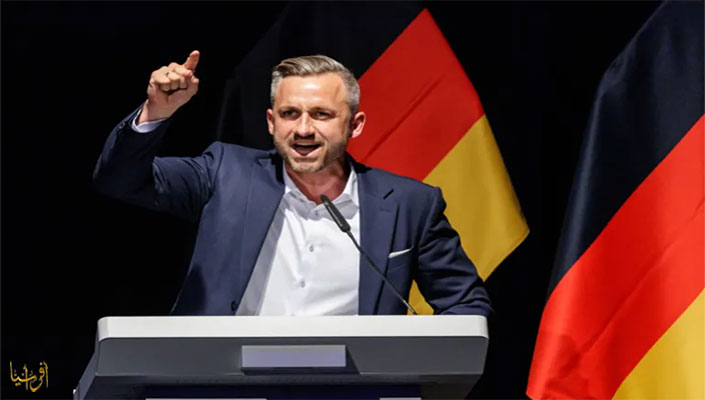
Ulrich Sigmund is the main candidate of the AfD in the Saxony-Anhalt state election (French)
The Right Towards Power
But what can happen when the right itself is close to power? The Alternative for Germany (AfD) is expected to win a landslide victory in the September 6 state of Saxony-Anhalt elections, with the possibility of an absolute majority in the state parliament.
If this is achieved, the party will find itself responsible for the police, the state intelligence service, the asylum system and schools, as well as the funding of culture, civil society and the region's public broadcaster.
The party sees German state rule as a path to power at the national level, and according to this vision, Saxony-Anhalt will be the first model of the "new Germany" that the party seeks to form.
This model is outlined in the party's 258-page state election platform, which the Times describes as "detailed and radical," and seeks to create a state in which Germans of ethnic German descent can put themselves first and regain their old self-confidence as one of the world's most prominent civilizations.
The party's leading candidate, Ulrich Sigmund, removed any ambiguity about the target groups of the policy, when he said in a televised debate that its implementation "would not have been necessary before 2015," referring to the influx of migrants from outside Europe at the height of the migration crisis.
On the immigration file, the party calls for a "re-migration campaign" that includes the repatriation of Ukrainian refugees, refuses to accept skilled workers whom it considers "cultural aliens," and seeks to abolish the fundamental right to asylum.
But polls show that the vast majority of Germans, and even a large percentage of the party's supporters, are reticent about some of these policies, raising questions about how serious the party is in implementing them.
While the party's critics say that what it announces reveals only part of what it intends to do, other polls show that less than half of voters expect the party to actually go ahead with its most controversial proposals.
European countries move to set up centres to repatriate migrants from outside the EU

Migrants on a small rubber boat try to cross the English Channel (Reuters)
Germany, Austria, Greece, Denmark and the Netherlands said they were seeking agreements this year to send migrants without legal residency to countries outside the European Union, during a meeting hosted by Denmark on Friday in Copenhagen.
The five countries, known as the Group of Five, announced that they had agreed concrete steps towards an agreement with a non-EU country to set up migrant repatriation centres, in Europe's latest effort to curb migration. The countries did not specify which countries they expected to host the repatriation centres.
German Interior Minister Alexander Dobrant told reporters at a news conference in Copenhagen: "This year we want to reach an agreement with third countries that will allow the establishment of repatriation centres."
The group, which has held a series of meetings this year, plans to hold a new meeting in Munich, Germany, at the end of September.
In June, the European Parliament approved a sweeping reform of migration policy aimed at speeding up deportations and allowing member states to set up centres outside the bloc, a move critics say could weaken guarantees for asylum seekers.
Criticisms
NGOs have criticized the plans, expressing concerns about their impact on the human rights of the migrants concerned, and they are likely to face a large number of legal challenges.
The Council of Europe, a non-EU body tasked with promoting human rights, democracy and the rule of law across the continent, said in July that the return centres posed "significant human rights risks", and several others criticised the plan.
Charlotte Slente, secretary-general of the Danish Refugee Council, said the best would be to implement the EU Charter on Migration and Asylum, which focuses on tightening border checks, speeding up asylum and return procedures, and expanding digital systems to manage asylum claims.
"Repatriation centres focus on a limited number of cases, will not deter people from taking more dangerous routes, and may violate basic human rights," she said.
Denmark's Minister of Migration and Integration, Morten Podskopf, said his country expects to be ready to send migrants to a return centre by the end of 2027.
"This is a new opportunity to live a life in a partner country," Podskopf said, noting that the five countries will hold consultations on next steps with the United Nations International Organization for Migration (IOM) and the United Nations High Commissioner for Refugees (UNHCR).
A UNHCR spokesman said it had not received any details on the proposal and could therefore comment on the arrangements under discussion.
________________
