
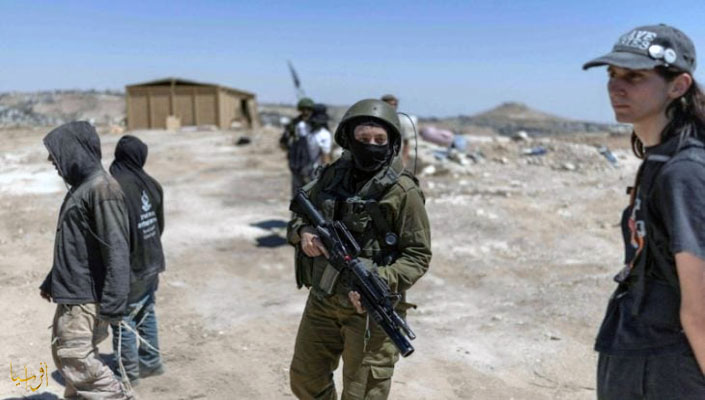
An Israeli soldier protects settlers during their attack on the West Bank village of Janata
Afrasianet - Israeli Prime Minister Benjamin Netanyahu boasted that his government had approved 264 settlements and outposts in the occupied West Bank, telling settler leaders that they were "preparing for a large migration to come."
Netanyahu, who is wanted by the International Criminal Court (ICC) for war crimes in the Gaza Strip, spoke to settler leaders in the central West Bank on Tuesday evening, according to a statement issued by his office on Wednesday.
Netanyahu told the settlers: "You are fulfilling the vision of the Land of Israel, and this is our land. Today, many of our brothers and sisters in the world are aware that this is our land," he alleged.
"And when I say our land, I say to every Jew: The door is open, we are waiting for you," Netanyahu continued.
He went on to tell the settler leaders: "You are paving the way for a big migration to come. You can't ignore the numbers: 104 settlements that we have established and settled together, 160 farms (outposts), and more on the way."
"Yesterday, I was with the defense minister (Yisrael Katz) and the government secretary in the army's Central District Command, and the first thing I wanted to see was a map," he said.
"And when I saw it, I saw the dots, the dots, the dots covering everything," he said, referring to the outposts in the occupied West Bank.
US delegation rebukes Israeli official over settler violence in the West Bank
Israel's Channel 12 revealed on Tuesday that a US delegation visiting Tel Aviv had issued a stern rebuke to a senior Israeli official during a meeting dedicated to discussing the escalation of settler violence in the occupied West Bank.
According to the channel, the delegation includes members of the US Senate and House of Representatives, advisers to senior US administration officials, as well as professional teams.
The channel quoted the members of the delegation as addressing a senior official in the Israeli security establishment, whom it did not name, saying: "We protect you in all ways and under difficult circumstances, while the whole world stands against you. The return cannot be acts of violence, looting and attempts to target Palestinians."
US delegation to the Israeli official: We protect you in all ways and under difficult circumstances, while the whole world is against you. The return cannot be acts of violence, looting and attempts to target Palestinians.
During the meeting, the members of the delegation added: "Do not take American support for granted, while you allow these acts to continue. This will bounce back on you through the back door. How can you not realize this for yourselves?"
The meeting came in light of the escalation of settler attacks and Israeli military operations in the West Bank since the outbreak of the Israeli war on the Gaza Strip in October 2023, in conjunction with the expansion of settlements and the tightening of restrictions on the movement of Palestinians.
The channel reported that Israeli Prime Minister Benjamin Netanyahu held a security meeting on Monday that included IDF Chief of Staff Eyal Zamir and other officials to discuss settler violence in the West Bank, in response to a US request.
The channel did not reveal the identity of the Israeli official who received the reprimand, nor did there be an immediate Israeli comment on the report.
According to data published by the Palestinian Committee for Resistance to the Wall and Settlements a few days ago, settlers have killed 25 Palestinians since the beginning of 2026, while the number of Palestinians who have been killed by settlers has reached 61 since October 2023, and 87 since 2019, the majority of them in the governorates of Ramallah, Al-Bireh and Nablus.
During the first half of 2026, settlers carried out 3,488 attacks in the West Bank, resulting in the death of 17 Palestinians and the displacement of 26 Bedouin and pastoral communities in whole or in part, in addition to the establishment of 42 new outposts, most of which are pastoral outposts, according to the Commission.
About 750,000 settlers reside in 156 settlements and 360 outposts in the occupied West Bank, including East Jerusalem, according to official Palestinian and Israeli figures.
From Assault to Displacement. How is settler violence reshaping the reality of the West Bank?
Between the flames of fire devouring homes, the olive fields uprooting, and the faces of Palestinians bearing the traces of the attacks, the circle of settler violence in the occupied West Bank is widening , as residents find themselves facing repeated attacks that not only target their property, but also reach their security and presence in their villages and lands.
Last Friday, the town of Tal, southwest of Nablus, witnessed clashes between heavily armed settlers and Palestinian residents, following a series of continuous attacks on the town, which took place under the protection of the Israeli occupation army, which prompted the residents to confront the settlers in defense of their homes and lands.
The clashes resulted in martyrs and injuries among Palestinians, including serious cases as a result of the Israeli occupation forces ' firing on them, while two Israeli soldiers, one of them with the rank of major, were killed near the town, following clashes that broke out during a raid carried out by settlers and included gunfire.
Following the events, the Israeli occupation forces imposed a tight military siege on the town of Tal and the city of Nablus, and Israeli Prime Minister Benjamin Netanyahu held a meeting with the Minister of Defense, the Commander of the Army and the head of the Israel Security Agency, after which he announced the issuance of orders to carry out a large-scale operation in what he described as "villages that constitute a source of terrorism" in the West Bank.
Since then, settler attacks have escalated in a number of West Bank towns and cities, coinciding with calls and incitement from Israeli ministers and figures to expand military measures against Palestinians, raising fears that the wave of violence could move to a wider stage.
Palestinian anger
These developments sparked a wave of anger among Palestinians, who expressed their fears on social media platforms that settler attacks would turn into a systematic approach aimed at pressuring residents to leave their lands and impose a new reality in the West Bank.
Arab Knesset member Ayman Odeh said that the burning of a mosque in the village of Qusra near Nablus came "under the protection of the army and encouraged by the government," noting that writing revenge phrases on the walls of the mosque reflects the escalation of incitement rhetoric, adding that "blood does not decorate the land, but desecrates it," warning against attempts to push the West Bank towards an explosion.
For his part, Arab Knesset member Ahmed Tibi said that the burning of the Rahma Mosque in Qasra and the writing of revenge slogans on it constitutes "terrorism", questioning the international response if a Jewish synagogue were to be attacked in a similar way.
The Secretary-General of the Palestinian National Initiative, Mustafa Barghouti, said that large areas of the West Bank witnessed a simultaneous escalation that included raids, arrests and shooting by the occupation forces, in addition to attacks carried out by settlers targeting houses, vehicles and main roads in a number of villages, calling for an end to these attacks.
Palestinian writer and activist Huda Judeh expressed her anger at the escalation, describing what is happening in the West Bank as turning the area into "hell on earth."
The Palestinian activist said that the West Bank has become "in the crosshairs of fire", considering that the escalation of the Israeli extreme right aims to push the region towards more chaos and impose new realities on the ground, warning that the next phase may be painted with "the features of fire and gunpowder" in light of annexation, displacement and escalation of violence.
A battle for the future
According to the Palestinian blogger Elena, the escalation of settlers in the West Bank cannot be reduced to a transient wave of violence, but is linked to a broader political context, in light of what she describes as the Israeli authorities' tolerance of settler attacks, especially with the growing influence of the settler movement within the current government.
It says that the aim of these attacks is not only to harm Palestinians, by burning vehicles, vandalizing property, and attacking villages, but also to create a new political and security environment that could lead to a large-scale explosion in the West Bank.
According to Elena, the outbreak of an all-out confrontation could give Israel's most radical currents justification for taking more drastic steps, including imposing a harsh security reality, marginalizing any political horizon, and possibly weakening the institutions of the Palestinian Authority in Ramallah.
She adds that the collapse of the Palestinian Authority will not mean a neutral vacuum, but may lead to security chaos that will bear the daily consequences of the lives of millions of Palestinians, noting that calls for escalation from outside the field are different from the reality of those living under the weight of the confrontation.
The West Bank is at a crossroads, as the issue is no longer just a matter of sporadic attacks, but a future struggle between the possibility of descending into open chaos or attempts to prevent a full-blown collapse that is difficult to contain.
Incitement of settlers
Palestinian activist Khaled Safi questioned the escalation of settler attacks in the West Bank, saying that the attacks on Palestinian villages are "taking place under the protection of the occupation soldiers," considering that these practices represent "terrorism" against Palestinians.
Palestinian activists unanimously agreed that what is happening in the West Bank represents a growing danger, considering that the practices of the settlers paint a new picture of the reality of the occupation, and warning that the scenes of destruction witnessed in the Gaza Strip will spread to the West Bank.
The current escalation is part of attempts to change the demographic reality in the West Bank and obliterate the presence of Palestinians on their land, bloggers said, noting that the continued settlement expansion threatens the future of the region.
Palestinian activists also circulated videos that they said documented widespread arrests carried out by the Israeli army against Palestinians in the West Bank, describing the scene as reflecting the escalation of security and military measures against the residents.
Official Incitement and Settlement Expansion
The escalation of settler attacks coincided with calls by Israeli government ministers to expand military operations in the West Bank.
Israeli Finance Minister Bezalel Smotrich called on the occupation army to "act forcefully against every Palestinian village from which an operation is carried out and the surrounding towns", while announcing that plans to expand settlement construction in the settlement of "Eli" by approving hundreds of new housing units.
For his part, Israeli National Security Minister Itamar Ben-Gvir called for dealing with the cities and villages of the West Bank as well as areas in the Gaza Strip, in statements that Palestinians considered to be incitement to a broad escalation against the population.
In the context of the escalation of incitement, Israeli activists circulated inflammatory calls that included calls for the killing of Palestinians and the demolition of their villages, amid Palestinian fears that this rhetoric could turn into new attacks on the ground targeting residents and their properties in the West Bank.
Settler Violence in the West Bank: Attempts to Erase and Cancel
In his book of the same title, Mr. Ahmed Hneiti reveals the dimensions of the attacks carried out by settlers in the West Bank.
Recently, the violence practiced by the colonial settlers in the West Bank has accelerated, especially after October 7, 2023, as large areas in the West Bank have become exposed to settler attacks and provocations. From a daily follow-up, these constant and intensified attacks, which are practiced on some sites more than once a day, raise many questions that this article tries to provide answers to, especially where does this violence fall within the Zionist colonial strategy in Palestine?
How do settler practices help to understand the settler-colonial situation in the Palestinian situation? This article is based on interviews and discussions conducted by the author with residents of Bedouin communities and villages, and daily follow-up of settler attacks through what is published in the "Jordan Valley, the Capital of the Sun" WhatsApp group, in which Palestinian activists from all areas of the West Bank participate, documenting settler attacks in all locations and places in the West Bank.
Many literatures have been published that analyze the colonial situation in Palestine, which agreed on the concept of settler colonialism, and varied in the nature of their conceptual frameworks through which they try to analyze the settler-colonial system in Palestine, using a wide range of concepts to analyze and interpret the policies pursued by the settler-colonial regime towards the Palestinians.
Through follow-up, the majority of the studies followed the theoretical analyses of settler colonialism, which were adopted by Patrick Wolfe and Verracini, especially the famous saying of Wolff, whose content is that settler colonialism is a structure and not an event.[1]Ferrassini, on the other hand, differentiated between classical colonialism and settler colonialism. Thus, the former deals with the logic of exploitation, i.e., "work for me," while the latter deals with the logic of abolition, i.e., "get out of here."[2]
Global colonial history has witnessed instances of settler colonialism based on the system of exploitation "work for me", as happened in Algeria and South Africa. As for attempts to explain the settler-colonial reality in Palestine, concepts such as apartheid were used, comparisons were made with what happened in the settler-colonial regime in South Africa, and the concept of ethnic cleansing was also used[3]and spatial,[4]So is the concept of ethnocracy.[5]The argument about the accuracy of the use of authenticity[6]In the Zionist colonial project in Palestine.
Some of these literatures aimed to put the Palestinian situation under the microscope of the critical theory of settler colonialism, in order to dismantle the Zionist narrative in Palestine and its practices, and to bridge the gap between the epistemological conclusions reached by the critical theory of settler colonialism on the one hand, and the representations, foundations and practices of the Palestinian national movement of Zionism in order to clarify the path of liberation struggle against it, on the other hand.[7]
The events that followed October 2023 revealed that the Zionist settler-colonial regime in Palestine has entered a stage that makes it more clear, and this is aided by the belief of those in charge of it that it has reached a stage close to completion to be expressed and the work to be intensified to complete it.
The process of this project can be viewed through two objectives: the first is tactical and the second is strategic; the first necessarily leads to the second and establishes it, and the second is the organizing line for all tactical objectives. The tactical and strategic are not only sequential, but sometimes run simultaneously as well.
The tactical goal is to strip the Palestinians of all the elements that help them resist, withstand and survive in Palestine, and these practices were sometimes violent, soft and attractive at other times, such as providing work in Zionist colonial facilities.
The strategic goal is the erasure/abolition of Palestinians from within Palestine (Mandate), and this is evident in the Basic Law passed by the Knesset: "Basic Law: Israel – The Nation-State of the Jewish People," on July 19, 2018, whose basic principles state that Israel is the historical homeland and nation-state of the Jewish people who exercise their sole right to self-determination.[8]
The patterns of erasure/abolition adopted by the Zionist colonialism to date are represented in two overlapping forms: the first is the genocide that began with the Nakba of 1948, during which the Zionist gangs committed many massacres against the Palestinians, and the second is ethnic cleansing, as also happened in the Nakba of 1948 and 1967. These two forms of erasure/cancellation work simultaneously and interchangeably.
Ashraf Badr believes that settler colonialism in Palestine "is a practical path that is subject to changes on the ground, including the effectiveness of the rulers and the main international and regional actors, and the contexts in which the whole process takes place, in addition to the fact that this path is based on trial and error, and that the common logic of it is the quest for control, control and control, which is managed by a set of policies, the most important of which are erasure, economic exploitation and population management."[9]
However, the events that have taken place since October 7 make Badr's understanding of the analysis of the colonial reality in Palestine inaccurate, as the practical path is the tactics practiced by the Zionist colonial regime to create the practical conditions towards achieving the strategic goal, or the overarching and ordering logic, which is the erasure/elimination of the Palestinian population.
For example, the economic exploitation of colonialism in Palestine can be understood as a tactic rather than a strategic goal, and its goal is to achieve colonial domination and control over the population and its land, and it falls within the economic peace that Moshe Dayan spoke about to distance the Palestinians from their political liberation project.
The work in the Zionist entity also contributed to providing labor to build the infrastructure of the colonial state, but more important for Zionist colonialism is to strip the population of their lands and provide the conditions for their control, as well as not to resist the process of confiscating them.
Many interviews conducted by the author with the residents of Palestinian villages indicated that some Palestinian workers in Zionist establishments refused to protest the confiscation of their land for fear of revocating their work permits that allowed them to work in Zionist establishments.
After October 7, the Zionist entity abandoned Palestinian labor, which caused the deterioration of the economic conditions of the Palestinians, some of whom are now looking for emigration, which is present in the Palestinian dialogues, who share examples of names for immigrants and immigration offices.
Another example is the Oslo Accords, which stripped Palestinians of all elements of their steadfastness and survival, specifically in the West Bank, and put them vulnerable to Zionist colonial policies.
The question is, how does this approach help us understand settler violence in the West Bank? In other words, how do the settlers work to achieve the strategic goal of the Zionist colonial state?
Demographic Equation
The Jewish nation-state that Israel refers to is the one Jewish state from the river to the sea (Mandatory Palestine), and automatically the logic of the process of erasure/abolition by the Zionist settler-colonial regime in Palestine, includes erasing the possibility of establishing a Palestinian state on the June 4 borders, or even on any geographical area in Palestine, regardless of the size or shape of this area, and this has been repeatedly evident in the speeches of Israeli Prime Minister Benjamin Netanyahu, and even in his speeches at the United Nations.[10]
And with him many Israeli leaders.[11]However, despite this, the Palestinian presence remains an obstacle to the realization of a Jewish nation-state.
The Zionist colonial policy on the issue of the demographic equation seems more obvious in Jerusalem, because the equation accepted by the Zionist entity in Jerusalem, as many reports indicate, is 70% Jews compared to 30% Palestinians.[12]Note that the percentage of Palestinians within the Zionist entity is about 17% of the total population.[13]This percentage does not pose a threat to the Zionist entity, and Israel has prepared many plans to maintain it.
According to statistics, there are 14 million people living in Mandatory Palestine, half of whom are Palestinians and the other half are Jews.[14]This contradicts the goal of the Jewish nation-state law, which sees its borders from the river to the sea (Mandatory Palestine).
This demographic equation poses a danger to the colonial system, and contradicts what Israel deems appropriate and similar to that in Jerusalem, which may explain the colonial regime's haste to work on the strategic goal, and to use tactical goals to achieve it, i.e., erasure/abolition, to solve the demographic problem.
The infrastructure of the reality that Palestinians are living in after October 7 has been designed and built by Israel throughout its history, and it has been activated with such violence when the right conditions exist.
The "Morality" of the Colonial State and its Policies in the West Bank
More than two years after the genocide in Gaza, Netanyahu, the main convict of genocide, came out to tell the world public opinion that what is being promoted about a genocide in the Gaza Strip is not true, and that everything that is happening is due to the practices of Hamas, which he accused of being directly and solely responsible for what is happening.[15]
As he described it in his speeches, aid is stolen, hospitals are exploited, and people are used as human shields. For this reason, Israel seeks in various ways to promote its army as the most moral army in the world in its war on the Gaza Strip.[16]
Israel's violent military colonial campaign in the northern West Bank has promoted the same allegations as it did in the Gaza Strip, particularly during its invasion of the Jenin camps in Jenin, Nour Shams and Tulkarem in Tulkarem, during which it displaced 40,000 residents of those camps to which they were displaced during the 1948 Nakba.[17]
At the time of writing, the Israeli army was still present inside those camps that it had isolated from its surroundings, preventing residents from returning to their homes, as well as destroying dozens of homes and completely destroying their infrastructure.
According to Tulkarem residents in an interview with the director of the camp's return center, the homes are no longer habitable due to the destruction of infrastructure.
But the question is: what policy does Israel adopt against other Palestinian communities in the West Bank, in which the justifications for the use of excessive violence in the Gaza Strip and the three Palestinian camps do not work?
Settler Violence Strategically Erasing/Abolishing
The colonial regime has found in the settlers an effective tool to achieve its tactical and strategic goals, and an alternative to colonial policies that require the international community to find convincing "moral" justifications for the use of excessive violence against Palestinians by authorizing them to use "dirty work."[18]
The Zionist colonial government shows that settler violence is fights between two population groups, and that what the IDF is doing is differentiating between these two groups. Based on this logic, the IDF issued a statement on July 12, 2025, stating:[19]
Earlier on Friday, terrorists threw stones in the direction of Israeli civilians near a town and lightly injured Israeli civilians.
Shortly afterwards, violent friction broke out in the area between Palestinians and Israeli civilians, punctuated with vandalism of Palestinian property, arson, physical clashes, and stone-throwing.
Reports of the death of a Palestinian and a number of Palestinians injured as a result of this friction are known and are being examined by the Shin Bet and the Israel Police.
Upon receiving the reports, forces from the army, the Judea and Samaria police and the Border Police rushed to the scene to disperse the friction. The forces used means to disperse the demonstrations, and those involved were removed from each other.
The Israeli army and security forces are committed to maintaining order and security for all residents of the area, and they act resolutely against any manifestations of violence within their area of responsibility.
IDF – Official Channel
Thus, the colonialism and power of the settlers is concealed by protecting them from punishment and ensuring that they are not harmed during the assault on Palestinians.
Since settler violence has become a phenomenon that the international community cannot remain silent about, the previous US administration under President Joe Biden was forced to impose sanctions on settlers accused of war crimes against Palestinians.[20]
Some European governments also continue to impose sanctions on some settlers.[21]The Zionist Government, which has objected to these resolutions, has not found itself in the position of being accused before the international community of its responsibilities for the terrorist practices practiced by the settlers against the Palestinians, as if these terrorist acts are separate from it and are not carried out with their support and support.
The Israeli Government is keen to portray these attacks as uncontrollable, uncontrolled and chaotic.
Patterns of settler violence
Contrary to what is promoted as chaotic and unplanned, settler attacks are carried out on the basis of centrally organized directives and guidelines, and in cooperation with the military to provide protection, support and support, which is why B'Tselem raised the slogan "Settler violence = state violence."[22]
Many of the videos and testimonies of the Bedouins and villagers interviewed by the author show the participation of the settler leaders in the attacks, their instructions to the army on what to do, and even the settlers filming videos of their attacks during the attacks, indicating that they are in direct contact with the central command, which works to issue orders to the settlers to move and intervene when needed.
In many cases, support reached the settlers during a very short period of the attack, and in most cases, the army came to the scene of the attack to protect the settlers in case the army felt that the settlers could be harmed while the Palestinians confronted them; For example, Palestinians are prevented from extinguishing fires set by settlers on their farms, ambulances are prevented from reaching wounded Palestinians, or Palestinians are prevented from recovering property stolen by settlers.
The question is: How can we understand the concentration of settler attacks against Palestinian communities alone?
The answer comes through daily follow-up, which shows that the settlers' attacks aim to achieve three issues: the first is to concentrate the Palestinians in the least geographical area in terms of residential and economic use; the second is to displace Palestinians outside Palestine; and the third is to punish Palestinians for resistance.
1. The concentration of Palestinians geographically:The most prominent example of this situation is the assault on Palestinian shepherds and Bedouins, who have been subjected to constant and multiple harassments and attacks since the occupation of the West Bank in 1967.
In the period leading up to the intensified "activation" of the settler role around 2020, the Bedouin resisted the coercive and displacement environment policies created by the Israeli government since 1967, which have been unable to relocate the Bedouin and prevent them from using the vast land as pasture for their livestock.[23]
In contrast, settlers have been extremely violent towards Bedouin and pastoral communities, and have introduced a pattern of pastoral outposts that enable them to have a permanent presence in pastures and between Palestinian Bedouin and pastoral communities, and to attack these communities on a daily basis.
These attacks include: preventing herders from using pastures; repeatedly attacking and breaking into homes and homes; burning agricultural and animal facilities and public facilities; stealing or destroying fodder; stealing or vandalizing water tanks; stealing or killing livestock; aggravating and attacking residents in these communities; filing complaints against residents and ordering the military to imprison them.
These attacks and acts of violence against Bedouins and herders contributed to the displacement of dozens of Bedouin and pastoral communities, and their relocation to the vicinity of Palestinian villages and towns.
The attacks were concentrated along the eastern strip of the West Bank mountain range, so that no Bedouin community remained in the east of Ramallah and Al-Bireh governorate, while one community remained north of Jericho, whose residents are expected to be displaced at any moment.
In addition, there are some attacks on Bedouin communities along the West Bank mountain range, such as on August 8, 2025, with the displacement of the Bedouin community in Deir Ammar, west of Ramallah governorate.[24]The Bedouins and shepherds express this reality by saying, "What Israel was not able to do in 50 years, the settlers did it in 5 years."
This type of attacks includes violence against villagers on the outskirts of the eastern villages of Ramallah and Nablus, such as Khirbet al-Tawil and Yanon, east of Aqraba, south of Nablus, and Bedouin communities on the eastern outskirts of the village of al-Taybeh in Ramallah governorate.
2- Displacement of Palestinians outside Palestine: Settler attacks are concentrated in locations where they believe they are having a remarkable success, which motivates them to carry out more attacks and show that they are protecting the "land of the Torah", but this does not mean that the settlers are always able to achieve their goals in all the locations they attack.
However, the focus on some villages east of Ramallah governorate can be understood because the Zionist government believes that these Palestinian residents have easy options in emigrating, as they have to achieve this goal, the settlers and the Israeli army are intensifying attacks, putting obstacles that make their access to their lands a danger to their lives, and burning thousands of dunams planted with trees.
However, the failure of the settlers' plan in the villages led to a decline in the attacks on some villages after they were subjected to almost daily attacks, and the attack began to be concentrated on other villages, such as the villages of Mikhmas in the southeast of the Jerusalem governorate, Barqa, Deir Dibwan, Taybeh, Kafr Malik, Betin and others.
The village of al-Mughayyir is a vivid example of this type of village that has been subjected to repeated attacks, including the raid by dozens of soldiers in the village east of Ramallah on August 21, 2025, in response to allegations that settlers had been shot and lightly wounded.
The raid lasted about 74 hours, in which the soldiers raided dozens of houses and caused extensive damage.
According to the villagers, the army stole money and jewelry that they found in the houses during the raid, and the residents' cameras documented the settlers stealing cars with the army's approval.
The army and settlers bulldozed hundreds of dunums planted with trees, especially olives, and built roads from the northern side of the village. The army had previously distributed a map of the area from which it wished to remove trees to protect the settlers.
The village of Al-Mughayyir has been subjected to settler attacks on a daily basis for several years, even before October 7, 2023, as the army storms this village on an almost daily basis to harass the residents and to ensure that there is no danger to the settlers during their terrorist attacks on the village.
The agriculture practiced by the villagers varies between trees, vegetables and field crops. In an interview with the head of the Agricultural Cooperative Society in Al-Mughayyir, which discussed the achievements of the association, he said: "Our association made people go back to farming, how can the land become green?"
3- Punishment for acts of resistance: Some villages and towns were subjected to violent attacks by settlers, during which many houses and economic facilities were burned, and Palestinians were killed, after Palestinian acts of resistance that led to the injury or death of settlers or Israeli soldiers.
The village of Huwara was subjected to more than one attack by settlers, and Minister Smotrich called for the village to be erased from existence. The village of Al-Hotel in the Qalqilya governorate was also subjected to more than one attack by settlers after the killing of settlers by Palestinian resisters.
After the killing of a settler on 15 May 2025 near the village of Bruqin in the Salfit district, the Israeli army closed the villages of Bruqin and Kafr al-Dik for more than a week, and during the closure, dozens of Israeli soldiers invaded the villages, carrying out practices similar to those committed by settlers, causing major vandalism to the homes, physically assaulting the residents, referring many of them to field investigation, stealing money and jewelry they found during the search inside the houses, and bulldozing agricultural land in the north of the village.
The soldiers expelled the residents of one of the houses located on the outskirts of the village of Bruqin, and temporarily housed a number of young settlers in the house. Later, the settlers' attacks on the villages of Bruqin and Kafr al-Dik were repeated.
The rationale governing the settlers' aggressions is the achievement of the tactical and strategic Zionist colonial goals, and the violence of the settlers is in itself the violence of the Zionist colonial government, as the settlers are part of the mechanisms of the settler-colonial system, like any other mechanism in this colonial state.
The colonial government is not hijacked by the settlers or works to serve them, but there are goals of this colonial regime, and the government, the army and the settlers work together and in an integrated manner to achieve these goals.
Therefore, the issue is not the existence of a right-wing or non-right-wing government, as the reality of the colonial situation in Palestine is a process that all Israeli governments have worked on for decades.
The Israeli army operates in high-risk areas, such as the Gaza Strip and Palestinian camps, and in villages where armed resistance is engaged in or poses a high risk to settlers if they attack such communities, while settlers take care of areas where their lives are not in danger, as well as in priority areas, or where they believe they are making clear achievements.
During the assault on Bedouin villages, towns and specimens, the settlers ask the Palestinian residents to leave Palestine: "Go to Jordan and Syria," and not move from Area C to Area A and B, which are also under attack.
The weak Palestinian reality today does not mean that the Zionist colonial project has been completed or close to perfection or success, as the Zionist leaders believe, but in many cases it has proven the failure of those attempts in which colonial policies intensify violence and extermination against the Palestinians due to their resistance and steadfastness, and their refusal to erase and abolish them.
________________
Sources:
[1]Patrick Wolfe, “Recuperating Binarism: A Heretical Introduction”, Settler Colonial Studies, vol. 3, issues 3-4 (2013), pp. 257-279.
[2]Azmi Bishara, "Settler Colonialism or Apartheid Regime: Should We Choose?" Omran for Social Sciences, Vol. 10, No. 38 (Fall 2021), pp. 13-42, inLink.
[3]Ilan Baba, "Ethnic Cleansing in Palestine," translated by Ahmed Khalifa (Beirut: Institute for Palestine Studies, 2007).
[4]Sari Hanafi, "Spatial Cleansing: A New Attempt to Understand the Strategies of the Israeli Colonial Project," The Arab Future, Vol. 31, No. 360 (February 2009), pp. 657-684.
[5]Aaron Yiftachael, "Ethnocracy: Land and Identity Politics in Israel/Palestine," translated by Slav Hijjawi (Ramallah: Palestinian Center for Israel Studies/Madar, 2012).
[6]Rana Barakat, "How to Read the Massacre in Palestine? Original History as a Methodology for Liberation", Omran for Social Sciences, Vol. 10, No. 38 (Fall 2021), pp. 149-172, inOnline Link.
[7]"Introduction: Settler Colonialism and the Conflict between Palestinians and the Zionist Movement (2)", Omran for Social Sciences, Vol. 10, No. 39 (Winter 2022), pp. 7-8, inLink.
[8]The law considers the website of the "Adalah Center/Legal Center for Arab Minority Rights in Israel", 2/8/2018, inOnline Link.
[9]Ashraf Badr, "Settler Colonialism in Palestine between Structure and Becoming: Erasure and Removal or Control and Control?" Omran for Social Sciences, Vol. 10, No. 39 (Winter 2022). p. 11, inLink.
[10]"Netanyahu: The idea of a Palestinian state is over and Egypt has turned Gaza into an open prison," Al-Jazeera website, 9/2/2025.
Netanyahu: The idea of a Palestinian state is over and Egypt has made Gaza an open prison | News | Al Jazeera Net
See also: "Prime Minister Netanyahu's Speech at the United Nations General Assembly", Israeli Prime Minister's Office website, 28/9/2024.
Prime Minister Netanyahu's Speech to the UN General Assembly Prime Minister's Office
[11]Hassan Shalita, "This is how Smotrich thinks about the Palestinians, transfers, revenge, and 'paying the price'!" , translated by Hisham Nafaa, Palestinian Center for Israel Studies / Madar, September 4, 2023.
This is how Smotrich thinks about the Palestinians, transfers, revenge and "paying the price"!
[12]Ahmad Heneiti,“Jerusalem's Villages: Grey Development and Annexation Plans”, Jerusalem Quarterly, no. 87 (Autumn 2021).
[13]"A System of Jewish Supremacy from the River to the Sea: It's Apartheid," B'Tselem - Israel Information Center for Human Rights in the Occupied Territories, January 12, 2021.
A System of Jewish Supremacy from River to Sea: It's Apartheid | B'Tselem
[14]Ibid.
[15]"Netanyahu is lying about the famine in Gaza. The facts expose his claims," Al Jazeera YouTube page.
(187) Networks | Netanyahu Lies About the Famine in Gaza.. Facts Expose His Claims - YouTube
[16]"Netanyahu: The Most Moral Israeli Army in the World", Al Jazeera's YouTube page.
Netanyahu: The most moral Israeli army in the world
[17]"Large-scale forced displacement in the West Bank affects 40,000 people", United Nations Relief and Works Agency for Palestine Refugees in the Near East (UNRWA), 20 February 2025.
Large-scale forced displacement in the West Bank affects 40,000 people | UNRWA
[18]Chen Shaleta, “How the Settlement Movement Lost Control over the Hilltop Youth: ‘They Respect No Authority – Not Rabbinical and Not Educational' ”, 17 July 2025, Shomrim -The Center for Media and Democracy,
Shomrim - How the Settlement Movement Lost Control Over the Hilltop Youth: ‘They Respect No Authority – Not Rabbinical and Not Educational'
[19]This statement was obtained by Amir Daoud, head of the information department at the Palestinian Commission for Resistance to the Wall and Settlements.
[20]"Washington imposes sanctions on an Israeli organization that supports settlements," Al-Jazeera, August 28, 2024.
Washington imposes sanctions on Israeli organization that supports settlements | News | Al Jazeera Net
[21]"Britain imposes sanctions on Israeli settlers in the West Bank," Asharq Al-Awsat, May 20, 2025.
Britain imposes sanctions on Israeli settlers in the West Bank
[22]"Settler Violence = State Violence", B'Tselem, Israel Information Center for Human Rights in the Occupied Territories.
Settler Violence = State Violence | B'Tselem
[23] [24]"Arab al-Jahalin – Ein Ayoub, Ramallah District: Displacement of Another Pastoral Community by Soldiers and Settlers", B'Tselem – Israeli Center for Human Rights Information in the Occupied Territories.
Arab al-Jahalin 'Ein Ayub, Ramallah District: Displacement of another herding community by soldiers and settlers | B'Tselem
________________
Ahmed Hunaiti, "Bedouin Communities in the Central West Bank as a Case Study" (Beirut: Institute for Palestine Studies, 2018).
________________
