
I find the door of Hebron open, and I find my grandfather waiting for me, and I hear his voice say, "Come, my son... We will go to Jerusalem." I stretch out my little hand... and walk.
Afrasianet - Munther Abu Hatem - Jerusalem wasn't the first city I saw. It was the first city I saw left. As the years passed, I felt that it wasn't moving away from me, it was getting closer, until it was closer to me than it was yesterday.
It's enough for a charcoal smoke restaurant to rise, or for a cardamom smell to touch my nose, or for black pepper to bite my tongue, until an old window opens inside me, and a six-year-old child comes out of it, holding his grandfather's hand, and walking reassuringly toward Jerusalem, in the late 1960s.
I don't remember the day it was, but I remember the light, and I remember my grandfather's hand.
It was a rough hand, dark like an old olive stump, but it was more tender than my mother's pillow.
I was walking inside that hand, not next to it. His fingers would close on my little fingers whenever we got closer to a busy road, and I felt like the whole world couldn't hurt me.
We left Tarqumia at dawn. The village was still yawning.
White smoke rose from the mud stoves, women were baking their morning loaves, roosters were scattering their voices over the stone roofs, while the vineyards stretched out on the hills like green carpets that the ground had spread out in celebration of the sun.
My grandfather spoke little. As for silence... He was good at company. When I asked him, "Is Jerusalem far away, my grandfather?" He would smile without looking at me and then say, "My son, the far away is the place that the heart doesn't like."
I didn't understand the meaning of his words at the time. I understood him more than 50 years later.
***
The closer we got to the city, the more the stone changed. It became warmer and brighter.
It was as if the sun was choosing the stones of Jerusalem alone to practice every morning. And then the walls appeared. They weren't walls. They were mountains of memory.
Each stone in it had a face that could not be seen, a voice that only those who came with longing could hear.
My grandfather stood up for a while. He took off his keffiyeh.
He wiped the sweat from his forehead and then said in a low voice, as if he was addressing the city, not addressing me: "Peace be upon you... O Jerusalem."
For the first time, I saw a man greeting a city, and I imagined that she would answer him. Perhaps she answered him...
But I was too young to hear the language of cities.
***
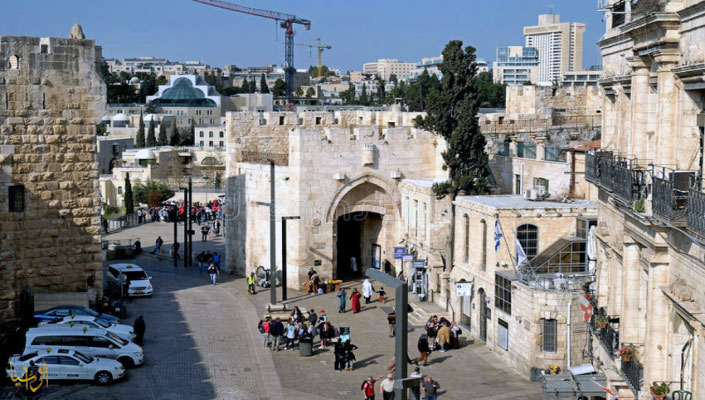
We entered through the Hebron Gate. As soon as we passed the stone arch, I felt that time had forgotten itself behind the door. It was no longer the cars driving the road, but the feet.
The asphalt no longer ruled the city, but the stone. Smooth stones, polished by millions of steps, until they resembled the backs of ancient turtles.
The alleys writhed like streams of light. Every turn hid a story, and every stone arch hid a small sky.
The houses leaned against each other like old women exchanging secrets, the half-open wooden windows watching passers-by in shame, and
the light came down from between the arches like water.
***
The first thing that attacked me was the people. Nor the sounds. There were the smells. There I realized that the cities had noses too. The smell of hot bread came out running towards me.
Then the smell of sesame followed it. Then roasted coffee. Then cardamom. Then cinnamon. Then pepper. Then thyme. Then coal smoke. Then jasmine.
The smells were intertwined in the air until it seemed to me that I was walking in a big perfume.
My grandfather laughed when he saw me inhaling the air as if I were drinking it and said, "Jerusalem is seen with the eye... but it is kept with the nose." He did not know that he would be right for the rest of his life.
***
We passed the "Khan of Oil." The market was long, shining under the stone arches.
The small shops were overflowing with olive oil, Nabulsi soap, pressed olives, cheese, dried figs, and honey.
Copper candlesticks hung from the ceilings, scattering shards of light on the faces.
Then we entered the Attareen market and there we were... My nose was lost.
Musk, amber, frankincense, sage, chamomile, mint, turmeric, cumin, cloves, and black pepper. The spices were not in bags.
They looked like colors that came out of a painter's painting, and they sat in copper plates waiting for someone to buy their smell.
The attar would lift a handful of cinnamon and it would smell like rain, and he would open a bag of cardamom and a whole forest would emerge from it.
***
Then came the sound of copper. In the copper market, hammers were playing on the plates. "A ton... a ton... a ton." An old rhythm, older than the song itself.
The jugs, trays, and big jugs sparkled until I counted them as small suns hanging on the walls.
I paused for a long time. My eyes were filled with that sparkle.
My grandfather... filled his heart with the city.
***
Suddenly... hunger shook me. My grandfather smiled. It was as if he was waiting for that moment. He took me to a small restaurant, the smell of charcoal rising from the door. We sat on two wooden benches.
The man placed a plate of grilled kebabs in front of us. I don't remember the name of the restaurant, the color of its walls, or the owner's face. But I remember that morsel.
It was soft as if it had melted before it reached the fire. And when I put it in my mouth... My tongue lit up. The black pepper was sharp, but it was delicious enough to make me cry and laugh at the same moment.
My grandfather giggled until his eyes watered. Then he handed me a glass of cold milk.
He said, "This is the first gift from Jerusalem."
Since that day... Every kebab I've eaten in my life has been just a failed attempt to imitate that bite. Every time the pepper bites my tongue, the six-year-old runs through the alleys, looking for his grandfather' s hand.
After the meal, the road became quieter. The voices of the vendors faded and the sky widened.
We walked towards the squares leading to Al-Aqsa Mosque.
***
As the sun was resting on the gold, we left the restaurant. But the smell of coal kept walking with us. It was stuck in my grandfather's clothes, with my little fingers, even with my laughter.
Whenever I stuck out my tongue to feel that hot sting, I would smile alone, and my grandfather would pat me on the head, as if he knew that some flavors never leave their owners.
We walked slowly. In Jerusalem, the wheel could not precede the eye. Every step opened a window, and every window looked at another century.
We arrived at the Qataneen market. My grandfather stopped. Then he said in a low voice, "Look carefully." Here people don't just sell cloth...
Here the stone also sells its shadow. I raised my head. The Mamluk arches were rising above us like frozen waves hundreds of years ago.
Light crept through thin threads, drawing carpets of light on the floor, which no one could step on without feeling that he had entered a mosque, even before he reached it. The small shops were juxtaposed in an old familiarity.
White cotton rolls. Silk fabrics. Crimson velvet. Keffiyehs. Clothes embroidered with thread like grandmothers' songs. Merchants sat in front of their goods in the quiet of the prophets.
They did not chase customers. The city knew how to market itself.
***
As we progressed, the trade lessened, and the silence increased. Even the air changed.
It became colder and clearer. It was as if Jerusalem had taken off its market garment, and put on its prayer garment.
We passed an old water trail. My grandfather approached. He washed his face.
Then he filled his palms with water. He handed them to me. I drank. The water was cold in a way I had never known before.
I said, "Why does it taste different, Grandpa?"
He smiled and said, 'Because fatigue drunk before you.'"
And then... The miracle happened. I didn't see her coming. She was hiding behind the trees. Behind the arches.
And suddenly... the way was cleared. I raised my head
and the world stopped. I didn't see a dome. I saw the sun... And I forgot herself on the ground.
The Dome of the Rock was blazing under the afternoon light. Pure gold... Not like gold.
Thick light. Even the light seemed poor next to it. I stared for a long time. Until I forgot to blink.
I felt that the dome did not reflect the sun, but that it was the sun that gave its light.
The sky was so blue that it made the gold more glowing, as if God had chosen for that day the two most beautiful colors in the universe, and then put them side by side.
I whispered to my grandfather, "Is it gold?" He smiled. He did not answer. He kept looking at it like a man looking at something that he did not dare to explain.
Then he said, "Some things, my son, if we know what they made, we will lose half their beauty."
I was silent, and let my eyes complete the question.
***
We entered the squares. Suddenly the ground widened and the narrowness of the alleys disappeared.
The old olive trees stretched their branches over the stone tiles, while the cypress trees stood as guards who did not grow old.
The pigeons were the most peaceful of the people of Jerusalem. He walked among the people...
and he was not afraid of anyone.
The kids were chasing him, and he would fly a little and then come back. He knew that this city didn't hurt its wings.
I sat on the edge of a stone terrace, and I put my palm on the ground.
The stones were warm. I closed my eyes. And I thought I could hear her breathing.
I said to my grandfather, "Do stones have a heart? "
He looked at me for a long time and then said, "If people love her... she has a heart."
***
In the distance, the call to prayer went up. It wasn't a sound... It was water.
It flowed over the trees, washed the air, and slowly ascended to the sky.
At the same moment, the bells of the Church of the Holy Sepulchre rang. I stopped.
I listened. I didn't feel one voice driving the other out.
It seemed to me that Jerusalem was playing them together. Two bells... and one heart.
My grandfather said in a low voice, "The city that has room for supplication is not narrowed by man."
I didn't understand his words at the time, but as I got older, I found myself coming back to him.
***
We stayed in the yards for a long time. I was collecting dry olive leaves and putting them in my pocket.
I picked up a small pebble and hid it from my grandfather. I don't know why.
Maybe because the child is afraid that the cities will be lost, so he tries to take a small stone from them, so that they don't forget the way,
and I don't know where that pebble went. But I'm sure some of it stayed in my heart, and something of my heart is still there.
He sits under an old olive, waiting for my grandfather to come back from prayer, to take a six-year-old kid and show him the city.
For the first time.
***
The city that came back with me.
I didn't know how long we stayed there. In Jerusalem, the clocks were losing their names.
The day wasn't going by... It was depositing.
Like an old perfume in a garment that wouldn't be washed.
I would follow my grandfather through the squares, lifting my head once to the domes, once to the trees, once to the sky, and I felt like I was in a tale bigger than I could understand.
Everything was new to me. But strangely, I felt that I had known him for a long time.
It was as if my little soul had visited Jerusalem before she was born.
***
When the sun went down, my grandfather said, "Come on, son... It's time to go back." I didn't like the word "return."
Because it seemed to me to mean that we were going to leave something behind.
I stood for a while. I looked at the Dome of the Rock again. The gold had changed.
It was no longer fire. It was warm. It was like the sun before it left, I approached it and whispered to her the secret of the evening.
I said to myself, "Don't close your eyes, Dome..."
But it stayed there. Quiet. Reassuring, as if she knows that those who see her once never leave her.
***
We went out of Hebron Gate. This time the door was different. In the morning it was a gate to wonder.
Now... it was a gate to nostalgia.
I didn't know what nostalgia meant when I was a child, but I felt it.
That beautiful pain that is like saying goodbye to someone you love, and you're sure you'll miss them before you walk away from them.
The markets were getting ready to close. The vendors were folding their fabrics.
The copper was going back to its silence. The smell of coffee faded a little, and the alleys were wearing their night cloak.
But Jerusalem wasn't sleeping. She was just closing her eyes a little.
***
On the way to Tarqumiah, I was silent. I didn't ask my grandfather about anything and he didn't talk to me much.
He knew that the child who entered Jerusalem in the morning was not the child who was coming out of it now.
I was looking out of the car window at the mountains and the fields.
The village was approaching.
But something of me was moving away.
A part of me was still there... In the perfumer market. Between the smell of cardamom and cinnamon.
At the cake vendor. Under the olive trees of the Al-Aqsa Mosque.
In front of the golden dome that made me hold my head up so long that I forgot I was a child.
***
We got home. My mother greeted me.
She asked me, "Are you tired?" "
I said, 'No.'
That was the first little lie I told in my life. I was tired, but I didn't want to admit it.
How can a child say he's tired of walking in a dream?
I went into my room. I put my head on the pillow and closed my eyes.
But I didn't see the ceiling of the room.
I saw Jerusalem.
***
Years passed. The child grew up and the distance between him and that day grew.
My grandfather passed away and many faces changed.
Voices disappeared from the markets, and the doors of shops that knew the names of their owners more than the names of their goods were closed.
And I moved away from Jerusalem and Tarqumia, and away from Palestine, but there are things that years can't reach.
The smell of coal, the sound of copper, the cold of the water, the glow of the golden dome, the sting of pepper in that first morsel of kebabs.
***
Today, when I sit alone, and I open the window of memory, I don't look for Jerusalem.
Jerusalem is not lost until we look for it. It is the one that is looking for us.
Sometimes it comes with the smell of coffee, or with the sound of distant bells, or with a child holding his grandfather's hand on the road.
And when it comes back. I come back, too. I go back to that little child.
I walk behind my grandfather in the stone alleys. I hear my little footsteps on the tiles of Jerusalem.
I lift my head towards the dome and feel the same astonishment, as if all those years have not passed, as if I am still six years old, as if my grandfather's hand is still holding mine.
***
I finally realized that man does not carry cities in his memory, but cities carry man.
Jerusalem was not a trip I went on one morning.
It was the door through which I entered into myself.
From that day, whenever I felt that the world had become harsh and narrow, I would close my eyes.
So I find the door of Hebron open, and I find my grandfather waiting for me, and I hear his voice say, "Come, my son...
We will go to Jerusalem."
Stretch out my little hand... and walk.
________________
