
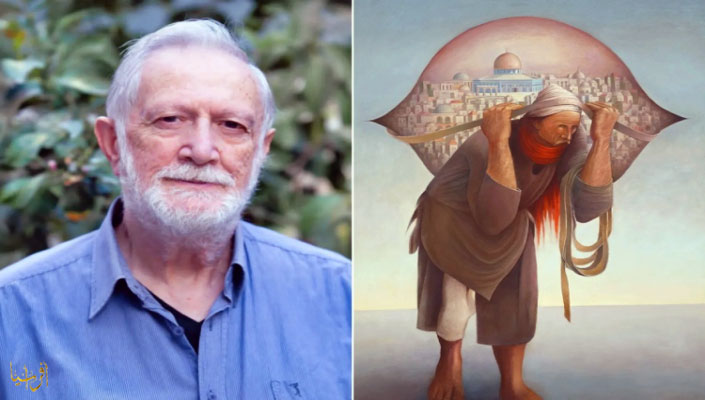
An artist who created a visual memory for Palestine.. The funeral of the "Sheikh of Palestinian Artists" in Birzeit and the restoration of an experience that was dedicated to the protection of the land, identity and memory
Afrasianet - Palestinian artists and officials mourned the body of visual artist and sculptor Suleiman Mansour in his hometown of Birzeit in the center of the occupied West Bank, in a funeral during which mourners recalled the biography of an artist whose experience went beyond the boundaries of painting, becoming one of the most prominent visual voices that shaped the image of Palestine in contemporary art, and preserved the details of its land, memory and heritage in the face of attempts to obliterate and forget.
Mansour died on Monday evening at Makassed Hospital in East Jerusalem, at the age of 79, after an artistic career that spanned more than five decades, during which he established himself as one of the most prominent contemporary Palestinian artists, and one of the most associated with the national identity and its visual vocabulary.
The presence of the land in his works was not just a visual subject, but was the essence of an artistic experiment that made the olive, Jerusalem, the village, the dress, the heritage and the Palestinian man recurring elements in the construction of his artistic world.
Mourners walked behind a black car carrying his coffin from his family's home in Birzeit to the Evangelical Episcopal Church in the center of the town, while the procession was led by bishops and clerics, before the church was filled with attendees, and the funeral ceremony was transmitted through a loudspeaker to the mourners in its courtyard.
The coffin was decorated with olive branches, a significant reference to a tree that was heavily present in Mansour's works, and which in his experience turned into more than one element of nature, as it is a symbol of the land, rooting, and steadfastness, and one of the signs that contributed to the formation of his own visual dictionary.
Artist Khaled Hourani said that since the news of Mansour's death spread, Palestine has looked as if it is "wearing a mourning dress", considering that his departure is "a great loss to Palestinian culture, as if an entire era has ended".
Palestinian artists call Mansour "the king" and "the sheikh of artists," according to Hourani, who believes that his legacy will live on through his great influence on Palestinian art and artists, and his contribution to "shaping and shaping Palestine."
Palestine that sees through the feather
During the funeral ceremony, Metropolitan of the Evangelical Lutheran Church in Jordan and the Holy Land, Imad Haddad, said that many knew Mansour's paintings, colors and symbols, and that many "saw Palestine through his eyes and feathers."
This phrase sums up a key aspect of Mansour's experience: the artist viewed Palestine as both a place and a memory. In his works, the land is not seen as a neutral natural landscape, but as a carrier of man, history, and story.
Everyday objects become dense signs: the olive tree invokes roots, the garment evokes identity, Jerusalem invokes history and uprooting, and the Palestinian man is present as the bearer of his memory and destiny.
In his speech, Haddad said that Mansour "embodied in his art the relationship between man and his land", and painted man "with his pain, sadness, joy, culture, heritage and memory", adding that the artist today returns to the land from which he "took a lot and gave it a lot", the land he loved and preserved in his heart and art.
It is this organic relationship between the artist and his place that has made Mansour's works go beyond their aesthetic function to become part of the Palestinian visual memory.
For him, art was not separate from political and social reality, but at the same time it was not reduced to direct political discourse. He searched for a language capable of transforming the Palestinian experience into symbols and images that could be continued and passed down through generations.
"Camel bearings".. a tale of a people
One of Mansour's most famous works is the painting "Camel of Bearings", which he painted in the 1970s, and over time has turned into one of the most famous artistic images in the Palestinian consciousness, and an icon that transcends the boundaries of plastic art to the broader national and cultural sphere.
The painting depicts an elderly Palestinian porter carrying the city of Jerusalem on his back, in a visual intensification of the story of a people carrying their homeland, history, and memory.
The power of the image and the simplicity of its symbols contributed to giving it an exceptional ability to circulate and continue, so that it became part of the modern Palestinian imagination.
The Palestinian Ministry of Culture believes that Mansour's works have been evoking the land, Jerusalem, heritage, the Palestinian dress and olives, to be "a witness to Palestinian history and a guardian of identity."
"Camel of Bearings" reveals one of the most important characteristics of Mansour's experience: the ability to produce an image that seems simple in its elements, but very dense in its connotations.
The man in the painting is not just a figure, Jerusalem is not just a city, and the pregnancy is not only a physical act, but these elements come together to create a metaphor for a people who bear the burdens of their history and carry their cities and memory with them.
Mansour thus gained his position as one of the artists who contributed to the establishment of what can be called the modern Palestinian visual memory. He was able to make local vocabulary, linked to everyday life, the countryside, the city, and heritage, into readable artistic signs beyond the boundaries of the place as well.
More than half a century in memory service
The importance of Suleiman Mansour does not stem from the fame of a single painting, no matter how prestigious it is, but from a long path in which art intertwined with the question of Palestinian identity.
For more than fifty years, Mansour remained true to his basic vocabulary, from the land, olives, and Jerusalem to the Palestinian man, his heritage and his memory, transforming these elements into a renewed artistic material.
This continuity allowed him to become part of the history of the contemporary Palestinian visual movement, and to influence generations of artists who came after him. An artist who dedicates his or her experience to the cause of place not only preserves images of the place, but also contributes to determining the way it is perceived.
During his participation in the funeral, the visual artist Mohammed Saleh Khalil said that Mansour's departure is "a great loss to Palestinian culture", considering that the artist dedicated his life to "preserving the Palestinian identity through politics and away from politics", and through the Palestinian heritage, olives and land.
Khalil added that Mansour did not leave a visual language that serves his national message except to use it, stressing that he "dedicated all his art to serving the authentic identity of the Palestinians."
Herein lies the peculiarity of Mansour's experience: he was not looking for slogans as much as he was looking for the image that remains after the slogan is gone.
He realized that memory needs shapes, symbols, and images in order to continue, and that the painting can preserve what a political document alone cannot memorize: the human form, the color of the land, the shape of the village, the details of the dress, the presence of olives, and the features of Jerusalem in the collective imagination.
An artist at the heart of the Palestinian plastic movement
With the death of Mansour, the Palestinian plastic movement has lost one of its most prominent pillars, presence and influence. He was one of the generation of artists who contributed to building a clear Palestinian artistic discourse, based on transforming the national experience into an aesthetic material, without separating art from its historical and social surroundings.
After the funeral in the church, Mansour's body was transferred to the town's cemetery, where he was laid to rest in the presence of his family, friends, artists, cultural and official figures, and wreaths were laid on his grave .
In Birzeit, Suleiman Mansour returned to the land that was a primary source of his art world. However, his departure does not mean that the image he created of Palestine is absent; his paintings, foremost of which are "Bearings Camels", will continue to carry memory in the opposite direction of oblivion.
If the artist spent his life painting a land that was carried by its children and carried it, his works today also bear his own image, as one of those who gave Palestine a visual language that remained present in art and conscience.
________________
