
Afrasianet - Raed Salha - U.S. President Donald Trump was joking when he said Friday that he would declare the Strait of Hormuz "U.S. territory" after Iran's "defeat," a White House official said, at a time when the war with Tehran is increasingly revolved around a fundamental question: Who will back down first?
The White House's clarification came after Trump's remarks during a speech in New York state, at a time when confrontation with Tehran over the strait is escalating. The Wall Street Journal reported that the Trump administration is intensifying economic pressure on Iran in conjunction with the naval blockade, while Tehran is betting on its ability to withstand sanctions, and that disruption in navigation and rising energy prices will eventually push Washington back.
The Wall Street Journal: Trump started the war declaring that his goal is to force Iran to reach a deal that would permanently prevent it from acquiring a nuclear weapon. But as the war drags on and Tehran has been able to exert greater influence over global energy traffic through the Strait of Hormuz, the U.S. president's priorities appear to have changed.
Iran escalated the standoff on Thursday by attacking two Emirati ships in the Strait of Hormuz, bringing the number of ships targeted in August to six. Navigation remains severely limited, with only 13 ships passing through the strait on Thursday, compared with more than 130 a day before the war.
Iranian Deputy Foreign Minister Kazem Gharibabadi responded to Trump's remarks by asserting that the Strait of Hormuz "was Iranian, it is Iranian and will remain Iranian," and that the decision to open or close it is in Tehran's hands.
According to the Wall Street Journal, the Trump administration has intensified economic pressure on Iran, putting lowering energy prices and reopening the strait at the forefront of its goals, and promising new financial sanctions to force Tehran to back down.
With Trump increasingly relying on the naval blockade of Iran's ports as a means of economic pressure, Iran's leaders are seeking to assert that they will not back down, and that they will continue to close the strait until high energy prices force the United States to ease its pressure.
Ali Vaez, deputy director of the Middle East and North Africa program at the International Crisis Group, said Tehran had concluded from its previous confrontations with Washington that "whoever holds out longer forces America to back down first."
Washington signaled this week that it would impose new restrictions on Iran's economy. Treasury Secretary Scott Besant said the measures would be a "double blow" in conjunction with the U.S. naval blockade of Iranian ports, stressing that additional measures would be announced next week.
The economic reciprocal measures between the two sides are pushing further away from the diplomatic track that appeared to open a window out of the war in the June deal, which provided for financial incentives for Iran in exchange for reopening the strait and engaging in serious negotiations over its nuclear program.
Vice President J.D. Vance said lowering energy prices was the administration's "number one goal," with preventing Iran from acquiring a nuclear weapon second. White House spokeswoman Carolyn Levitt said on Friday that the two goals were equally important to Trump.
Trump started the war by declaring that his goal was to force Iran to reach a deal that would permanently prevent it from acquiring a nuclear weapon. But as the war drags on and Tehran has been able to exert greater influence over global energy traffic through the Strait of Hormuz, the U.S. president's priorities appear to have changed.
According to U.S. officials quoted by the Wall Street Journal, the Trump administration has become more pessimistic about the prospect of a final settlement of the nuclear file, focusing instead on strangling Iran's economy to force the regime to reach an agreement on opening the strait, allowing Trump to declare "victory" and end the war.
In return, control of the Strait of Hormuz gives Iran greater leverage to pressure the United States without compromising on its nuclear program. Tehran believes that time is on its side, while raising the ceiling of its demands to reopen the strait, demanding an end to the war, lifting the blockade, easing sanctions and freezing Iranian funds.
The two sides escalated their war of statements on Friday. Trump said during a speech in New York state that after "defeating Iran" he would soon declare the Strait of Hormuz "U.S. territory," before a White House official clarified that the president was joking.
Gharibabadi responded by saying that the strait "was Iranian, it is Iranian and it will remain Iranian," stressing that the decision to close or open it will be in Iran's hands.
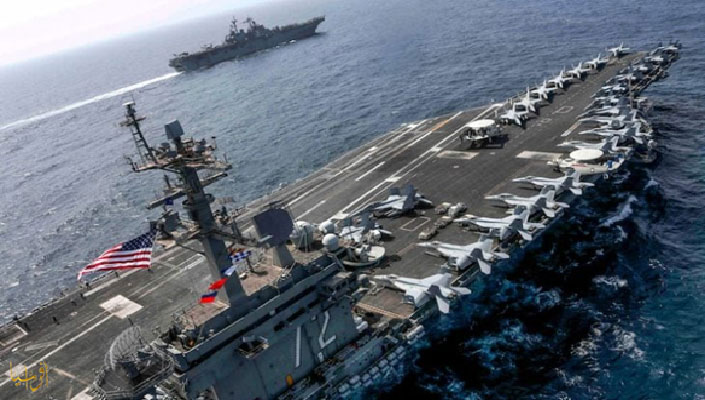
U.S. Defense Secretary Pete Hegseth said the Navy could continue the blockade on Iran "indefinitely." Meanwhile, the United States is preparing to replace the aircraft carrier Abraham Lincoln in the region with the George Washington, amid growing concerns about living conditions aboard the Lincoln and the fatigue of the troops from the long deployment.
Iran has repeatedly used force to prevent commercial ships from crossing the strait, making its ability to escalate military escalation difficult for Washington to extract concessions through economic pressure alone.
The latest attack on ships linked to the Abu Dhabi National Oil Company (ADNEOC) brought the number of ships attacked in August to six. The UAE, a major oil exporter, has been trying to pass its shipments through the strait despite Iranian restrictions.
The strait remains largely closed, with most ships reluctant to cross without Iran's consent, while those that do often use the Tehran-administered northern route.
Ship-tracking data shows 13 ships crossed the strait on Thursday, compared with more than 130 per day before the war. Of those ships, nine took the Iranian-operated route. Traffic also slowed in August compared to July, when the average number of ships crossed was 26 per day.
Global oil prices have fluctuated below $90 a barrel in recent days. Although oil flows through the strait continue to decline, producers in the region have been able to find alternative routes to keep their exports moving.
But continued turmoil is draining global oil stocks and reducing markets' ability to absorb new shocks. Eurasia analysts believe that tensions between Washington and Tehran over the status of the strait will keep the risk of a new crisis and its closure high until the end of 2026.
With the midterm congressional elections approaching, Trump prefers to limit the repercussions of the war internally and avoid a return to all-out fighting by intensifying economic pressure on Iran. His aides have briefed the president on data showing the extent of the damage the sanctions have already done to Iran's economy and regime.
Meyad Maleki, a former U.S. Treasury official, said Iran's oil exports had fallen from about 2 million barrels per day before the April blockade to near zero recently, while Tehran faces a shortfall of about 29 million liters per day of gasoline supplies that the blockade prevents it from replenishing.
He added that the blockade could "bring down the regime" if Washington made clear it would not lift it on a timetable that Tehran could wait until its end.
But Iran, in the face of mounting pressure, is transforming into a survival economy designed to withstand sanctions and blockades. After years of sanctions, Tehran is passing on a larger part of the cost of the crisis to citizens by rationing fuel and electricity, restricting foreign currency, and cutting investments, while preserving basic imports and state resources.
Earlier in the war, Washington tried to force Iran to make concessions when it imposed a naval blockade just days after a fragile ceasefire was reached. U.S. officials believed at the time that the blockade would push Tehran to end the war on U.S. terms within weeks.
But in June, Trump agreed to a deal that ended the blockade in exchange for Iran's pledge to reopen the strait and discuss its nuclear program. A few weeks later, Tehran resumed attacking ships after objecting to U.S. attempts to divert navigation in the strait.
Thus, the war is no longer just about Iran's nuclear program or military control of the Strait of Hormuz, but about each side's ability to bear the cost of economic and military confrontation.
While Washington is betting that strangling Iran's economy will force Tehran to back down, the latter is betting that continued energy market turmoil and the rising cost of war will force Trump to ease his demands.
As the escalation continues, the central question in the war has become clearer: Who will back down first?
________________
