
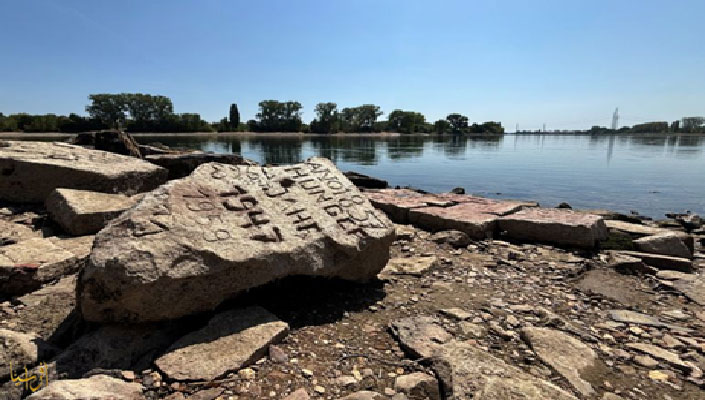
"Hunger stones" appear as the water level of the Rhine River drops near the German city of Worms
Afrasianet - When phrases such as "If you see me, cry" or "We cried and you will cry" appear on what has become known as "hunger stones" at the riverbeds of central Europe, these warnings at first glance suggest fear of drought, hunger and water shortages.
But their appearance this summer does not mean that the banks of the Elbe, Danube and Rhine rivers in Germany in particular are on the verge of famine.
The link between the appearance of these stones and the occurrence of famine in Germany today seems exaggerated and far from reality, as Germany is a country with an integrated food system and an economic structure capable of coping with drought crises and water shortages.
However, the appearance of these stones this year has gained symbolic significance because their appearance when rivers dry up and water levels decline is reminiscent of the harsh droughts that the banks of these rivers have experienced. The most famous of these stones is located on the left bank of the Elbe River between the Deutsche region of the Czech Republic and Berna in Germany and is inscripted in 1616.
Because the appearance of the "Hunger Stones" was repeated in 2018, 2022 and this year as well, these stones have become more of a symbol of drought and climate change than a harbinger of famine, and although some social media often tend to exaggerate and exaggerate whenever these stones appear, the repercussions of drought and low river water levels are beginning to be tangibly visible in people's daily lives as transportation costs and the prices of some agricultural products rise.
To what extent are the effects of this crisis already beginning to be felt in people's daily lives?
Thomas Boulos, head of the Department of Transport and Infrastructure Studies at the German Institute for Economics, says that under the current situation, the freight sector has become more expensive. The prices of transporting goods from the Rhine to the port of Rotterdam have risen almost fourfold because ships can only sail with very light cargo.
With the water level falling, the expert adds, transport routes across the Rhine are likely to be cut off soon. Due to limited capacity for transport by road and rail along the Rhine, these quantities of goods can only be partially transported at a very high cost. Some companies have already announced that they intend to reduce their production.
According to the website, the increase in transportation costs will lead to an increase in the prices of some food products, but above all fuel prices, which have already risen in the areas on the Rhine compared to the rest of Germany.
This is because river transport is an important part of fuel supply chains and therefore higher transport costs can quickly reach the consumer. The transport crisis on the Rhine is also expected to lead to a further increase in the costs of the construction sector.
Rising food prices
Far from the drop in the water level of the Rhine, the effects of the drought are already beginning to be seen in the shops. The prices of many types of fresh vegetables and potatoes grown in open fields have risen particularly due to reduced supply. This includes lettuce in particular, as well as some types of cabbage such as broccoli, cauliflower and carrots.
Meanwhile, German farms are increasingly trying to adapt to the effects of climate change. According to the North Rhine-Westphalia State Chamber of Agriculture, many farmers are starting to change their farming methods including using plant varieties that are more adaptable to new climatic conditions, and growing multiple varieties to distribute risk.
Acceptance of reality
According to Der Spiegel, the current problem politically is that Germany has reached a stage of indifference to the status quo. In an article titled "We Have Reached the Last Stage of Doom", the magazine borrows a model consisting of 5 stages that a person goes through in the face of death: denial, anger, bargaining, depression, and then accepting reality.
Germany has reached the final stage, which is to accept and live with the new climate reality rather than try to change it, saying that this summer what climate scientists have been warning about for decades has become tangible: we are approaching a tipping point. Theoretical warnings have become reality, but we have simply called this reality the "new normal."
Surrender to new circumstances
German Chancellor Friedrich Merz's recent statement that Germany must learn to live with the consequences of climate change reflects a capitulation to deteriorating climate conditions and may be understandable from a humanitarian point of view, but its consequences for society and politics are dire.
This acceptance does not change the fact that in the medium term, falling water levels threaten Germany with the loss of a basic source of life, and the implications for the economy and industry, as well as on the health of the population, are already serious. However, the German government's policy is to ignore the problem and continue to wait for things to improve, as if the message is: "Don't worry, it will rain again."
Agriculture Sector
In an article titled "The Rhine River is drying up and we are paying the price", Focus magazine says that the drought in Germany is no longer just an environmental problem, but is becoming an economic problem that affects the daily lives of citizens.
The low level of the river is hampering navigation and raising the cost of transporting coal, chemicals, grain and fuel, which may gradually affect the prices of some commodities and fuel.
At the same time, the agriculture sector is under significant pressure due to declining crops and rising irrigation costs, especially in the cultivation of cereals, vegetables and potatoes.
Continued droughts can also increase the cost of providing drinking water, due to the need for new wells, reservoirs and water networks. Rising temperatures and water shortages are also affecting electricity production as some power plants rely on river water for cooling.
However, this does not mean that Germany is heading for famine or a full-blown water crisis: drinking water supplies are still guaranteed at the national level. Some of the crop shortages can be offset by imports. But the recurrence of droughts is making the economy more fragile.
Hence, it can be said that the appearance of "hunger stones" in the past was a reminder that the decline in the level of rivers may lead to low crops, high prices and suffering, while this phenomenon today reveals that drought does not necessarily mean famine, but it can turn into an economic bill that society will gradually pay for.
________________
Source: German Press
________________
