
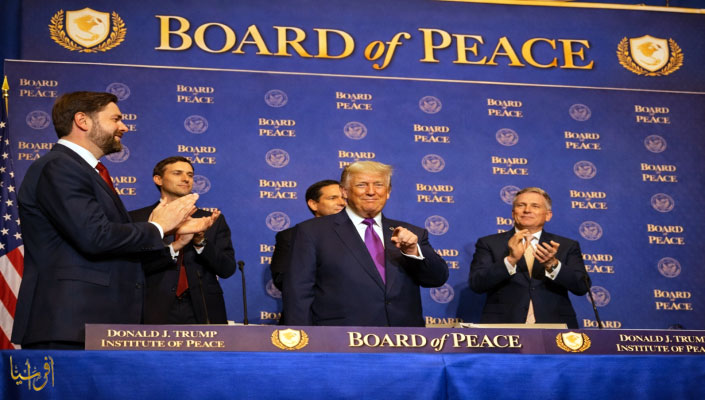
Afrasianet - The Guardian newspaper published a report by Kate Brown and Aram Ruston in which they said that the Gaza Peace Council, chaired by Donald Trump, plans to grant itself broad legal status and immunity, documents show.
According to a draft resolution obtained by The Guardian, the peace council, announced by Trump earlier this year to administer Gaza, plans to grant itself broad legal immunity, and the draft resolution allows the commission to acquire public property in Gaza "for free."
The four-page resolution, which is classified as "sensitive but not secret," gives broad protection to all members of the Peace Commission, its administrative apparatus and the Office of the High Representative, as well as Palestinian technocrats, international stabilization forces, and non-resident contractors who will be contracted to work in Gaza.
According to the resolution, the legal proceedings that would grant immunity to all would include "any arrest, detention, or legal proceedings in the courts or other authorities in Gaza."
But it is unclear whether the document seeks to exempt the Peace Commission and its affiliates from prosecution in international courts, as well as potential lawsuits in Gaza.
The draft resolution, issued in June 2026, states that the head of the Peace Commission, Donald Trump, will have the right to waive legal immunity to anyone, provided that a majority of the Peace Commission's members agree.
The seven-member Executive Council consists of Jared Kushner, Trump's son-in-law, Special Envoy Steve Whitkoff, Chief of Staff Susie Wiles, and his national security adviser Marco Rubio.
Despite pledging billions of dollars, most have yet to transfer funds to support the council's work in Gaza, and no major contracts have been concluded. The White House has referred questions to the peace council.
The White House did not respond to specific questions about the resolution, but an official said in a statement: "There is no operational decision or immunity in the way your question describes, and any suggestion that these measures are determined to create chaos or impunity is incorrect and misleading and turns the issue on its head on its own."
The official added that "the claim that the president will have a role in establishing or lifting immunity in Gaza is absolutely false," and that "the council will ensure that all employees, contractors and participating entities comply with the applicable law, and that they work in accordance with clear rules, oversight mechanisms and accountability."
The official did not clarify what such oversight and accountability was.
Nikolai Mladenov, a Bulgarian diplomat who serves as the Peace Council's high representative in Gaza, is holding meetings in Cairo this week with Palestinian officials selected by the council to administer Gaza. According to a source familiar with the agenda, the discussions focused on improving the Council's framework in the sector.
The source said that the possible immunity decision, entitled "Resolution No. 2026/3," was not shared with the Palestinian group.
The newspaper hired six lawyers who specialize in U.S. contract law and armed conflict to read and interpret the decision.
If the resolution goes into effect, they said, it is unclear how Peace Council officials, soldiers, and contractors will be held accountable in the event of shooting incidents or other incidents affecting Gazans, or even how the council will be able to resolve routine disputes related to business or land use there.
U.S.-led reconstruction efforts in Iraq and Afghanistan have been the subject of controversy over corruption, civilian deaths or abuses by U.S. contractors, including Blackwater and KBR employees, who have faced lawsuits in U.S. courts. Any reconstruction efforts in Gaza may face similar challenges.
Emily Schaefer-Omer-Mann, an expert in litigation of international humanitarian law cases before Israeli, U.S. and foreign courts, said: "It looks like an attempt to absolve the council and all of its staff from accountability for potential legal violations."
A number of lawyers, including Omer-Mann, referred to the specific risks associated with item 7 of the draft resolution, entitled "Third-Party Liability/Claims", which establishes a system for the Peace Council to consider and adjudicate any claims relating to "loss or damage to property and personal injury" caused by occupation or death.
Noura Erekat, a professor of international law at Rutgers University, said: "They are basically saying that there is no external oversight, including the international law that is in force regarding the occupation. It creates a legal system that stands on its own."
Contractors have also lobbied for clarity on the legal protection afforded to potential works in Gaza, with the Trump-backed Peace Council requesting offers for rubble clearance, security work and large-scale reconstruction efforts planned there.
Jared Kushner described the plans to transform the coastal sector as aimed at transforming it into luxury resorts, high-tech cities and regional business hubs.
Laws governing the work of international contractors and military forces are usually in "status-of-forces agreements" between states, but there is no such agreement for Gaza. U.S. contractors may be subject to U.S. law for some crimes even if they are working overseas.
Doug Brooks, president emeritus of the International Association for Stabilization Operations, says, "I think any company would want a very clear legal framework, there are issues of liability that any serious U.S. company would like to clarify."
One U.S. security contractor reported that Israeli officials do not want to negotiate a status agreement on Gaza, because Israel does not want to recognize Gaza as a state.
The contractor added: "It is very important politically and legally, it provides protection and security. It also gives the people of Gaza clarity and reassurance about how they are treated and treated by contractors."
The final section of the draft Peace Council resolution, entitled "The Headquarters of the Peace Council, the Office of the High Representative and the International Stabilization Forces," states that "the headquarters and public facilities necessary to accomplish tasks in Gaza shall be provided free of charge."
Legal experts said that this phrase alone could open the door to the illegal confiscation of Palestinian property. It remains unclear which party – Israel, Hamas or the Palestinian Authority – will be responsible for "provisioning" the peace council, and under what conditions.
According to contractors involved in the operation, the peace council plans to build a base for an international military force, as well as logistics hubs to support its operations there. The international force is intended to help disarm Hamas, a crucial step in Trump's peace plan. Israel has refused to proceed with the steps set out in the November 2025 ceasefire agreement if Hamas does not lay down its arms.
Omar Shakir, executive director of Dawn, a non-profit organization that studies the effects of genocide, apartheid and occupation, said that "the Peace Council, by unilaterally declaring the authority to seize Palestinian land, property and buildings for its own use without consent, compensation or review, is following the example of Israeli methods of repression."
"This document refers to the entrenchment of some of Israel's most egregious features, including genocide, apartheid and occupation. This portends not only complicity, but also serious violations directly."
A number of lawyers raised questions about the Peace Council's legal authority to manage public facilities and buildings.
"If they don't have a status-of-forces agreement with Israel, it's not clear what their legal authority is," said Brad Parker, assistant director of policy at the Center for Constitutional Rights.
The center's attorneys have represented victims in U.S. lawsuits against Blackwater and other U.S. security contractors for alleged abuses in Iraq.
The UN Security Council passed a resolution allowing the Peace Council to oversee the administration of Gaza until December 31, 2027. The Charter of the United Nations grants its diplomats and organizations specific legal protection for the work they perform on behalf of United Nations missions abroad.
The drafting of the Peace Council resolution appears to be based on those existing frameworks, which include protection against arrest or detention of United Nations diplomats in the course of their official duties, as well as the confiscation of United Nations property. It is unclear whether the Peace Council can rely on UN immunities to protect itself.
The draft resolution stipulates that it will enter into force immediately upon Mladenov's signature. The Peace Council did not respond to inquiries about the others, if any, that would sign its comprehensive resolution.
"What is the value of this document if they are the only ones who will sign it?" asked Shaker.
________________
