
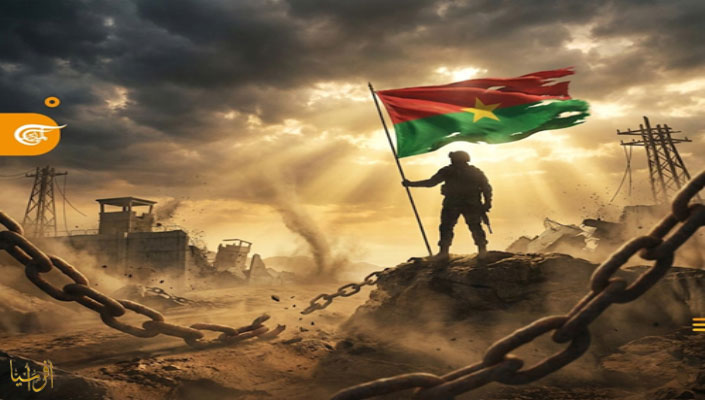
Afrasianet - Thabet Al Amour - Why did Burkina Faso decide to sever diplomatic relations with France with immediate effect?
In an article I wrote in Al-Mayadeen Net on May 13, 2026, I asked, "Why is Macron running in the streets of Africa?" "Macron succeeded in running through the streets of Africa and creating the image he wanted, but catching up with the new Africa requires more than running," she said. Macron seems to have not only caught up with the new Africa, but lost the race and got out of it, and a new chess piece has fallen out of the square of French influence in Africa.
France was officially declared defeated in the marathon of the race to what was left of an old traditional influence in Africa when the government of Burkina Faso, in a statement broadcast on state television, announced: "The government of Burkina Faso announces to the national and international community that it has decided to sever diplomatic relations with France starting today, June 26, 2026." Burkina Faso accused France of harboring "neo-colonial ambitions that are clearly manifested in its active support for subversive networks and terrorists who are plunging our country and the Sahel region into mourning."
The question is, why did Burkina Faso decide to sever diplomatic relations with France with immediate effect? What are the implications, consequences and repercussions of this? And why did the rupture from military relations evolve from political relations? Has France failed to repair the erosion of its relations? Or is what Burkina Faso did the title of a strategic African shift towards traditional colonialism whereby Burkina Faso toppled France's last pawn in Africa?
Burkina Faso's decision to sever diplomatic relations with France is not just a transient crisis, but a strategic decision that reflects a radical shift whose features have begun to expand across Africa and is not limited to a specific country, and the title of this transformation is to rearrange the determinants of relations with the old colonial collective "Europe", and not only France, as before the decision to sever relations with France, the Ministry of Foreign Affairs in Burkina Faso, on June 24, 2026, summoned the head of the European Union mission accredited to it, Philippe Bronchin, to inform him of Ouagadougou's displeasure A resolution adopted by the European Parliament criticizes what it described as the continued "crackdown" and "deterioration of fundamental freedoms".
Earlier, Burkina Faso's Foreign Minister Jean-Marie Traoré denounced the statements of French MEP Christophe Gomart, saying that talking about a country he has not visited and providing figures about it "is an insult to the status of the European Parliament by giving a speech with a neo-colonial tendency."
Burkina Faso's relations with Europeans have been strained since Captain Ibrahim Traoré came to power following a military coup at the end of September 2022. France had gradually withdrawn its diplomatic presence, as it had not had an ambassador in Burkina Faso since January 2023, and later in 2024, Burkinabe authorities expelled three French diplomats on charges of carrying out activities they described as "subversive".
In the course of escalating tension and rolling divergence between the two countries, the expulsion of French Ambassador Lucia Pialot from Ouagadougou was not the beginning of the crisis, but the inevitable result of an upward context that began since the coup d'état of Captain Ibrahim Traoré in September 2022. It was inaugurated with the military disengagement and the end of the effects of Operation "Saber" of the French special forces, and was completed today with the severing of full diplomatic relations with immediate effect.
This decision, which Burkina Faso justified by the absence of "mutual respect" and the accusation of supporting "subversive networks", is not limited to the bilateral sphere, but extends to reformulate regional and international balances. In one sense, it means that France, despite its loss and contraction, has not yet understood the nature of the transformations taking place in the new Africa in general and in Burkina Faso and its neighbour in particular.
The decision means the institutionalization of France's isolation and the completion of its rejection, and by severing diplomatic relations with it, the circle of African rupture led by the countries of the Sahara Alliance (Mali, Niger, and Burkina Faso) is completed, and this means that President Macron's run did not open the closed doors and did not keep the remaining doors open, and it means that the countries of the African Sahel as a political and geographical bloc are determined to bring down the pawns of all of France and close the doors to its entry, and that this rejection and expulsion is not limited to France but extends to the whole of Europe. Nor On May 11, 2026, Niger announced the closure of 9 French media outlets, and the authorities justified their decision by "repeatedly publishing content that would seriously threaten public order, national unity, social cohesion and the stability of the institutions of the Republic."
Therefore, the decision of the government of Burkina Faso to sever diplomatic relations with France with "immediate effect" was not just an angry protocol measure or a passing political crisis, but rather a declaration of the fall of the last pawns of old colonialism from the Sahel region, represented by France, which is no longer a partner and is no longer desirable, but has become, in the popular and official African point of view, a burden and a colonial legacy that must be discarded. The decision was not born of the moment and was not born out of thin air, but came as a result of accumulation, miscalculation and French arrogance It led to what the scene had reached.
The decision does not mean that France has lost only Ouagadougou, but that it has been translated as France has been expelled from the entire Sahel region of Africa (Mali, Niger, Burkina Faso), to be replaced by the state powers of Russia, China, and regional powers Turkey and Iran.
One of the implications of the decision to cut ties between Ouagadougou and Paris is that the rupture has shifted from the military dimension to the political dimension, and that the leaders of the Sahel countries are no longer satisfied with ending security agreements and expelling soldiers, but have moved to the stage of clearing the African space of the French presence and role politically, institutionally and diplomatically.
Burkina Faso's severing of diplomatic relations with France with immediate effect means that France's plans to return to Africa and its president's attempts to run to catch up have all failed, that France, as a state, institutions, presidency and foreign affairs has failed and its failure has ended with a big zero, that Africa is changing while France has not tried to do so and has continued to deal with the new Africa in the old way, and that France has not read the new African mood, which seems determined to complete the state of change and reject the tutelage.
Therefore, the escalation has progressed from severing and ending military relations to severing diplomatic relations, which means that Africa is on its way, while France remains in its retreat, the erosion of its presence and its failure. While France views Africa with a paternalistic and condescending view, Africa views France with a peer view, and that the military that France has been betting on at times, legitimizing at other times, and sometimes summoning with its agendas, goals and tools are now leading the change, expelling France, leaning on the street, and intersecting with it in rejecting and expelling France.
The decision of Burkina Faso to sever its relations with France is not just the end of relations between two countries, and it is a decision loaded with observations, readings and implications, the most important of which is that France is still insistent on addressing the leaders and peoples of the African Sahel countries with the logic of trusteeship, and thinks that it can still punish the leaders of these countries, dictate to them and stipulate them, and that it has neglected and ignored the transformation and change taking place in Africa, so it has ended up in failure, expulsion and estrangement because it has failed to reintroduce itself to the new Africa.
France misread the transformations and changes and thought that the coups in the Sahel (Mali, Niger, and Burkina Faso) were just a passing summer cloud that could be encircled and overcome, so it reaped its miscalculation by falling its last pawns in Africa.
As for Burkina Faso, it is noticeable that it is impulsive in making and making its decisions, and that it does not leave lines for revision and review, and that there is a sharp tendency in its transformation of its international relations, and that it puts all its eggs in the Russian basket.
Burkina Faso's decision to sever ties with France is an official announcement of a fundamental and new transformation in the determinants of Ouagadougou, whose implications will extend to other new African countries, declaring successively the fall of France's pawns and its exit from African geography. "Sovereignty" has turned from a political slogan to a popular and military doctrine that sees the French presence as a protector of terrorism rather than a fighter against it, which has made the expulsion of France and the severance of relations with it an irreversible popular demand, and a tributary to the legitimacy of the military that rebelled against France and its tutelage.
In conclusion, the decision of Burkina Faso means the end of the era in which France decided the fate of African governments with a battalion of paratroopers, and that if France wants to stay, it must abandon the mentality of the old colonizer and turn to partnership and peerage, instead of patriarchy, because the African scene in its relationship has become open to alternatives, options, and relations extending from Moscow and Beijing to Ankara and Tehran.
________________
