
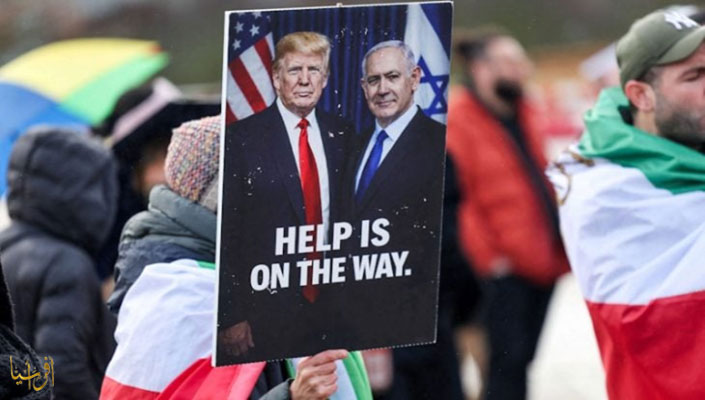
Afrasianet - The Financial Times published a report by Neri Zilber in which he said that the Iran war has fulfilled a long-held dream of Israeli Prime Minister Benjamin Netanyahu, but has left him in the worst political situation he has faced in his political career. Just four months ago, Benjamin Netanyahu witnessed the realization of his decades-long political dream: the start of a joint U.S.-Israeli war on Iran.
But what has been described in Israel as the "final" battle against its arch-enemy did not go according to plan: Donald Trump's interim deal with Iran was met with outrage in Israel, where critics accused it of a catastrophic strategic failure overseen by a weak-willed U.S. leader.
Washington responded strongly, with Vice President J.D. Vance warning Israel not to be aware of the reality of its situation. Dan Shapiro, a former U.S. official and former U.S. ambassador to Israel, said, referring to Trump and Netanyahu, "They both were arrogant, they misestimated what they could achieve, and they missed the best strategic opportunity."
Donald Trump's interim deal with Iran has been met with outrage in Israel, with critics accusing it of a catastrophic strategic failure overseen by a weak-willed U.S. leader.
Netanyahu was greeted with a warm reception in his meetings with Trump after the latter's return to power, with the two men meeting at least seven times between the inauguration of the US president and the start of the war. But since that fateful meeting in February before the conflict erupted, they have not appeared together. As part of its deal with Iran, Washington has also sought to impose a ceasefire in Lebanon, which has drawn a wave of intense condemnation from residents of northern Israel and angry far-right ministers of what both sides called a "loss of sovereignty."
Netanyahu has insisted that his forces will not withdraw from his unilaterally declared "security zone," making Lebanon a key focus in tense U.S.-Iran peace talks. Last week's memorandum of understanding between Washington and Tehran was the clearest indication so far of the radical divergence in interests of the United States and Israel.
In addition to covering the Lebanese front, the memorandum did not address Iran's ballistic missile program or its support for proxy militias in the region, despite repeated Israeli demands that these matters should be included in the agreement.
A former senior Israeli official said that "the nuclear issue is only discussed in words," without real commitments from Iran to give up its stockpile of highly enriched uranium. Based on the progress of the negotiations and their steps to reopen the Strait of Hormuz, Iran is expected to obtain U.S. exemptions to sell oil and access its frozen assets, while the regime itself still rules Tehran. "It is difficult to overstate the scale of the strategic catastrophe that this war has been," the former Israeli official said. "Compared to before the war, the situation today is much worse," he added, especially since "our position is no longer identical to the position of the United States as it was before."
Netanyahu's popularity has plummeted since late last year, since the US president called him a "hero" of the war during a Mar-a-Lago meeting, with Trump saying at the time: "Israel probably wouldn't exist without someone else leading the country," referring to Netanyahu. That moment may be the culmination of Netanyahu's highly aggressive security doctrine, which has achieved a series of field victories across the Middle East – at a heavy human cost – in response to the Hamas attack on October 7, 2023.
From Lebanon to Gaza and Syria, Israel has struck its "enemies," established multiple buffer zones, and launched attacks as it pleases, often under the guise of highly favorable U.S.-brokered ceasefires.
Netanyahu's biggest obstacle may be his growing distance from Trump, whom he has described in recent weeks as "absolutely insane."
In Iran, Trump's promise to support anti-regime demonstrations there has turned into an all-out attack instigated by Netanyahu. Several previous U.S. presidents have rejected previous calls by him to launch an attack on the Islamic Republic. Shapiro, who now works at the Atlantic Council, says, "The protests broke out, and the system seemed to be on the verge of collapse. [Netanyahu and Trump] thought it would take only a small push to bring it down."
Despite heavy losses, from its top leaders to critical infrastructure and thousands of civilian deaths, the Iranian regime came out of the war feeling that the war had strengthened its position.
Perhaps the biggest obstacle for Netanyahu is his growing distance from Trump, whom he has described in recent weeks as "absolutely insane" and told the Financial Times, "I'm the one making the decisions, not him."
The U.S. president's popularity among Israelis, especially among Netanyahu's right-wing base, has also declined sharply. A poll conducted by Israel's Channel 12 last Thursday showed that only 13 percent of Israelis trust Trump, who was widely popular, to protect Israeli interests. Media figures loyal to Netanyahu called Trump, who had previously declared himself "the most pro-Israel president of the United States in history," as a "loser" and lashed out at Vance and envoys Jared Kushner and Steve Witkoff. Yanon Magal, a presenter at the far-right Channel 14 and close to the prime minister, wrote on X last week that Trump had succumbed to pressure from the "degenerate" Vance, along with Whitkov and Kushner, who he claimed had "pledged allegiance to their brothers in Israel."
On Thursday, Vance attacked far-right Israeli cabinet ministers for criticizing the deal. "If I were in the government of Israel, I would not have attacked the only strong ally I have left in the entire world," he said.
Shira Efron, a researcher at the RAND Corporation, commented that the recent war on Iran is similar to Israel's other campaigns that followed the events of October 7, in that it was characterized by "high and unrealistic expectations" and a unilateral focus on military solutions to every problem. "The Israeli approach was based on the principle: what doesn't work by force is solved with more force. There has been no use of diplomatic means on either front, this is a border crossing."
Netanyahu continues to dismiss any talk of failure, claiming in a rare June 15 press conference that there was a "systematic campaign to downplay the achievements" of the war. He claimed that the war had saved Israel from the threat of "nuclear annihilation" and "mass death," claiming that Iran was rapidly rushing toward a nuclear weapon, a position not supported by Israeli or Western intelligence assessments.
Remarkably, many of Netanyahu's successes, such as the return of Israeli prisoners from Gaza, the destruction of Hezbollah's massive missile arsenal and its top leadership, and even the targeting of Iranian nuclear facilities, date back to before the last war. Hamas still controls about 40 percent of Gaza, and Israel's behavior in the Strip has further isolated it internationally. At the press conference, Netanyahu barely mentioned Trump, saying only that disagreements "happen in even the best families."
As Shapiro put it, Trump's willingness to minimize his losses and strike a deal with Iran is an expression of his desire to "step back and reduce his influence in the Middle East." Future U.S. presidents will almost certainly pledge not to engage in such a military adventure: the Persian Gulf states, which have borne the brunt of Iran's response, have been seeking to ease tensions with Iran, while Tehran has gained new influence and more money, he said.
"It was a huge strategic mistake, with a fundamental lesson: In a post-October 7 world, there is no such thing as mission accomplishment," Shapiro said.
________________
