
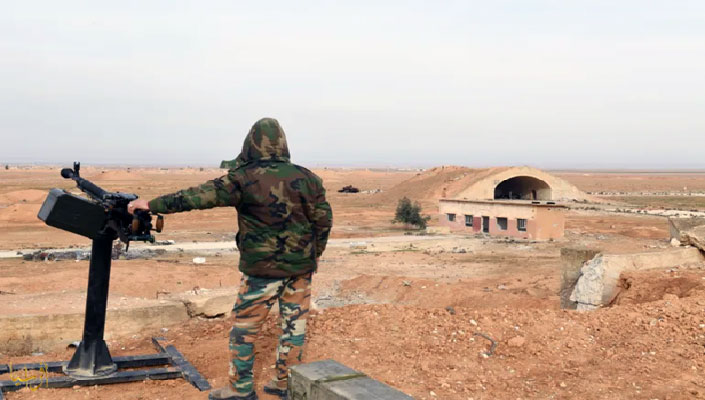
The direct bombardment of the runway of the Abu al-Duhur air base in Idlib province came as an explicit announcement of Israel's transition to an open clash.
Afrasianet - Badi'a Al Sawan - The region is witnessing a new phase of direct confrontation with the Turkish-Israeli friction in the Syrian arena and the eastern Mediterranean moving from the circle of sharp statements and political debates to the square of imposing facts on the ground.
In light of Israel's preemptive bombardment to curb Turkey's military expansion, as Israel says, and the escalation of naval maneuvers off the coast, the situation is heading towards a complex deterrence equation that oscillates between fixing red lines and avoiding a slide into a direct collision.
Public clash in Idlib
The direct Israeli bombardment with several strikes that hit the runway of the Abu al-Duhur air base in the Idlib province in northwestern Syria turned into an explicit and direct announcement of Israel's transition from a strategy of ambiguity to an open clash to prevent any military position of Turkey in the Syrian arena.
On the strategic level, the official statement issued by the office of Israeli Prime Minister Benjamin Netanyahu reflected the seriousness of this shift, as Tel Aviv considered allowing the deployment of Turkish forcesin Abu Duhur an imminent violation of the "status quo" and a clear violation of repeated Israeli warnings .
Netanyahu's office said in a statement that Israel attacked the base because Syria was "on the verge of violating the agreed status quo on security matters by allowing Turkish forces to deploy there."
Israel sees this Turkish air deployment as a prelude to imposing a "no-fly" equation or restriction on the freedom of movement of the Israeli Air Force over Syrian territory, which has prompted it to adopt the doctrine of pre-emptive bombing to stabilize its red lines on the ground, regardless of the political consequences.
On the other hand, the strike was met with sharp condemnation from Ankara and Damascus, which considered the offensive act as aggression, a violation of sovereignty and an unjustified provocation that threatens regional stability, calling on the international community to stop Israeli expansion.
Despite this direct escalation, the US position expressed by Special Envoy Tom Barak has emerged to reflect Washington's concern about this "unnecessary escalation", stressing at the same time that Damascus does not adopt an offensive stance and prefers de-escalation, highlighting the depth of complexity on the ground.
Damascus Novel
In a revelation of the background of the crisis, Syrian Foreign Minister Asaad al-Shaibani refuted the Israeli pretexts taken to launch the strike, stressing – in statements to Axios – that Damascus made it clear to Israel and the Trump administration before and after the strike that there was no intention to establish a permanent Turkish military base or deploy troops at the site.
Al-Shaibani explained that the ongoing work was limited to rehabilitating the facility for the benefit of the Syrian Air Force as part of the military co-operation and training programs conducted by Damascus with several regional and international countries.
He pointed out that linking the strike to the presence of a Turkish military presence at the base is not supported by the situation on the ground.
Al-Shaibani also revealed that there were year-long security negotiations between Damascus and Tel Aviv brokered by the United States, where a "written security agreement was reached" that took into account Israeli concerns, but Tel Aviv later reneged on its commitments, according to Axios.
Despite the strike, the Syrian minister stressed that Damascus's doors are still open to political solutions and a truce conditional on respect for Syrian sovereignty, while US President Donald Trump refused to directly comment on or criticize the strike, saying only that he "knows its details," reflecting the sensitivity of the balances that Washington is trying to manage in the region.
Turkish Position
The head of the Turkish Presidency's Communications Department, Burhanuddin Durán, launched a sharp attack on Israeli Prime Minister Benjamin Netanyahu, stressing that "his threats and lies against Turkey and Syria reflect the extent of his international isolation, political fears and delusions."
Durán explained that Turkey's peaceful foreign policy will ensure "the thwarting of the games of the inconsiderate like Netanyahu, who do not hesitate to ignite the entire region in order to ensure their political future."
In turn, official Syrian sources revealed to the Associated Press new dimensions that preceded the Israeli attack on the Abu al-Duhur military base, as they indicated that a Turkish military delegation visited the base a few hours before it was subjected to Israeli airstrikes, in the first confirmation on the ground of the Turkish presence in this strategic facility to follow up on the ongoing rehabilitation work there.
These developments come in light of the depth of the growing military partnership between Ankara and Damascus, which has been framed by formal agreements, including training Syrian forces and providing them with equipment and logistics.
The Israeli Interior and the Concern of Expansion
The reverberations of the Israeli strikes in Syria did not stop at the borders of regional field and diplomatic movements, but extended to the explosion of a fierce political debate within Israel.
Former Israeli Defense Minister Moshe Ya'alon launched a scathing attack on Prime Minister Benjamin Netanyahu, accusing him of "deliberately keeping the war fronts open and trying to open new ones" in order to evade the formation of a government commission of inquiry into the October 7 failures and hold him accountable.
Ya'alon said in his remarks that Netanyahu ignited tensions with Turkey by attacking the airport in northern Syria, to take advantage of the multi-front military escalation "to serve his political and personal interests, escape electoral entitlements, and hold him accountable judicially and politically."
At the same time, statements by Israeli military officials also revealed the depth of fear about the strategic dimensions of the Turkish move.
In an interview with Israel's Channel 14, Reserve General Uzi Dayan stressed that the increasing Turkish incursion into Syria poses a critical security challenge for Israel in the short and long term.
Dayan explained that Israel fears that at some point the Turks will be able to threaten the demilitarized zone that Israel has established in southern Syria, noting that this zone allows Israel to maintain an "open and clean corridor" for the possibility of launching an attack on Iran.
He added that Israel's concern is not limited to the current Turkish presence, but is also related to the possibility of the formation of what he described as a "Sunni axis of evil" in the face of the axis created by Iran.
Dayan said that Israel has been working for some time to draw a "red line" against Turkish expansion, adding that the Turks know this line, because Israel, according to him, attacks every time they advance a little towards the south.
He pointed out that in the latest case, Israel bombed an airport that he said was inactive and uninhabited, explaining that the aim of the strike was to prevent the Turks from deploying their planes there.
Dayan concluded by saying that Israel strikes when the Turks cross the line it has set, adding that Israel does not often claim responsibility for these strikes, but in the latter case it wanted to send a clear message to Turkey that it is serious about drawing these red lines.
The state of tension within Israel did not stop at the level of political divisions and accusations that Netanyahu deliberately expanded the war fronts, but this concern extended to the depth of relations with the United States, as political circles in Tel Aviv fear the approach of US envoy Tom Barak and his influence on President Trump's decisions, especially with Barak's public warnings of the risk of a direct regional confrontation between Israel, Turkey, and Syria following the Abu al-Zuhur strike.
Israeli sources see Barak as a key supporter of strengthening Syrian President Ahmed al-Shara's position and linking him politically and security to Ankara, ignoring Israeli security sensitivities, according to Yedioth Ahronoth.
The gap between the two sides is widening as the US envoy pushes for Syria's reconstruction and regional integration, as well as the possibility of Turkey restoring its F-35 fighter program, which Tel Aviv considers a major threat to its status and military superiority in the region.
________________
