
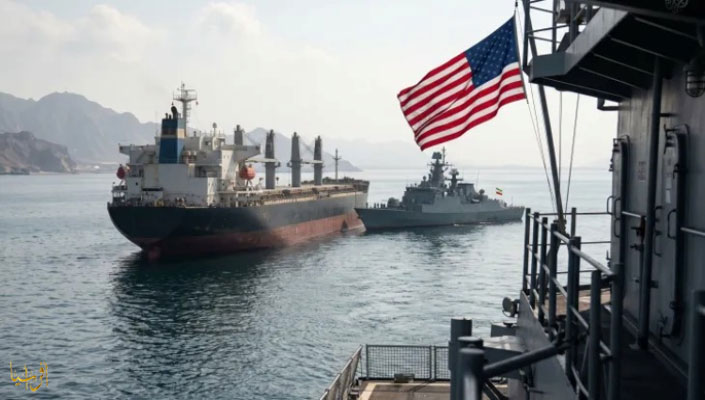
Afrasianet - Ibrahim Darwish - U.S. President Donald Trump confirms that the Strait of Hormuz has become "officially" U.S. territory, and posted on his platform a map showing a circle surrounding the Strait of Hormuz and the territory stretching along its coasts in Oman, the United Arab Emirates and Iran, describing the region as "new U.S. territory."
In a recall of Victory Day, when allied forces landed Its troops on the beaches of Normandy in France and the defeat of Nazism in Germany during World War II.
Days earlier, he threatened to bomb Oman, which is negotiating an agreement with Iran to manage the strait, as Tehran insists on arranging for toll passage.
Frustrated President
Analysts say Trump's inflammatory messages this week reflect a growing frustration, as the president does not appear to see a way out of the war he started himself.
Nearly six months after launching attacks on Iran in cooperation with Israel, and 75 days before the election that will determine whether his party retains control of Congress, Trump finds himself caught up in an open, endless conflict, the kind of war he once claimed he would end.
As The New Yorker magazine (8/20/2026) says, there is no indication that the "American Gulf" announced by Trump will achieve victory before the November elections, as it is still stuck in an unpopular war, which many Americans have even declared their rejection of in his electoral base, in light of the continued cost of living and the increase in oil prices at gas stations.
The United Arab Emirates (UAE) announced the severing of its trade relations with Iran, with many analysts skeptical of the possibility of cutting Iran's financial and economic artery and the connection with the outside world.
This is why the Wall Street Journal (19/9/2028) said that Trump's economic punishment plan will live and die in Dubai, as the United States has encouraged the UAE during the current period of tension to take tougher measures against sanctioned Iranian entities and other networks operating clandestinely inside the UAE.
However, Iran, accustomed to sanctions and economic blockades over the past two decades, has developed what it calls a "resistance economy" and has borders with seven countries through which it can circumvent U.S. sanctions.
Cutting off the UAE's trade ties with Iran will be difficult because so much of the activity takes place out of sight.
Despite the strained relationship between the UAE and Iran, Abu Dhabi does not want to sever ties entirely.
Emirati officials fear that Washington's strategy to destroy Iran economically reflects negatively on sectors of Gulf economies that rely on tourism and trade rather than oil, and could eventually provoke more Iranian military responses.
In its attempts to circumvent the sanctions, Iran has set up a number of trade fronts in the UAE and relied on a "shadow fleet" of aging oil tankers to transport sanctioned crude, while concealing the movements of ships and their ownership structures.
There is another dimension to Trump's economic liberation war, namely the countries that deal with Iran, especially China, which buys most of its oil from Iran, will Trump risk a trade war with Beijing?
The New York Times (20/8/2026) believes that the Trump administration is cautious in pressuring China, especially in light of the upcoming summit, which leaves the door open to the question of the extent of the escalation of the US economic campaign against Iran.
Perhaps the only message observers understood from Trump's recent announcement was that he did not want to go back to fighting with Iran.
The president's problem with his economic war is that he has repeatedly threatened Iran with large-scale destruction, and then backtracked down on that threat.
In June, he also spoke of his fears that a protracted war would push the United States into an economic "depression." In recent months, the Iranian regime has shown its ability to withstand the devastation and heavy casualties left by US and Israeli bombs, as well as the US incurring heavy losses, including attacking oil tankers in the Strait of Hormuz.
Bullying of allies
There is a question about how Iran will respond under such intense financial pressures, especially with the widespread acknowledgement that Trump is seeking to avoid a return to war.
Unable to force Tehran to surrender and declare the victory he was seeking, Trump is increasingly pouring his anger on allies. In the words of the "Washington Post" (20/8/2026), it seems to be concerned about the possibility of concluding a side agreement between Iran and other Gulf countries that would lead to the opening of the strait.
Andrew Lieber, a Middle East scholar at the Carnegie Endowment for International Peace, was quoted as saying, "He is in a predicament from which he cannot get out, and unlike many other situations in which Trump has embroiled himself, there is no one to save him this time."
"This is a problem that cannot be solved by military force or by hollow threats. So, when he can't force Iran to change course, he pours his anger out on others."
Alan Ayer, a former diplomat who was a member of the U.S. negotiating team that struck the 2015 nuclear deal with Iran, likened the Trump administration's actions to that of a "raging mastodon that slowly dives into a hole of bitumen" during the Ice Age.
Ayer noted that the president's remarks this week reflect a state of "frustration at his inability to achieve even the minimum goals, which is to restore navigation in the Strait of Hormuz to normal levels."
While the real reason for the anger at Oman is not understood, Ayer believes that this frustration may be due to one reason: he is "upset with Oman for the same reason that he is upset with South Korea," referring to Trump's harsh criticism of the Southeast Asian ally for refusing to join the war effort, adding, "Neither has succeeded in solving his problem."
Overconfidence
The president's frustration stems from the self-confidence he has entered the war with Iran, only to find himself unable to achieve any of his goals, whether it is regime change or helping the Iranian people, who reassured him at the beginning of the year that "help is coming," instead dropping 1.5 million pounds of bombs on him and killing more than 3,000 people, according to Iranian figures.
The factor behind this confidence was the ease with which Venezuelan President Nicolás Maduro was removed from office in a way that convinced him of the dominant U.S. power.
In addition, Iran and its proxies have been hit hard in Gaza, Lebanon, Yemen and the regime itself in Tehran. For all U.S. military might, Iran feels that it came out of the war much stronger, not only in terms of regime stability, but more broadly, in terms of its self-confidence.
As Johns Hopkins University academic Wali Nasr says, for Iran, the cup is half full, and even if we don't use definitive adjectives like "win" and "lose," it is quite clear that the cup is half empty for Americans.
U.S. power has declined significantly, as the United States has depleted its stockpile of precision-guided munitions and air defense munitions and its military bases in the region have come under heavy Iranian fire, damaging civilians and energy infrastructure across the region.
The new trilateral defense alliance between Saudi Arabia, Turkey, and Pakistan, which Trump has publicly welcomed, is emblematic of a region that thinks outside the United States and seeks to hedge against the uncertainty posed by both a stubborn Iran and an aggressive Israel.
"Everybody now sees America as less powerful than it used to be," Nasr adds. He sees Trump's plight as part of a "sharp collapse of American power and prestige," he says, "once this war is over, the United States will find it very difficult to steer the rest of the world toward any coherent policy."
Elie Geranmaye, a senior researcher at the European Council on Foreign Relations, said: "Trump has thrown himself into a losing war for America."
Remembering the Suez War
The irony is that the US president, who talks about expanding American territory to the Strait of Hormuz, ignores that his war on Iran has in fact ended the real American power in the region, and what is leaked about the Pentagon's plans to reduce the American presence in the region, a number and equipment that indicates that the United States is no longer able to protect its soldiers, in addition to the countries that have spent billions of dollars on preparing the infrastructure to deploy troops on their territories and buy American weapons.
The Washington Post (18/8/2026) revealed that the Pentagon is assessing the losses of its bases in the Gulf and may not rebuild them or repair the damage in them.
It is also considering reducing the number of troops or moving them west to Jordan and western Saudi Arabia or Israel to protect them from Iranian missiles and drones.
On the other hand, the Gulf countries are reconsidering their alliances, and the Mecca Agreement came to reinforce this trend, as the Financial Times (17/8/2026) commented that the war on Iran has reshaped alliances in the Middle East in ways that Trump or Benjamin Netanyahu did not expect.
She noted that Trump had ventured into the future of the Middle East the moment he decided to attack Iran.
Gulf states are reassessing their reliance on the United States as a key guarantor of security after Iran launched attacks on military bases, energy facilities, airports and other infrastructure across the region, it said.
This war has increased Arab and Muslim leaders' fears of Israel as a destabilizing force.
Many see Netanyahu as plunging the region into war with Iran in pursuit of Israeli interests at the expense of regional stability.
Contrary to the expectations of Trump or Netanyahu, their war in the Gulf will not expand the Abraham Accords or make Israel beloved by Arab states. Its anger grew when Ankara applied to Interpol for a red warrant to arrest Netanyahu.
The Mecca Agreement, which Trump welcomed, can even be seen as an attempt to protect America's traditional allies from the whims of the United States, according to an analyst at The Hill (8/20/2026).
Although the agreement seems like a dead letter to some, it is an attempt to protect the signatory countries from America's decisions that do not consult anyone.
The End of the American Middle East
As Mark Lynch pointed out in Foreign Affairs (8/18/2026), Iran's war is the final gasp for a failed American regime in the Middle East. Lynch said the U.S. role in the Middle East was over.
The regional order that has prevailed since 1991 has been one of the victims of the U.S.-Israeli war with Iran. The failure of the United States and Israel to dislodge the regime in Tehran has proven the failure of decades of sanctions and violence.
The United States' inability to protect its Gulf allies from Iranian attacks or to keep the Strait of Hormuz open has seriously undermined the basic security agreement that justified its network of military bases in the region.
Israel's growing threat and abandonment of any pretense of interest in a settlement with the Palestinians have ended Washington's decades-long mission of bringing its Arab allies and Israel together in a lasting security partnership.
The United States' main goal for three and a half decades has been to bring its disparate allies together into a system based on Israel's protection, containing Iran and Iraq at first and, more recently, Iran and its non-state allies. Far from being a deviation from that strategy, Trump's war has brought this strategy to its logical conclusion, seeking to remove the Iranian threat by force all at once.
As U.S. commanders did before the 2003 invasion of Iraq, and before Israel waged its wars against Hezbollah and Hamas, the architects of this war greatly overestimated what military power could achieve, underestimated adversaries' adaptability, assumed that allies would stick to their position, and completely ignored the lives of ordinary people.
Like the Suez crisis of 1956, which is remembered as the final breath of British and French imperial influence in the Middle East, it took years to reach the moment of the end of American influence.
The realities of the Iranian war and the Israeli war on Gaza have already changed the calculus of U.S. allies and adversaries. Another round of fighting or the election of another U.S. president will not fix this rift.
The coming years will bring more controversies. Israel and Iran have a common interest in keeping the Middle East in chaos and violence, and the United States has few means of restraining either.
Israel hopes to expand its de facto borders, including annexing as much of historic Palestine as possible, and imposing its control by force over large swathes of the region.
Assuming the Iranian regime does not collapse anytime soon—which seems highly unlikely—Tehran, increasingly emboldened, will seek to defend and expand its regional influence by dragging Washington into the endless, borderless "gray zone" conflicts in which it has long thrived.
The collapse of the U.S. regime, which was based on protecting autocrats and containing Israel's enemies, may be an opportunity to build a new order based on dealing with the region's problems with openness, but will Israel allow this?
Or to put the question another way, will America exert pressure on Israel to stop its violence, expansion, and sabotage of all efforts it leads in the region?
The State of the Settlers
At the moment, Trump does not seem interested in doing so, even though he has a lot of cards to pressure Netanyahu, as Foreign Policy magazine (19/8/2026) pointed out, whether he supports him in the upcoming elections or stops supporting him.
So far, Trump has not expressed clear support for Netanyahu, while the Israeli opposition has reached out to Trump's inner circle to urge him to withhold support for the current prime minister.
There are several reasons why the Trump administration is reluctant to support, including Netanyahu's failure to help Trump on the Gaza and Iran files, and the latter's troubles inside the United States.
Instead of helping, Netanyahu is trying to start a war in the West Bank by supporting settlers who terrorize Palestinians.
He only moved to send troops to Qusra after the Trump administration urged him to do so because one of the besieged houses was owned by a Palestinian-American. Still, Netanyahu does not mind a war or an intifada in the West Bank as long as it serves his interests.
The Economist magazine (20/8/2026) believes that Trump has the pressure card on Netanyahu, but the latter rejected the Gaza agreement to disarm Hamas and an Israeli withdrawal from Gaza, fearing provoking the anger of the extreme right.
He continued to issue orders for airstrikes on Lebanon and Syria, despite the opportunity to agree on a safer border. He remains true to his hollow promises that he has defeated Israel's enemies, and he does not mind an intifada in the West Bank in the end, as long as it serves the interests of the extreme right and the settler state.
________________
