
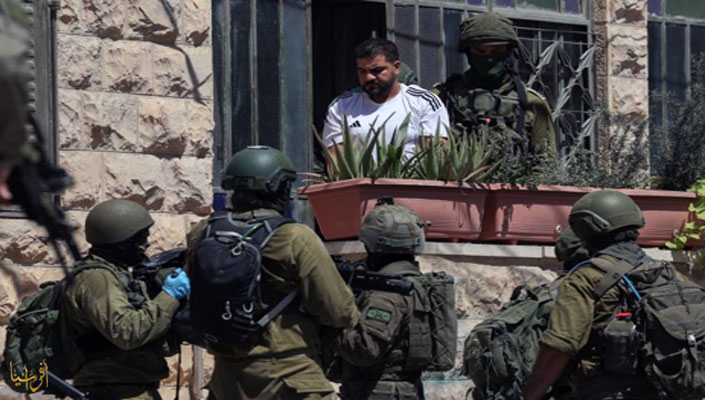
The occupation army arrested about 100 Palestinians during its raid into the town of Anata and Shu'fat refugee camp
Afrasianet - Saeed Abu Mualla - Israel has threatened an "all-out war" in the occupied West Bank, targeting Palestinian Authority leaders and officials, and displacing residents from cities and towns, while two Palestinians were killed in two separate incidents in Nablus and Qalqilya, one on Monday by the Israeli army, and the other during an attack by settlers on Sunday evening.
The threat came from Israeli Defense Minister Yisrael Katz, following a stabbing attack in the "Maoz Yehuda" outpost near the village of Osrin, south of Nablus, in which a settler was moderately to seriously wounded, before the army announced the killing of the Palestinian he accused of carrying out the attack.
According to Katz, the campaign could target senior PA officials, agencies and associated entities, in addition to what he described as "terrorist infrastructures," and threatened assassinations and evacuations of residents from cities and villages from which the occupation says operations, while keeping the army in the areas being evacuated, similar to what Israel has done in areas in Gaza, southern Lebanon, and northern West Bank camps.
The occupation forces continue to besiege the neighborhoods of Shu'fat camp and the town of Anata
The Israeli occupation forces continue to besiege the neighborhoods of Shu'fat camp and the town of Anata, north of occupied Jerusalem, in search of the perpetrator of the Shu'fat checkpoint attack, which resulted in the death of a female soldier and the wounding of 3 others last Saturday.
Meanwhile , a state of tension prevails in the area of Shu'fat refugee camp and the town of Anata, where the occupation forces are trying to intercept a peaceful protest organized by the residents of the camp in northern Jerusalem and neighboring towns to express their protest against the continued siege of the area.
What is happening in the Shu'fat refugee camp and the town of Anata in Jerusalem?
In the middle of Tuesday night, the Israeli occupation army announced the launch of a "concentrated" military operation in the Shu'fat refugee camp and the adjacent town of Anata, northeast of Jerusalem, pushing into the area with military reinforcements accompanied by bulldozers.
The Jerusalem Governorate downplayed the importance of the justifications given by the occupation for its operation, saying that the matter goes beyond security needs to impose political realities and try to erase the camps from existence, as is happening in the northern West Bank.
How did the Israeli operation begin and why?
The operation began with the push of military vehicles accompanied by bulldozers to the camp and the town, with the announcement of the imposition of a curfew, the closure of all entrances, and the prohibition of residents from moving.
In a statement, the Israeli army announced the launch of an operation it described as "concentrated" in Anata and Shuafat to thwart the activity of Palestinian elements and the possession and trafficking of weapons.
He said he would work in Anata and Shuafat as he did in other refugee camps, alleging that Palestinian groups were active.
Since January 21, 2025, the Israeli army has continued a military operation in the Jenin , Tulkarem , and Nour Shams camps, during which it demolished hundreds of homes and displaced more than 33,000 residents.
This comes at a time when the occupation authorities are waging war on the United Nations Relief and Works Agency for Refugees (UNRWA), which handles the affairs of Palestinian refugees in these camps, until they are banned in late 2024 and then seized their headquarters in Jerusalem.
What did the army do during the raid?
According to the Jerusalem Governorate, the raid included:
• Massive deployment of the army into neighborhoods and main streets.
• Raiding and searching dozens of houses and shops, removing their doors and damaging their contents.
• A campaign of arrests of at least 100 Palestinians.
• Preventing the movement of citizens to and from the town and the camp.
• Schools and kindergartens are being disrupted and shops and markets are closed.
• Obstructing the movement of ambulances and transporting chronic cases to hospitals.
All of this has paralyzed the lives of at least 80,000 civilians in the army's area of operations.
What is the Palestinian description of what is going on?
In a statement, the Jerusalem Governorate believes that what is happening is "an attempt to impose the annexation project and expand what is known as the municipal boundaries ahead of the elections scheduled for next October to change the administrative reality of Jerusalem," considering that "the security arguments made by the occupation are weak" and that "military operations are unjustified," and warned of "a dangerous escalation and collective punishments that affect the lives of tens of thousands of citizens and their basic rights."
Omar Rajoub, the governorate's media spokesman, told Al Jazeera Net that the repeated aggression against Qalandia camp and the town of Kafr Aqab, north of Jerusalem, is happening in Shu'fat camp and the town of Anata, considering this "an indication of a broader political and occupation path that goes beyond the declared goals of each separate incursion."
He explained that the issue is not only what is happening inside the camp during the aggression, but also what results from the recurrence of these attacks and incursions in the long term, and the form that the occupation seeks to impose on these areas.
According to the governorate spokesman, the matter goes beyond carrying out arrests or military raids, as the same set of tools is repeated: a large military build-up, closing entrances, isolating areas, imposing curfews, restricting the movement of residents, raiding homes and shops, arrests and field investigations, seizing property, using it for military purposes, and targeting infrastructure and basic services.
When these tools are repeated in different Palestinian camps and towns over a short period of time, Rajoub adds, "we are facing a pattern of control and reshaping of the Palestinian sphere in the vicinity of Jerusalem, not in front of separate events."
Where is the political danger in storming the camps?
From a political point of view, one of the most dangerous things that this type of incursions will produce is the dismantling of the natural relationship between these areas and Jerusalem, or its Palestinian surroundings in general, as the occupation is working to make the movement between the Palestinian communities and their surroundings subject to its military decision, according to the spokesman of the Jerusalem Governorate.
Therefore, Rajoub added, the occupation can at any time close any entrance, impose a curfew, isolate an entire area, or disrupt education, work, trade and services, and this practically means turning Palestinian towns into areas that can be controlled and isolated separately from their surroundings.
Regarding the camps in particular, he said that the occupation seeks to gradually weaken their existence, function and nature, and to transform them from cohesive centers into fragmented, besieged and compressed communities, "and therefore this is a real danger that must be warned of and monitored."
The most dangerous thing is that this path does not affect the camp alone, but also the Palestinian presence in the vicinity of Jerusalem in general, according to Rajoub, who indicated that weakening the camps and towns and isolating them from each other and from the city center contributes to reshaping the demographic and geographical map of Jerusalem, and makes the Palestinian presence more fragmented and less able to communicate and stabilize.
What is the peculiarity of Anata and Shuafat?
The bulk of the land of the town of Anata is under Israeli control, both because it is located within the boundaries of the Israeli municipality of Jerusalem and because it is classified as Area C according to the Oslo Accords, and a few of it is administratively affiliated with the Palestinian Authority.
The mayor of Anata, Taha Numan Al-Rifai, said that the occupation confiscated and seized 90% of the village's lands, and built 5 settlements on it, in addition to deliberately surrounding it with the separation wall.
According to 2025 statistics, the population of Anata is 30,000, including about 13,000 Jerusalemites who hold the Israeli (blue) ID card, which is an Israeli identity issued by the occupation authorities to Palestinians within the borders of the city of Jerusalem as residents rather than citizens.
Shu'fat camp, located 5 kilometers north of Jerusalem between the villages of Shu'fat and Anata, is like a small prison surrounded by bridges above it and the settlements around it.
The camp was established in 1965 on an area of 200 dunums (one dunam is equivalent to 1,000 square meters) and is surrounded by the separation wall, but its land belongs to the boundaries of the occupation municipality in Jerusalem, but it is isolated from it by the wall.
The camp is home to more than 70,000 people, whose origins belong to 55 villages belonging to the Jerusalem, Lod, Jaffa and Ramle areas, and were displaced from them during the Nakba, all of whom carry blue IDs, and are distributed among the camp and 3 other neighborhoods, namely Ras Khamis, Ras Shehadeh, and Al-Salam suburbs.
The camp and its adjacent neighbourhoods suffer from poor infrastructure, lack of water supply, sewage network and paved roads, lack public parks and playgrounds, lack classrooms, services and other social facilities, poor security, and widespread crime and lawlessness.
Jerusalem groans under the weight of the siege
Jerusalemite S.A. cannot hide her extreme concern about her daughter's academic career as she prepares to take the Tawjihi exams in Jerusalem, and about the fate of these exams, which will be held under the state of emergency due to the war raging between Israel andIran.
The family lives in the Kafr Aqab neighborhood behind the apartheid wall, and the school where they will take their exams in the town of Beit Hanina is located inside the wall, which requires passing through either the Qalandia checkpoint or the military packages.
The student joins thousands of other Jerusalemite students whose exam schedules have been modified due to the IDF's Home Front recommendations to close places of study until Saturday, June 21, the date of the first high school exams.
Although all exams are allowed to be held on time, provided that they are in schools with shelters, access to the halls on time is the biggest dilemma for students as the city tightens its grip and closes more entrances to the villages and towns surrounding Jerusalem.
Mobility subject to mood
On June 15, the third day of the confrontation between Israel and Iran, the Israeli occupation army installed two gates at the eastern and western entrances to the town of Hizma, northeast of Jerusalem, while another gate was erected on June 18 at the northeastern and only entrance to the town of Anata, also northeast of the city.
Most of the residents of the town of Hizma carry the Palestinian West Bank (green) ID, while some residents of Anata carry the Israeli (blue) ID, and the two towns have been turned into a large prison by the occupation force, according to the residents' description.
For his part, the mayor of Hizma Nofan Salahuddin told Al Jazeera Net that all the entrances to the town are now closed with gates or concrete blocks, after the southern entrance was closed after October 7, 2023 with an iron gate and cement blocks, the eastern and western entrances, which are only 200 meters away from each other, were also closed with iron gates.
"Some 10,000 Palestinians have been forcibly imprisoned, half of whom are workers, employees, school and university students who are forced to leave the town for different destinations, and their movement is now dependent on opening or closing the gates."
Salah al-Din added that the people of Hizma depend on the cities of Ramallah and Jerusalem for medical treatment and reviews, and now access to the two cities has become very difficult, as the checkpoints towards the city of Ramallah are closed most of the time, such as the Jabaa and Beit El checkpoints, and access to Jerusalem hospitals requires special permits and coordination, and therefore the siege of the town seriously affects patients and the elderly with chronic diseases.
90% of the town is sourced
The mayor touched on the restrictions that have been going on for years, saying that its historical area is 10,400 dunums (a dunam equals 1,000 square meters), and that the residents have been confined to living on an area of 1,000 dunams only.
He added that "half of the village's lands were isolated after the construction of the wall and are located inside it, and the other half is classified as B and C according to the Oslo Accords, and in the current period the town is surrounded by settlements, especially the roads that were built for the settlers in the settlement of Adam, Pisgat Ze'ev, Neve Ya'akov and Alamon."
Since October 7, when the war broke out, Hizma has been witnessing an attack targeting 3,000 dunums in the Eastern Province with "pastoral settlements", which has led to the displacement of families living in that area for hundreds of years, and access to those lands is no longer available.
For his part, the media advisor to the Jerusalem governorate, Maarouf al-Rifai, who hails from the town of Anata, said that the number of residents who were directly affected by the erection of the new iron gate ranges between 40 and 50 thousand people, in addition to the residents of Dahiyat al-Salam, Shu'fat camp, Ras Khamis and Ras Shehadeh, who prefer to pass through the entrance to this town, instead of the Shu'fat camp checkpoint due to the great restrictions on it.
Therefore, about 130,000 citizens use this road daily, and this gate will control their movement, because its opening and closing is subject to the mood of the occupation army, according to Rifai.
85 obstacles around the city
The gate was placed at the northeastern entrance to Anata and turned the town into a large prison, and this arbitrary step reminded of the harsh conditions suffered by the residents of Shu'fat camp in its five neighborhoods, whether through demolitions or repeated incursions and the accompanying arrest campaigns.
Rami Saleh, director of the Jerusalem Center for Legal Aid and Human Rights, began his speech by saying that there are currently 85 obstacles around the city of Jerusalem, including military checkpoints, earthen berms and iron gates, the latest of which has been installed at the entrances to the towns of Hizma and Anata, with the aim of preventing Palestinians from reaching the city and dismembering the holy city from its geographical, natural and social extension.
As human rights defenders, they see this as a violation of international law and fundamental human rights, especially with regard to freedom of movement and easy access for patients to clinics and hospitals in a timely manner and worshippers to places of worship, he said.
He added: "Through our various meetings with the local community, we confirm that these checkpoints have prevented the continuation of proper social communication, and we point out that the number of visitors to the center, especially those coming from north Jerusalem, whether from Shu'fat or Kafr refugee camp, has declined to zero."
________________
