
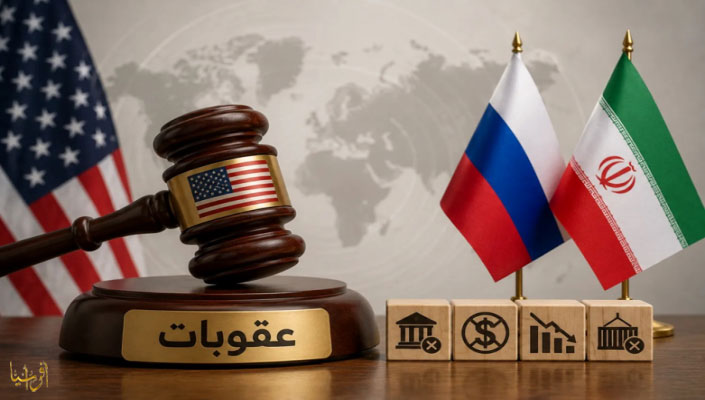
Afrasianet - A visitor to the U.S. Department of the Treasury's Office of Foreign Assets Control (OFAC) finds a list of more than 35 countries and economic entities on which the United States has imposed various sanctions, some of which date back to the agency's founding in 1950.
The headlines start with Afghanistan, Belarus, Burma, and Libya, and hardly end with Russia, North Korea, Nicaragua, and Iran, and are not absent from countries allied with the West such as Ukraine, or have undergone a U.S. invasion such as Iraq and Venezuela.
Especially when it includes the diamond trade, the judges of the International Court of Justice and Criminal Court, and the science of nuclear programs, it is an explicit declaration of the inability of sanctions to bring about a fundamental change in the structure of the sanctioning body, and their impact on direct victims who are not responsible for policies or regulations, in addition to the opposite results in terms of the development of industrial and commercial production networks that go beyond the effects of sanctions.
This situation has already been recorded by sanctions imposed on Iraq before the US invasion in 2003, on the ruling military junta in Myanmar, and on the Russian Federation.
Perhaps the clearest evidence of the fiasco is that the International Monetary Fund acknowledged, in April 2024, that Russia's economy will grow faster than any economy in the developed world, including the United States itself.
If the sanctions, which came in response to Russia's special military operation in Ukraine, weakened the ruble slightly, the overall effects remained limited in most sectors.
Washington does not rule out the resumption of military force.Having repeatedly made statements by senior US officials about achieving "victory" over Iran, since the start of the US-Israel war on February 28, the Treasury secretary did not back down, calling the latest series of sanctions "Economic Victory Day", in advance and even before the implementation of one step of the "economic strangulation" attack, as the White House put it.
As a justification for launching it, the US administration has practically accomplished nothing but the loss of thousands of innocent lives and the mass destruction of Iran's civilian infrastructure, the closure of the Strait of Hormuz, which was open before the aggression began, and the severe damage to the global economy and energy supplies.
It is no secret that the latest American tour addresses the American interior first, as the popularity of the American president, like the legitimacy of the war, is falling to low levels, and the specter of the supplementary congressional elections hangs over the entire scene.
A new item added to the OFAC list is therefore not more often, although little of it weighs on the Iranian people's blackness and adds a new war crime to the White House's busy records.
________________
