
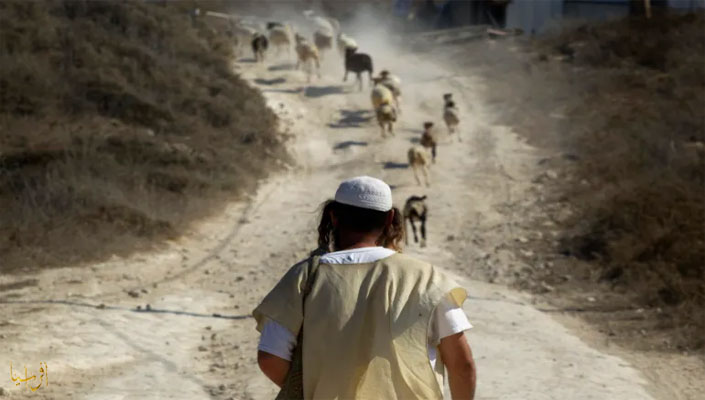
Even the theft of sheep has become a daily practice and a target of settler attacks
Afrasianet - Anas Zaki - The aggressions of the Israeli occupation have never been new news since its heavy feet set foot in the land of Palestine with the help of Western countries, especially Britain, in 1948.
That year, Israel was established on Palestinian land occupied by armed Zionist gangs that committed massacres and displaced at least 750,000 Palestinians, before Israel occupied the rest of the territory and refused to withdraw from it.
Even with the genocidal war on the Gaza Strip that began on October 7, 2023 and has continued until now, the West Bank has not been immune from the occupation's aggressions, despite the Palestinian Authority's insistence on what it says is the option of peace and diplomacy.
Therefore, the escalation that has been witnessing in the occupied West Bank for weeks is not new, but what is new is that this occupation, with its army and Jewish settlers, has exceeded all limits in its attempts to abuse the owners of the land, and even affected animals and plants.
For many years, the news of the incursions into the camps and cities of the West Bank has been a common denominator that is almost absent, and it has often been accompanied by arrests by the occupation targeting those who deliberately resist or are thinking about it, not to mention the demolitions of the homes of those who carry out an act of resistance to the occupier, even if it is a reaction to the action.
However, the past weeks have shown that the occupation's reaping of aggression is not running out, and that it no longer finds a deterrent from international law or norms, in light of a state of silence that has engulfed the world and its inhabitants only a little.
Take the tally of last July, according to the Palestinian Commission for Resistance to the Wall and Settlements (government), which confirms that during this month, the occupation army and settlers carried out 2,256 attacks against Palestinians, their lands and property, of which the army forces accounted for 1,458 and the settlers sponsored 798 attacks.
The Authority says that settler attacks in the West Bank increased by 63% during the first 7 months of this year, compared to the same period last year, as the number increased from 2524 during the first 7 months of 2025, to 4113 attacks during the same period this year.
What happened?
The Nablus governorate, specifically the villages of Qusra and Jalud, were the scene of a renewed pattern of settler attacks, which began to act undeterred, under the protection of the army, which declared the area a "closed military zone."
Siege
The settlers are no longer satisfied with attacks from time to time, this time dozens of them have been besieging three houses in the Ras al-Ain area of the village of Qusra for the past three weeks, and carrying out what Israel Hayom described as riots that threaten to ignite tensions.
The settlers prevent the villagers from reaching their homes, while the owners insist on staying there for fear of the settlers taking control of them, especially with the complicity of the occupation army.
Gas & Stones
On Saturday, dozens of settlers attacked a Palestinian house in the Ras al-Ain area of the village of Qusra, fired tear gas canisters at it and threw stones at it, injuring 7 Palestinians with suffocation and bruises.
A number of masked settlers also moved from Qusra to the nearby village of Jalud and attacked its residents, raising the number of injured in the two villages to 9 Palestinians as well as two foreign journalists.
Interestingly, the Israeli army fired tear gas canisters at Palestinians immediately upon its arrival in the area, and then arrested and tied up a number of them, without arresting any of the settlers.
Burning and displacement
The deliberate arson of Palestinian property has become one of the systematic forms of the occupation's aggressions, as the Palestinian Commission for Resistance to the Wall and Settlements confirms that it has documented 900 fires targeting Palestinian homes, facilities, and vehicles since the beginning of 2023, and that the settlers are responsible for 89% of these fires.
According to the same authority, the same period witnessed the displacement of 121 Palestinian communities, fully or partially, including 46 that were completely emptied, which led to the displacement of more than 6,200 Palestinians, including more than 3,000 children, under a "government enabling environment" that provides protection to settlers and contributes to their impunity.
The report described the escalation of arson and vandalism as part of a policy of "coercive and expelling environment" that aims to create harsh living conditions that push Palestinians to leave their areas by restricting their access to their land and water sources.
Ambulance detention
Even the medical facilities are not spared from the settlers' attacks, as are the ambulances that settlers stopped while they were heading to the village of al-Mughayyir, northeast of Ramallah , in the central West Bank, to transport the injured as a result of the attack launched by the settlers.
Settlers prevented Palestinians from al-Mughayyir and the nearby village of Abu Falah from returning to their homes, while the Israeli army deployed in the area and clashed with Palestinian youths who tried to confront the citizens.
The occupation army was no better than the settlers in terms of targeting the ambulance, as it detained medics affiliated with the Palestinian Red Crescent Society who were on their way to transport the bodies of martyrs targeted by an Israeli raid on a house in the city of Jenin.
Sheep theft and logging
As if the settlers' attacks have become borderless in terms of laws or customs, human beings are not the only targets, but also their livestock property, which is what happened in the village of Al-Mughayyir, when settlers broke into a house and stole sheep from inside.
This was not the first time settlers had done this before in the same village when they stole about 150 sheep last April, according to Quds Press.
Not only the animals, but also the plant is not spared from the Jews, as happened on Friday in Khirbet Farasin, southwest of Jenin, when they cut down about 450 guava trees, and destroyed parts of the irrigation network and the fence surrounding the agricultural land.
The official Palestinian news agency (Wafa) quoted the owner of the land, Ali Amarna, as saying that the same land was previously planted with olive trees before the settlers attacked it and uprooted it.
Settlers also vandalized a Palestinian farm in Jenin governorate and tried to destroy the fence surrounding the land, as well as cutting down fig trees in the Arraba plain in the south of the governorate.
Prohibition of Prayer
Is there anything else that the settlers have not done that people denounce and that other customs reject?
Yes, they prevented Palestinians in Khirbet Tana in the town of Beit Furik in the Nablus governorate from going to the Al-Wali and Hajj Hussein mosques to perform Friday prayers a few days ago.
The municipal council of Beit Furik explained that a group of settlers dressed in the Israeli army stormed the eastern area of the town and prevented Palestinian citizens from going to pray.
Israeli Descriptions
Interestingly, the Israeli escalation in the West Bank, which comes in the midst of an internal conflict as the Knesset elections scheduled for October 27 approach, has been heavily criticized by opponents of Prime Minister Benjamin Netanyahu, who see it as a release of settlers in the West Bank in order to win more far-right votes.
The number of settlers in the West Bank and occupied East Jerusalem is estimated at more than 750,000.
Some Israeli politicians have come up with descriptions that may not have been issued by Palestinian and Arab tongues, and the following are the most prominent examples of them in the past few days:
• Israeli President Isaac Herzog criticized the settlers' attack on the village of Qusra in the northern West Bank, describing it as "a crossing of the red line and a stain on Israel's face."
• Opposition leader Yair Lapid called the attackers "a moral stain on the State of Israel" and said in a statement that the government's failure to deal with them was "a national disgrace that inflicts enormous damage on Israel's standing in the world."
• Lapid even used the term "terrorism" when he said in his statement that "the time has come to put an end to settler terrorism in the West Bank."
• IDF Chief of Staff Eyal Zamir has warned Netanyahu of the possibility that the situation in the occupied West Bank could spiral out of control due to settler violence, according to Israeli media.
• Channel 15 quoted an unnamed senior Israeli military official as saying, "We are about to lose control, everyone is doing what they want," referring to the settlers.
• Netanyahu, on the other hand, appeared to be trying to contain the situation when he spoke in a statement yesterday in which he spoke of what he described as "criminal acts of violence carried out by a handful of hooligans."
According to the Anadolu Agency, Netanyahu did not address the injury of Palestinians or the role of the army in protecting the settlers, but rather focused that the attacks "impede the work of the army and harm Israel's standing in the world."
The agency adds that Netanyahu's condemnation of the attacks comes despite Yedioth Ahronoth's revelation on Friday that during a security meeting held last Monday, he did not want to hear details related to the settlers' attacks.
Systematic policy
But beyond the statements, Israel continues its repressive policies toward the West Bank.
The Israeli occupation continues to insist on refusing to return 33,000 Palestinians to their homes in the Jenin , Tulkarm and Nour Shams refugee camps in the north of the occupied West Bank.
A few days ago, the Israeli government informed the Supreme Court that the military was refusing to allow Palestinian citizens to return to their homes in these camps, in response to a petition filed by an Israeli association that said Palestinians had been suddenly evacuated from their homes in a sudden, violent and humiliating manner.
In response, the Israeli army said that it is also preparing to maintain what it described as "long-term operational control" in the area, a year and a half after the start of the military operation in January 2025.
According to the Israeli newspaper Haaretz, the army plans to take control of the roads connecting the refugee camps, and in June began work on the establishment of a new military site near Jenin, in an area that has supposedly been under the full civilian and security control of the Palestinian Authority since the Oslo Accords.
Under the 1995 Oslo II Accords, which were supposed to be a temporary arrangement, the West Bank was divided into three areas: A, B, and C, where A is under full Palestinian control, B is under Palestinian civilian and Israeli security control, and C is under full Israeli occupation, making up about 60 percent of the West Bank.
According to UN data provided in the petition, more than 33,000 Palestinians remain displaced from their homes.
Israel has occupied the West Bank, including East Jerusalem, since 1967, and some 750,000 settlers reside in 156 settlements and 360 outposts, and commit attacks aimed at forcibly displacing Palestinians.
For years, the occupied West Bank has been witnessing intensified attacks by the Israeli army and settlers against Palestinians and their property, and the situation has escalated for weeks as the Israeli general elections approach on October 27.
Settlements in the heart of Ramallah's controlled areas. What is left of the so-called Palestinian sovereignty?
The expansion of Israeli settlements in the occupied West Bank is accelerating, this time exceeding the borders of Area C, to reach the heart of the areas that, according to the Oslo Accords, are supposed to be under the control of the Palestinian Authority, civilian, security or at least civilian.
As the outposts expand within areas classified as "B", and there are indications that settlements have reached Area A, the image of "Palestinian sovereignty" on which the PA was founded is increasingly declining, appearing in front of a reality on the ground imposed by the occupation without any real ability to prevent it.
With Israeli political and government support, the settlers are seeking to establish more outposts across the West Bank and entrench their presence within Area B, which is supposed to be under civilian control.
In this context, the Hebrew newspaper Haaretz, in a report published on Thursday, revealed that the Israeli government is trying to attribute the violence in the town of Qusra, south of Nablus, and other areas to a small group of extremist settlers, but the facts on the ground point to more than just individual movements.
Dozens of hotspots within the authority areas
According to the report, at least 30 outposts have been established over the past two and a half years in areas under the authority's jurisdiction, most of them within areas classified as "B", in a phenomenon that appears to be organized and deliberate, and enjoys broad support from right-wing lawmakers in the Israeli Knesset.
The inaction of the occupying forces is a structural part of this scene, while new outposts are being established along the road axes, on the tops of the mountains, and near the new Palestinian communities and construction, thus establishing a new reality on the ground.
The details indicated that at least one outpost would be established within an Area A, while the other outposts were chosen for strategic purposes, including thwarting Palestinian expansion and construction and imposing new restrictions on the movement of Palestinians.
Despite the portrayal that Tel Aviv is trying to present of these moves as separate or unofficial settlement initiatives, the facts point to cooperation with the occupation army and the full support of Knesset members.
As settlement expansion continues, the new phase appears to be aimed at shifting the process of dispossessing Palestinians from Area C to areas that are theoretically within the scope of the PA's work.
Increasing settlement incursions
Areas A and B make up about 40 percent of the West Bank, and since 2024 they have been relatively far from establishing new outposts. Attempts to expand outposts from Area C into Area B were previously thwarted by orders from the Israeli Civil Administration.
However, this reality changed during the current tenure of Benjamin Netanyahu's government. Initially, the new outposts were established in Area B adjacent to Area C, before gradually infiltrating deeper into areas under the authority of the Palestinian Authority.
In the summer of 2025, research organizations monitored about a dozen outposts in areas under the authority's authority, most of them within a nature protected area that has been agreed to ban construction under the Wye River agreements.
In parallel, the authority to plan and enforce building laws within the reserve has been withdrawn, while other enforcement powers in Areas A and B related to the environment, antiquities and water have been transferred to the Israeli Civil Administration this year.
Prior to this boom, such outposts were considered extremist and pariah even according to the Israeli concept, but the rapid increase in their numbers, amid the occupation's disregard for the laws and procedures that are supposed to prevent them, along with the repeated rounds of support carried out by members of the government coalition, have turned them into an increasingly present part of the scene in the West Bank.
Last January, the Israeli army announced that 42 outposts had been established "without the approval of the political level" and that they were responsible for about 90% of what it described as a "national crime" in the West Bank, referring to settler attacks.
However, a report by the rights group Yesh Din indicated that most of these attacks took place in areas classified as "A" and "B".
Authority without Authorization
These developments re-raise the question of what is effectively left of the powers of the Ramallah Authority, after areas supposedly under its control have become the scene of settlements, confiscation, demolitions, and direct Israeli intervention.
The reality on the ground, in light of the Oslo Accords, reveals a continuous erosion of Palestinian powers, to the extent that the PA appears, according to the description used by the late chief negotiator Saeb Erekat, "an authority without authority."
PA President Mahmoud Abbas has also acknowledged on more than one occasion that the PA is working "under the rugs of the occupation" and that his movements to and from Ramallah, and even to his office, are linked to the occupation's procedures and approvals.
But the larger paradox is that the PA, which was originally based on the Oslo arrangements, is still unable to protect the territories within its jurisdiction from Israeli settlement incursions.
The Oslo track shows that the Ramallah Authority was designed from the outset within the framework of a limited autonomous administration, similar in many aspects to the "Civil Administration" established by the occupation, and that its powers remained linked to the will of the power controlling the ground.
With the start of the Oslo negotiations, the arrangements focused heavily on security aspects, while effective control over land, crossings, movement and resources remained in the hands of the occupation.
From this standpoint, the continuation of coordination and security arrangements, in contrast to the continuation of settlements and their incursion even within Areas A and B, deepens the PA's crisis and raises increasing questions about the nature of the role it plays.
As the outposts gradually move to the heart of the areas supposedly under Ramallah's jurisdiction, "Palestinian sovereignty" seems more like a political address with no substance on the ground.
Settlements are expanding, land is being confiscated, and the PA's powers are shrinking, while the occupation continues to impose facts on the ground, leaving the PA facing a clearer reality: even areas that once bore the title of "areas of Palestinian control" are no longer immune from Israeli settlements.
________________
