
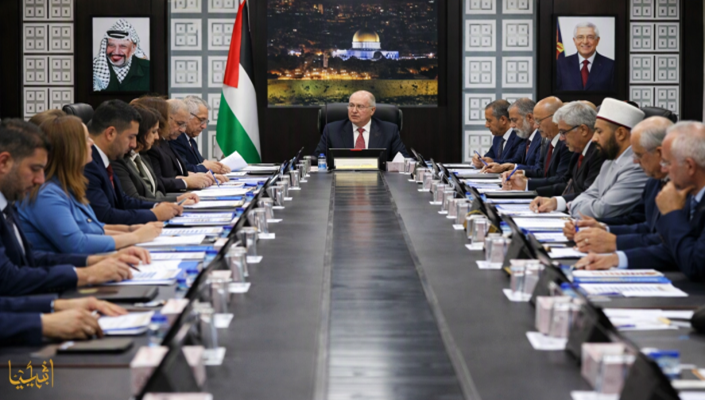
Afrasianet - Israeli actions in the West Bank continue on more than one track, from restricting the movements of senior officials of the Ramallah Authority to accelerating settlement projects and land seizures, to expanding the policy of withholding clearance funds, amid questions about what remains of the sovereignty of the Authority..
The Israeli army on Wednesday prevented the Prime Minister of the Ramallah government, Mohammed Mustafa, from reaching the area of Barak Suleiman, south of Bethlehem, after MK Zvi Sukkot announced his intention to go to the area to protest the ceremony of laying the foundation stone of a mosque that was scheduled to be built there.
The decision is the latest indication that the Israeli authorities continue to control the movement of Ramallah Authority officials inside the West Bank, as the implementation of the visit remained subject to Israeli security approval, which ended up preventing it.
This reality raises many controversies in light of the keenness of ministers and officials in the Ramallah Authority to flaunt the processions and positions, while the mere fact that their passage from Ramallah to any other city in the West Bank remains subject to military approval from the occupation.
In parallel, a joint report issued by the Israeli organizations Peace Now and Kerem Nabot titled "The Three Years of Obesity... The Israeli government's actions to annex the West Bank between 2023-2025" indicate an unprecedented acceleration in the steps of settlement expansion since the formation of the current Israeli government.
The report began by referring to Article 37 of the Israeli government's coalition agreement, which states that "the Jewish people have an exclusive and inalienable right throughout the Land of (Israel)," with the government pledging to support, develop and promote settlements in the Galilee, the Negev, the Golan and the West Bank.
According to the report, between 2023 and 2025, about 185 new outposts were established in the West Bank, including 130 agricultural outposts and settlement hills, while these outposts now control more than 170,000 dunams, or approximately 18% of the area of the West Bank.
Israeli settlement expansion
The report pointed out that in 2025 alone, about 300,000 dunums were added to the areas controlled by settlers through agricultural outposts, explaining that about 60% of these lands are not classified as state lands, but include private lands, endowments, and lands that have not been completed in the settlement procedures.
The report also documented the displacement of 118 Palestinian herding communities over the past three years, due to the escalation of settler attacks, and the denial of herders access to pastures and water sources, in the absence of effective protection from law enforcement authorities.
In the settlement construction sector, the report indicated that plans for the construction of 40,064 settlement units have been approved during the past three years, of which 27,941 units will be completed in 2025 alone, a figure that is more than double the previous annual rates.
He added that during the same period, the settlers took control of about 11,500 dunums for agricultural purposes, by ploughing and cultivating land and preventing Palestinians from accessing it, in addition to building at least 223 kilometers of new dirt roads throughout the West Bank after October 7, 2023, in addition to developing tens of kilometers of existing roads.
According to the report, the Israeli government has also declared about 25,959 dunams of state land over the past three years, an area equivalent to nearly half of the total land declared by Israel as state land since the signing of the Oslo Accords.
The report also noted that the Israeli government has allocated 244 million shekels to complete procedures for regulating the legal status of the West Bank in the West Bank, with its authors warning that such a move could lead to the dispossession of large areas of land for Palestinians.
Palestinian Financial Crisis
On the economic front, financial pressure on the Palestinian Authority continues through clearance funds, with the Israeli Knesset approving the first reading of a bill that would allow for the freezing of additional amounts of funds owed to the Palestinian Authority.
The bill stipulates the withholding of sums equivalent to what the Israeli government says the PA has transferred, and that the frozen funds will be used to compensate victims of attacks attributed to the Gaza Strip, and the bill passed with the approval of 12 lawmakers without registering any opposition.
In the same context, Haaretz reported that Tel Aviv is currently withholding about 14 billion shekels of Palestinian tax money collected on behalf of the PA, noting that this policy has been ongoing since 2019, with about 400 million shekels added to the amounts withheld monthly.
Taken together, these developments point to the continued use of security, administrative and economic tools in parallel with the acceleration of settlement activity, at a time when restrictions on the work of the PA are increasing, which in turn is committed to continuing security coordination and refusing to take any reaction against Israel's aggressive actions.
