
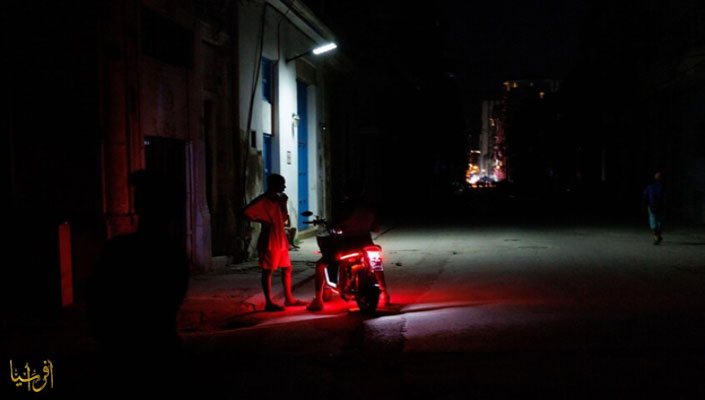
Afrasianet - Democratic members of the U.S. Congress who visited Cuba described U.S. President Donald Trump's energy blockade on the island as turning Cuba into what they described as a "silent Gaza."
The United States imposed an energy embargo on Cuba in January, following the arrest of Venezuelan President Nicolás Maduro, and Washington has threatened to impose tariffs on other countries that sell fuel to the island, further exacerbating a five-year-old humanitarian and economic crisis caused by previous sanctions and failed domestic policies such as currency unification.
Cuba's power grids disrupt again
Reps. Mark Buchan of Wisconsin, Teresa Leger-Fernandez of New Mexico, Maxine Duster of Oregon and Delia Catalina Ramirez of Illinois arrived in Cuba last Thursday for a visit that lasted until Monday, which included a meeting with Cuban President Miguel Díaz-Canel, the second such visit by U.S. representatives in just three months.
The four lawmakers told reporters that they also met with Cuban ministers, medical professionals, and business leaders, and toured the streets of the capital, Havana, but clarified that there are currently no bilateral talks between Washington and Havana, when asked about the progress made in the bilateral dialogue aimed at lifting the energy embargo. "I think Marco Rubio makes this personal, not professional," Rubio said, referring to Rubio's background as the son of Cuban immigrants and growing up in Miami under the influence of anti-Castro exile groups.
In a remarkable development, the 95-year-old grandson of former Cuban socialist leader Raul Castro, Colonel Raul Guillermo Rodríguez Castro, recently offered himself as a mediator with Trump, secretly meeting with Rubio on the sidelines of the Caribbean Community summit in St. Kitts in February The past reflects behind-the-scenes attempts to ease tensions between the two countries.
Trump and Rubio have indicated that they hope the energy blockade will strangle the island's government, which they accuse of inefficiency and mismanagement of the economy, in return, the Cuban authorities have denounced the blockade as collective punishment that affects the entire Cuban people, and the consequences on the ground are very tangible, with Cubans suffering power cuts for more than 20 hours a day, limited public transportation, flight cancellations, a sharp decline in tourism, reduced working hours, and general paralysis in the Everyday life, which makes the daily life of Cubans more like constant suffering.
The U.S. lawmakers condemned the devastating impact of the energy blockade, and Buchan said that someone he spoke with in Cuba described the current situation as "silent Gaza," a description that Buchan considered "appropriate" to the reality that Cubans are living in. Léger-Fernández It is "absolutely illogical to force a country to suffer" in such an inhumane way.
Dester, who is also a certified physician, and Ramirez announced that they will work to promote amendments in the U.S. Congress aimed at mitigating the health impact of the embargo on the Cuban people and preventing any further actions by Trump without legislative authorization, such as the military operations that the president has repeatedly threatened, reflecting efforts within the U.S. legislature to curb the Republican administration's hardline policies toward Cuba.
Cuba again appeals to the United Nations to lift the US embargo
Cuban President Miguel Díaz-Canel announced that his government would once again go to the United Nations General Assembly to put forward a resolution calling for the lifting of the US trade and economic embargo.
Díaz-Canel wrote in a post on the "X" platform that Cuba annually submits to the United Nations General Assembly a resolution calling for an end to the blockade imposed more than 60 years ago, noting that this step stems from Havana's belief in multilateralism and the United Nations as a mechanism for settling disputes.
"Since we believe in multilateralism and the United Nations as a mechanism for settling disputes, and also because the blockade has reached an unbearable level with the aim of provoking a social explosion, we will once again turn to the General Assembly," he said.
The initiative has the traditional support of the vast majority of UN member states, with 187 countries voting last November in favor of a similar resolution, with the United States and Israel abstaining, and only Ukraine voting against the resolution.
However, the decisions in this regard are of a "cosmetic" nature and are not legally binding on the United States, which continues to impose the embargo regulated by the Commercial Embargo of Cuba Act of 1963 .
It is estimated that losses from the U.S. blockade, according to Cuban official data, have exceeded $154 billion, with losses last year alone amounting to about $4.8 billion. Cuba is facing severe shortages of fuel, medicine and food, with frequent power outages, with what the government describes as a "suffocating blockade policy" aimed at forcing Havana to change its policies.
President Donald Trump's administration has tightened sanctions on Cuba, accusing it of supporting undemocratic regimes and that Havana threatens U.S. national security, while Havana has stressed that it will not give up its revolutionary principles no matter how intense the pressure.
Cuba is due to present its annual draft resolution to the U.N. General Assembly at its next session, in a bid to boost international pressure on Washington to lift the embargo.
________________
