
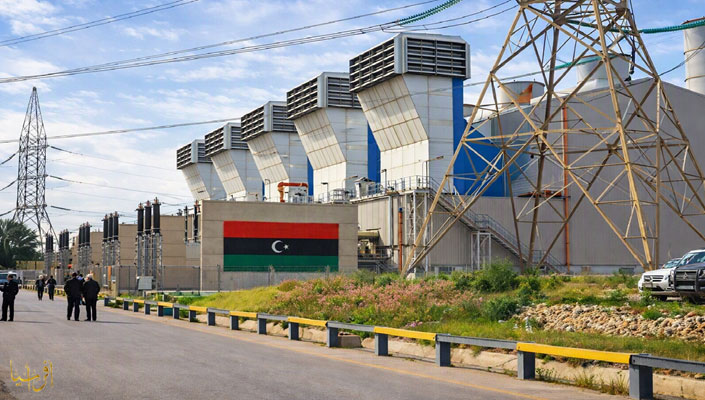
A crisis waiting for solutions.. Protesters called for the departure of all current bodies and leaders, calling for urgent measures and radical solutions to the worsening service crises.
Afrasianet - Al Habib Al Aswad - The capital Tripoli and all cities in western Libya witnessed widespread popular protests and the closure of institutions, with the threat of entering into a full-scale civil disobedience as a result of the deterioration of services, especially in the field of electricity coverage.
The protesters called for the departure of all current bodies and leaders, calling for urgent measures and radical solutions to the worsening service crises, stressing that the current situation is no longer sustainable.
They also called for the overthrow of the government of Abdelhamid Dbeibeh, which has been unable to play its role in managing public affairs and providing the necessary services to the local population.
The Protection and Security Force of the Prime Minister's Office tried to calm the situation by calling on Libyans not to be dragged behind rumors and calls to stir up chaos, which observers saw as a call to the protesters not to advance and erase the headquarters of the government and control it.
According to eyewitnesses, protesters blocked the highway west of the Tripoli University Bridge using a truck, as part of the protest movements in rejection of the continued power cuts and the deterioration of the situation.
They also closed the headquarters of the Ministry of Foreign Affairs of the outgoing unity government, and the headquarters of the Libyan National Television Channel in the Zawiya al-Dahmani area with earthen berms in protest against the prevailing situation.
The protesters succeeded in closing the headquarters of the accounting debts in the Dhahira area of the capital Tripoli, the highway and a number of main roads in the areas of Tajoura and Souq al-Juma, as well as closing a number of ministries, service institutions and banking headquarters, in an attempt to pressure the authorities to respond to their demands.
The youth of the Friday Market Movement closed the headquarters of the Telecommunications Holding Company in the Al-Nawfaleen area of the capital with earthen berms, in protest against the deteriorating conditions suffered by citizens, and demanded the overthrow of the Dbeibah government.
The movement announced the start of a comprehensive civil disobedience, including the closure of state institutions within the region, stressing that the movements will be peaceful and will not target public roads or property, explaining that the beginning will be the closure of a number of public institutions and companies, including the "Libyana" and "Al-Madar" telecommunications companies, all the way to the branches of the Central Bank of Libya, before expanding the movements inside Tripoli.
For its part, the Tajoura Sons Movement announced that the region has joined the comprehensive civil disobedience, stressing in a statement that the movements will continue until "the overthrow of the governments in the east and west of the country."
Since Sunday evening, the Libyan capital Tripoli has been witnessing a wave of widespread protests, which reached the declaration of civil disobedience in a number of areas, amid demands for the resignation of the Dbeibah government.
The demonstrators demanded that all those responsible for wasting billions of dinars of public funds, deteriorating livelihoods, and the collapse of services be held accountable.
Protesters from the cities of Gemayel, Zaltan, Raqdalin, Zuwara and Al-Ajilat in the far northwest of the country carried out their threats to desecrate the complex and prevent workers from entering it, as part of a protest movement that was previously announced to demand the treatment of the deteriorating service conditions.
This came hours after a statement in which residents of the cities of Zuwara, Gemayel and Raqdalin, which border the common border with Tunisia, threatened to close Mellita once and for all if the loads continued.
In a statement, they announced that they would enter the sit-in in protest against the continued power cuts for many hours, in light of the exacerbation of citizens' suffering as a result of repeated loads.
They said that they agreed to give the company one last chance to respond to their demands, and if the loads continue to be put out for 10 hours or more, Mellita will be shut down as an escalatory step until those demands are met.
In the city of Bani Walid, local residents launched a series of popular protests, threatening to declare a full-scale civil disobedience, and the protesters called on the General Electricity Company to develop radical solutions to the electricity crisis, and to end the policy of throwing loads that extend to 9 and 10 hours a day, stressing that the continuation of the interruptions exacerbates the suffering of citizens, especially people with special needs, children and patients, as well as their impact on nurseries and health facilities.
The participants threatened to escalate their protests if the crisis continues, stressing that vigils will not be the last option, and calling on Libyans to take action to demand their rights in light of what they described as the government's failure to address the crisis over the years.
The Misrata Movement Against Injustice declared that it supports the right of citizens to peacefully express their opinions, and to peacefully assemble and demonstrate to demand reform, as this is a legitimate right and a fundamental pillar of any credible political process.
"We refuse to reproduce the crisis by enabling anyone surrounded by serious accusations of corruption, human rights violations or abuse of power to assume public responsibilities, until these allegations are resolved through an independent judiciary and fair legal procedures," he said, noting that "the suffering of citizens is exacerbated as a result of the continued deterioration of economic and service conditions, the high cost of living, and the continuation of the electricity crisis, in light of growing fears of continued corruption and impunity from accountability, which deepens the trust gap between citizens and state institutions."
The Hirak stressed that the Libyan people are the source of legitimacy, and that no political path must exceed their will or impose on them arrangements that are not acceptable, and said that "any serious political project must be based on the principles of the rule of law, the independence of the judiciary, the fight against corruption, respect for human rights, ensuring the neutrality of state institutions, and the peaceful transfer of power," declaring "the opening of dialogue with all Libyans, including individuals, initiatives, political forces, civil society institutions and national figures, in order to contribute to the Preparing a national document that serves as the basis for an inclusive political project that expresses the popular will, enjoys the trust of Libyans, and establishes the state of law and institutions," based on the premise that "Libya today needs a national project that brings Libyans together and does not exclude anyone, rebuilds trust between the state and the citizen, and establishes a stage in which recourse to the law, respect for the popular will, accountability, and justice are the basis on which state institutions are built."
For its part, the Sons of Zawiya Movement launched a peaceful civil movement to protest the current situation, and called for the suspension of work in public institutions and facilities inside the city until the departure of the Government of National Unity headed by Abdel Hamid Dbeibeh, stressing that the move comes in protest against what it described as corruption and mismanagement of state institutions, demanding that those responsible for these files be held accountable, and considering that the current government has completed its mandate.
The suspension of work will include all public institutions and facilities located within the city of Al-Zawiya, including the municipality, service agencies and the Al-Zawiya Refinery, stressing that this step will continue until its declared demands are met, stressing that health institutions will be completely exempted from the suspension procedures, including hospitals, medical centers, ambulance and emergency services, to ensure the continuation of the provision of humanitarian services without interruption, and stressed the rejection of any attack on citizens or public and private property, calling for the preservation of He also criticized the Dbeibah government, accusing it of obstructing elections and thwarting political initiatives, according to the statement.
________________
