
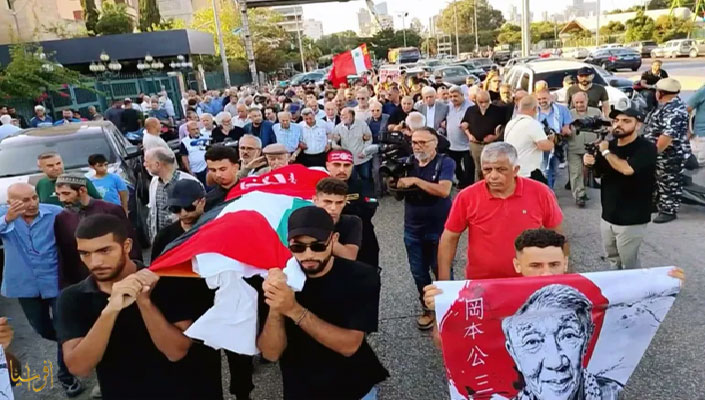
Funeral of Japanese Kozo Okamoto
Afrasianet - Omar Fares - In a majestic spectacle befitting the size of a man, the world bid farewell to one of the greatest symbols of the international struggle, the liberated prisoner of war Kozo Okumoto, or as he was known in the Arab nation's consciousness as "Ahmed the Japanese."
That revolutionary, who carried his rifle at a young age, immortalized his name in the annals of the resistance as one of the heroes of the Lod airport operation on May 30, 1972, an operation that shook the Zionist entity and caused an earthquake in the human conscience.
"In the occupation prisons, Okumoto became a symbol of steadfastness. He learned Hebrew, delved into the Palestinian cause, and became a historical and theoretical reference for many prisoners".
________________
From the Land of the Rising Sun to the Land of the Revolution
Born in Japan in 1947, in a country that knew exactly what it meant to be occupied and destroyed, where its cities had been ravaged by the atomic bomb.
Growing up in a leftist environment influenced by anti-imperialism, he joined the Japanese Red Army movement, which believed that the liberation of peoples could only be completed with genuine international solidarity.
Okumoto was not just a passing militant, but a model of a global revolutionary who saw the Palestinian cause as the cause of all the free people of the world.
In the spring of his youth, he made a fateful decision: to put his life at the disposal of the Palestinian revolution. He traveled to Lebanon, trained in the guerrilla camps, learned the Arabic language, and chose an Arabic name for himself, "Ahmed", to become one of the sons of this nation, soul, heart and blood.
The Lod Airport Operation:. When the World Shook the Occupation Entity
On the morning of that fateful day, Kozo Okumoto and his two comrades (Osama and Adnan) set out to carry out a qualitative operation at the Lod airport (now known as Ben Gurion Airport).
The operation was a response to the Zionist massacres against the Palestinian people, especially the Munich Airport massacre that preceded it, in which Palestinian athletes were killed.
The three entered the airport carrying their suitcases that were hiding their weapons, and when they reached the passenger terminal, they opened fire heavily and threw grenades, killing 24 people and injuring dozens.
The operation was shocking to the Zionist entity, because it proved that the resistance is capable of striking the deepest strongholds of the occupation, and that international solidarity with Palestine is not just slogans.
From the battlefield to the courtroom
Okumoto was wounded during the operation, and was arrested by the Zionist forces. He was tried and sentenced to life imprisonment. But his imprisonment was not the end of his story, but the real beginning of a new phase of his struggle.
In the occupation's prisons, Okumoto became a symbol of steadfastness. He learned Hebrew, delved into the study of the Palestinian cause, and became a historical and theoretical reference for many prisoners. He rejected all offers of deals that violated his dignity, and insisted on his principled position: that Palestine belongs to all the free people of the world, and that the occupation is inevitably gone.
"Kozo Okumoto was not just a fighter, he was a philosopher of struggle, and a humanist par excellence. He believed that the liberation of man from injustice was the ultimate goal, and that vulnerable peoples everywhere should unite against imperialism, Zionism and tyranny".
________________
The body fell, but the idea lasts forever.
After 13 years in captivity from 1972, Okumoto was freed in a prisoner exchange deal in 1985, implemented by the Popular Front – General Command, but he did not leave the occupied territories, but chose to remain in the West Bank, married to a Palestinian activist, and dedicated his life to historical documentation and political and cultural struggle.
He lived among the Palestinians, breathing their air, and sharing their joys and sorrows with them, until the last days of his life.
On the day of his departure, the movement in the hearts of millions ceased. But physical death did not end his presence, but turned him into an immortal symbol, a star shining in the sky of the international struggle.
As the saying goes, "The body has fallen, but the idea and the effect remain forever." Kozo Okumoto was a living example of this truth. He did not die by his death, but moved into a new phase of immortality, where he became an icon with which militants everywhere challenged colonialism, domination and exploitation.
An international and humanitarian legacy
Kozo Okumoto was not just a fighter, he was a philosopher of struggle, and a humanist par excellence. He believed that the liberation of man from injustice was the ultimate goal, and that vulnerable peoples everywhere should unite against imperialism, Zionism and tyranny.
In his writings and interviews, he argued that the revolution was not just violence, but a comprehensive renaissance project that restored human dignity and dignity. He warned that colonialism was not conquered by weapons alone, but by consciousness, culture and unity.
"Okumoto was a unique model in the history of the international struggle: a Japanese identifier, a Palestinian of belonging, a visionary and a revolutionary of practice. He carried his gun one day, his pen for years, and his conscience all his life".
________________
Glory to him and his comrades
With the departure of Kozo Okumoto, the Arab nation is losing one of its most prominent adopted sons, and humanity is losing one of the pillars of justice in the modern era.
But his legacy will remain, passed down through generations, and reproduced in new contexts, whenever injustice intensifies and tyranny prevails.
Okumoto was a unique model in the history of the international struggle: a Japanese identifier, a Palestinian of belonging, a visionary and a revolutionary of practice. He carried his gun one day, his pen for years, and his conscience all his life.
Glory to you, Ahmed the Japanese, glory to your fellow fighters, and glory to all those who believe that freedom is not an illusion, and that human dignity is above all considerations."
He will remain a star, a fighter, a humanitarian and an international for ages, illuminating for the militants the path of liberation from imperialism, Zionism, domination and exploitation."
Goodbye Cozo... Farewell, O immortal revolutionary.. To a meeting on the roads of the coming victory, where the flags of justice fly in every sky, and where the free dwell in a homeland not occupied by an oppressor.
________________
