
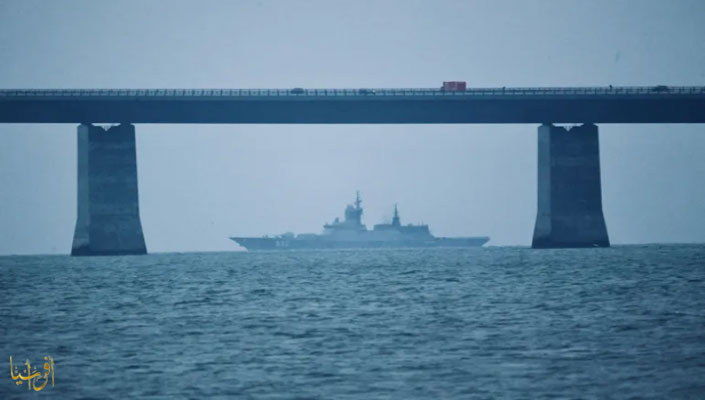
Afrasianet - Russia's Interfax news agency reported Tuesday that the Russian navy conducted military exercises in the Baltic Sea to practice missile launches, in conjunction with major joint exercises between the United States and NATO in the same region.
NATO's naval exercises (Baltops) or "Baltic Exercises", which began on June 4 and will continue until June 20, are the largest in the Baltic Sea this year, with the participation of about 20 ships from 15 countries and about 6,000 military personnel.
The Interfax reported that Russia conducted its own drills on Monday and today in its Kaliningrad enclave and its surroundings, with the participation of about 10 military aircraft, including fighter jets and bombers, in addition to two small missile ships.
Kaliningrad, which borders the Baltic Sea coast between NATO members Lithuania and Poland, has a population of about one million. It has a strong military character and is the headquarters of Russia's Baltic Sea Fleet.
In late May, Russian President Vladimir Putin said Moscow had all the means to destroy any force trying to attack Kaliningrad, in response to Lithuania's foreign minister's statement that NATO must prove to Moscow its ability to penetrate the enclave.
"Baltic Autumn" Kaliningrad: Russia's Strike Force Deep in Europe
The war in Ukraine has caused an unprecedented escalation between Russia and Western countries on the various areas of contact between them in Europe, as the Baltic Sea has become one of the most prominent points of confrontation between powers that have historically competed for influence in it.
The rivalry between Russia through its advanced stronghold in the heart of the continent in the Kaliningrad Oblast and NATO, which seeks to make the Baltic a closed lake for the alliance, threatens to face an open confrontation on all scenarios.
Kaliningrad is Russia's nuclear thorn in Europe's side and its advanced shield against NATO countries, as its geographical location on the Baltic Sea has given it a strategic advantage in terms of military and economic aspects.
As Russia-West relations deteriorated, the Baltic region has become an arena of conflict between Moscow and NATO, a conflict that escalates daily to mobilize armies, blow up gas pipelines, cut off maritime communications networks and intercept commercial vessels.
A Russian military air and naval strike force equipped with the latest weapons and missile systems capable of carrying nuclear warheads, as well as radar stations and early detection of strategic missile attacks is assembled in the Kaliningrad region.
It is also home to Russia's Baltic Sea Fleet, which includes dozens of multi-mission naval units.
According to Valery Gromak, a captain in the Russian Baltic Sea Fleet, the province is solidly protected and has the latest Russian weapons.
Gromack told Al Jazeera that the missiles in Kaliningrad "need a few minutes to reach the decision-making centers in Europe," noting that Kaliningrad is practically deep in Europe.
The Baltic states fear that Russia could take control of the Sualki corridor, which connects Belarus to Kaliningrad via Lithuania, and separate them from the rest of NATO countries.
Adding to the tension is the expansion of NATO's activity and military presence in the areas around Kaliningrad, in addition to what Moscow sees as provocations by European countries returning old names to the region before it was annexed to the Soviet Union, which has angered Russia.
Strategist Yuri Zverev says that behind Kaliningrad stands all the Russian military power, so "it will not be an easy morsel in a confrontation with NATO," expressing his conviction that "the attempt to encircle it has played with fire."
According to Zverev, the West is well aware of this, especially after the amendment of the Russian nuclear doctrine, which states that "if Russia cannot stop aggression with conventional weapons, then nuclear weapons will have the final word."
Soviet leader Stalin acquired Kaliningrad from Nazi Germany with the aim of obtaining a port on the Baltic Sea, and after the collapse of the Soviet Union, it became part of the Russian Federation due to its administrative dependence on it in the Soviet era.
Today, however, the situation has changed, as it is a separate enclave from Russia in Europe, surrounded by NATO countries on all sides, and the Baltic states restricted the transit of goods from their territory between Russia and the boycott with the outbreak of the Ukraine war, and imposed logistical sanctions, making Kaliningrad the most affected Russian province by Western sanctions.
The sea and air routes remain the only available area to supply the province with its needs, and industrial and commercial traffic in the province, which relied primarily on imports and exports with EU countries, has declined due to border closures.
Ala Ivanova, assistant governor of Kaliningrad province, says that the ban on the passage of goods by land costs additional expenses, as well as maritime transport faces logistical difficulties, stressing that there is a fleet of 25 Russian ships working around the clock, to secure the transport of goods to and from Kaliningrad.
Moscow sees the blockade of Kaliningrad Oblast and its complete isolation from the Russian mainland as threatening a direct military confrontation with the West.
Moscow has not hidden its concerns about the West's attempts to turn the Baltic Sea into a closed NATO lake, which threatens to close the sea to Russian warships and merchant ships in the event of a direct confrontation with the West, especially after Finland and Sweden joined NATO.
Source: Al Jazeera
