
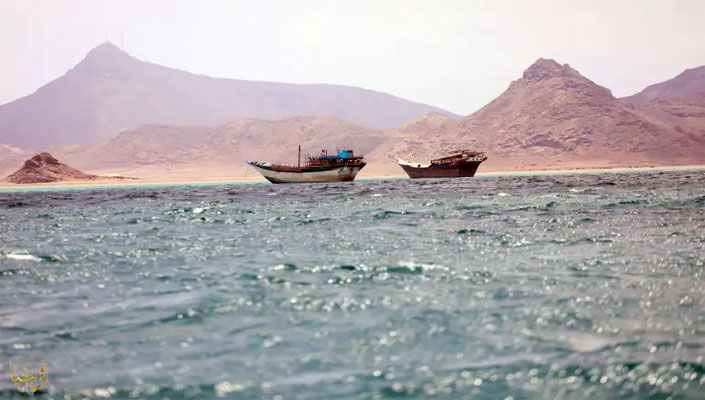
Boats sailing off the coast of Yemen's Bab al-Mandab Strait
Afrasianet - The Ansar Allah group (Houthis) on Friday expanded its control over Yemen's western coast to the heart of the Bab al-Mandab Strait, after its militants deployed on the strategic island of Mayun and reached Dhobab, in a development that strengthens the group's presence on one of the most important shipping and global trade corridors.
The Houthi advance follows a series of accelerated gains on the Red Sea coast, including the capture of the city of Mokha and Zagr Island, while the group is besieging government forces on the Greater and Lesser Hanish Islands, in an effort that puts most Yemeni sites and islands bordering the Bab al-Mandab Strait under its control or within the scope of direct military pressure.
The group said in a military statement that it had removed "Saudi forces from 6 districts in Taiz and Hodeidah governorates, with a total area of 5,400 square kilometers," and that "its forces targeted 7 military divisions that include 38 brigades," which led to the death, capture and injury of hundreds of its members, according to the statement.
It added that it was able to free a number of prisoners who it said had been held by pro-Saudi forces for years on the west coast, and that it also carried out 32 operations to counter Saudi warplanes, which according to its account, resulted in the downing of 9 planes.
In a parallel field development away from the west coast front, Yemeni government forces said their air defences in the Sixth Military Region shot down five Houthi suicide drones east of al-Hazm, the center of al-Jawf governorate.
Positioned in the heart of Bab al-Mandab
"Boats carrying Houthi gunmen arrived on the island of Mayun after government forces withdrew from it yesterday," a Yemeni government official told AFP, while witnesses reported that the group's militants deployed on the beach of Bab al-Mandab and were seen moving in the area in military vehicles.
Mayun Island, also known as Breem, is located in the middle of the Bab al-Mandeb Strait, giving it exceptional military importance as it directly oversees the shipping lanes connecting the Red Sea, the Gulf of Aden and the Indian Ocean.
The government official said the number of Houthis who have arrived on the island is "not large", suggesting that their primary goal is likely to be "to concentrate on the hills overlooking the strait", which could give the group observation posts and control of the sea lane.
Dhubab Control
Meanwhile, Reuters quoted two Yemeni government sources as saying the Houthis had arrived in the town of Dhubab, located directly on Bab al-Mandeb off Mayun Island.
Government sources confirmed to the agency on Thursday that the control of Doubab and Mayun is a key element in consolidating military influence in the strait.
The importance of this progress increases as the Houthi movements extend to the chain of islands spread in the Bab al-Mandeb area, including Zagr Island, which the Houthis took control of on Thursday, and Mayon, where they deployed on Friday, as well as the Greater and Lesser islands of Hanish.
Government military sources told AFP that the Houthis were besieging government forces in Greater and Lesser Hanish, amid uncertainty over the fate of more than 2,000 personnel deployed on the islands.
The sources added: "We do not know the fate of our forces, which are more than 2,000 members on the islands. As far as we know, the Houthi enemy asked them to surrender."
A senior military official said the besieged forces had appealed to the authorities to intervene to rescue them, provide them with food and water and lift the siege, adding that the lifting of the noose "requires air support".
After the control of Mokha
The pressure on the Bab al-Mandab islands comes a day after the Houthis took control of the port city of Mokha, a move that opened the way for them to continue advancing south towards the strait, and turned the battles from a conflict over coastal cities into a confrontation directly linked to the security of one of the world's most prominent sea lanes.
The strategic importance of Bab al-Mandab stems from its being the link between the Red Sea and the Gulf of Aden, through which commercial traffic and energy shipments to and from the Suez Canal pass.
Control of its surroundings is becoming more sensitive in light of the turmoil in energy supply routes, especially since Iran announced the closure of the Strait of Hormuz following the outbreak of war between Iran and the United States and Israel last February.
The Houthis' reinforcement of their position at Bab al-Mandab would give the group greater weight in the equation for the security of navigation in the southern Red Sea, at a time when the corridor is becoming increasingly important as other routes for transporting oil and energy in the region are disrupted or disrupted.
Positions and Movements
In his first Iranian stance on the developments, Mohammad Mokhber, an adviser to the Iranian leader, congratulated the Houthis on what he described as a "great victory" in the Bab al-Mandab Strait, saying that this progress "proved once again that security is not a means to be bought."
Mokhber linked developments in Yemen to the broader regional confrontation, saying that "Iran's strength in the Strait of Hormuz and the will of resistance have pushed the United States and its allies to an impasse at the tactical and strategic levels."
He added that the American people and Washington's allies are "paying the price for the economic crisis and the ambitions of the US president", in statements that reflect Tehran's reading of the Houthi advance as part of the regional balance of power.
In an indication of the widening regional repercussions of the Houthi advance, Axios reported, citing informed sources, that US Central Command commander Brad Cooper headed to Saudi Arabia on Friday to participate in urgent coordination meetings to discuss the latest developments and the progress made by the Houthis.
Meanwhile, Houthi-affiliated media reported that the port of Mokha was subjected to two raids, which they said were carried out by "Saudi aviation", a day after the group took control of the city. On the other hand, Yemeni government media said that the raids targeted Houthi gatherings in the port and airport of Mokha.
The Houthis' simultaneous control of several areas on the west coast indicates a qualitative shift in the battles in the region, as the Houthis' advance is no longer limited to expanding the area of control inside Yemen, but has directly affected the military balance around Bab al-Mandab and the security of navigation in the Red Sea.
________________
