
The climate has become an economic variable in its own right
Afrasianet - The price of wheat in Cairo, shipping prices between Asia and Europe, the rice crop in India, and the movement of ships in the Panama Canal all seem at first glance to be parts of different phenomena. But sometimes it is enough for the water to warm up in a remote area of the ocean for these phenomena to begin to intersect.
The name sounds lighter than the phenomenon it describes. But it's not one storm or one drought, it's a disturbance in the Pacific climate system that can redistribute heat and moisture over large areas of the planet. And when that happens, it's not just the weather that changes. Crops, water stocks, food prices, energy production, ship traffic, economic growth trajectories change itself. That's El Niño.
A study published by Dartmouth University found that the two strong El Niño events of 1982-1983 and 1997-1998 were associated with global income losses of about $4.1 trillion and $5.7 trillion, respectively, over the next five years. The study estimated that the El Niño effect that occurred in 2023-2024 could reduce global economic activity by about $5.7 trillion by 2029.
Global Economic Shock
These numbers do not mean that El Niño "wasted" those amounts in cash, nor that every dollar of losses can be attributed to the phenomenon alone. The global economy is more complex than that, and climate-economic models carry a measure of uncertainty. But they reveal an important shift in thinking: the damage caused by El Niño does not end when the ocean warms normally. Its effects on production, investment, productivity, and trade may last for years.
And that's where El Niño is changing. It's no longer just a phenomenon that meteorologists are watching and farmers are preparing for.
El Niño occurs when the surface of the water in the central and eastern part of the equatorial Pacific Ocean warms unusually in conjunction with changes in wind and atmospheric pressure. La Niña is the corresponding cold phase, when the water in that region becomes colder than usual and atmospheric circulation patterns change. The two phenomena do not occur on a fixed schedule, but they usually occur every few years.
The problem is that the Pacific Ocean is not just an ocean. It is one of the largest regulators of the Earth's climate system.
When the temperature of its tropical waters changes, the movement of air, humidity and energy in the atmosphere changes, and the effects of this can be seen in places thousands of kilometers away. Areas may receive more rain than usual, while others may face drought. Fisheries productivity may decrease in some coasts, while others are exposed to floods, heat waves or fires.
It is this ability to move turbulence from one place to another that makes El Niño as economical as it is climatic.
In Australia, for example, El Niño events have historically been associated with periods of extreme drought. In Peru, warmer ocean waters can affect fisheries and agriculture. In parts of Asia, rainfall patterns can change, reflected in rice and other crops. In parts of the Americas, heavy rains and flooding can occur while other regions are experiencing drought.
The economy does not need a major catastrophe to feel these changes.
It is enough for one staple crop to drop slightly. The price rises. Importing countries begin to look for alternative sources. Demand for global stocks increases. Governments intervene to protect consumers. Exporting countries may impose export restrictions. The shock is transmitted from farm to port, from port to food company, and from company to consumer.
Thus, a local phenomenon at the beginning turns into global inflation at the end.
The global economy has already learned this lesson from other crises. The COVID-19 pandemic has exposed the fragility of supply chains. The war in Ukraine has exposed the fragility of food and energy markets.
The turmoil in the Red Sea and the war in the Strait of Hormuz have proven that a single sea route can change global shipping calculations. El Niño adds something different: it is a disruption that does not need war or political decision to happen.
It comes from the ocean. And that makes it harder to prepare for than to face a political crisis that can be negotiated.
A story about the value of time
Take the Panama Canal as an example. The canal looks like a piece of infrastructure, but its operation depends on fresh water. In years when rainfall is low and drought is intense, maintaining the water levels needed to operate the canal becomes an economic and commercial challenge.
The drought linked in part to El Niño reduced vessel traffic in the canal during the previous crisis, and in 2026 the canal again faces transit restrictions as El Niño returns and water levels fall. Authorities plan to reduce the number of daily crossings to 32 ships in September, with additional restrictions likely if dry conditions persist.
The canal handles about 5 percent of the world's maritime trade, so it's not just a Panamanian problem. When the canal becomes less able to receive ships, trade doesn't disappear. Ships are looking for another route.
That could mean getting around the Cape of Good Hope, on a much longer journey, with more fuel consumption, longer time, higher security, and new bottlenecks at ports.
That's how El Niño works economically. It doesn't need to close a port to disrupt trade. It's enough to raise the cost of using it.
Shipping companies have already begun to address the prospect of restrictions in the Panama Canal by rerouting some flights, and some offers for priority transit have reached millions of dollars.
This is not a climate story in the traditional sense. It's a story about the value of time. A ship that waits for days in a congested canal is not just a late ship. It's late cargo, factories waiting for inputs, companies increasing their stockpiles, and consumers who end up paying part of the cost. In a global economy built on the principle of "timely arrival," water can become a commercial bottleneck.
But the Panama Canal also reveals something deeper: El Niño doesn't hit countries equally.
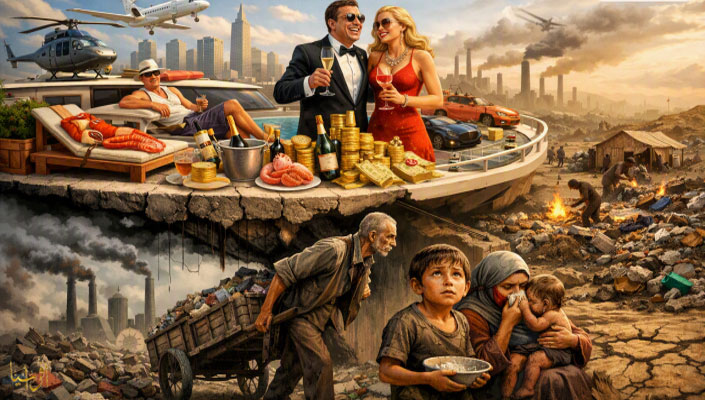
Rich countries can often buy time. Big companies can change shipping routes, hedge commodity markets, store materials, insure against certain risks, and invest in alternative sources. Poor countries, especially tropical countries that rely heavily on agriculture or fishing, may not have these options.
And that's one of the most worrisome aspects of El Niño. The natural phenomenon itself doesn't distribute its damage evenly. A weak economy that might be hit by a small climate shock and turn into a financial crisis. A rich economy might be exposed to the same shock and absorb it through budget, insurance, and imports.
"El Niño is no longer just a climate disorder but has turned into a global economic shock that redistributes heat and humidity and affects crops, trade, and growth across continents"
________________
The study, led by researchers at Dartmouth, has already found that low-income tropical countries have borne much of the economic losses associated with previous El Niño events. In these economies, drought can mean lower yields, lower incomes for farmers, more expensive food imports, larger external account deficits, currency pressure, and then higher prices for basic materials.
The climate phenomenon thus becomes a debt problem. The government may be forced to import additional food at a time when export revenues fall. It may need to support prices at a time when tax revenues fall. It may have to increase disaster spending as borrowing becomes more expensive.
Fear is part of the problem
El Niño doesn't bring down a government, but it can make a weak government more vulnerable. This is where food security becomes part of economic security. The problem is not just the decrease in the amount of food produced, but how countries respond. When governments fear supply shortages, they may resort to restricting exports. And when several countries do so at the same time, the global supply shrinks even if the actual shortages in production are not catastrophic.
The world has seen this dynamic in previous food crises. Markets are not just dealing with the current crop; they are dealing with expectations of the next crop. If traders believe that rice, wheat, or corn will be less available, prices can start moving before agricultural losses reach the markets.
El Niño, then, doesn't just change the weather. It changes the forecast. And that's important for central banks as well.
If the phenomenon leads to higher food, energy, and transportation prices, central banks could face inflation that does not come from domestic demand. Raising interest rates will not make it rain in Australia, it won't bring water back to the Panama Canal, and it won't increase Asia's rice crop. Yet banks may find themselves having to deal with inflation caused by a climate shock as if it were traditional economic inflation.
Herein one of the most difficult paradoxes of climate economics emerges: monetary policy tools are limited to ocean-pronged shocks.
The central bank can raise interest rates to reduce demand, but it cannot increase rainfall.
The government can subsidize bread, but it cannot repair a damaged crop.
The shipping company can change the ship's route, but it can't change the water level in the canal.
Confronting El Niño is therefore not a matter of response after the damage has occurred. It is a matter of preparedness before it happens.
The good news is that El Niño is not a sudden earthquake. Scientists can monitor its signals months in advance, and satellite networks, buoys, and climate models provide advanced predictability for its development. This means that governments know, to varying degrees, that the danger is coming before it reaches crops, ports, and markets.
The question, then, is not whether El Niño can be predicted, but what governments do with this knowledge. This may be the most frustrating part of the story.
The world knows that some weather events are going to come again. It knows where flooding can happen. It knows that some countries are prone to drought. It knows that canals, ports, airports, and power grids depend on water- and heat-sensitive infrastructure. Yet preventive investments remain less politically attractive than spending after a disaster.
A politician who builds a reservoir before a drought often doesn't get the same image as a politician who sends aid after a disaster.
But economics doesn't care about images. It cares about cost.
A recent study published in the journal Science in August 2026, based on ancient climate records of the Galapagos Islands' corals, estimated that El Niño intensity increased by about 36.5 percent compared to the pre-industrial era, with a marked increase in recent decades. The researchers linked this to human-induced warming, acknowledging that the magnitude of this effect is still debated among scientists.
This result, if confirmed by further evidence, is as important economically as it is scientifically.
Because the problem is not just a repetition of an ancient natural phenomenon in a warmer world. Rather, it becomes the possibility that the climate system in which the global economy used to operate is no longer the same system.
The solution is in hedging
Hundreds of billions of dollars of investments have been built on previous climate assumptions: when it rains, when rivers dry up, how high the water level is in the reservoirs, when the planting season begins, and how much heat the infrastructure can withstand.
If these assumptions change, some assets become less valuable than expected. This means that climate change is not just an environmental problem. It is a problem in asset valuation.
A farm that was productive could become more volatile. A dam that relied on a stable water pattern could face more difficult years. A port that did not anticipate water shortages could become more restrictive. Even insurance companies may find themselves exposed to risks that are difficult to price in the old ways.
This is where El Niño meets the larger transformation of the global economy. Modern markets are trying to turn everything into a number: the cost of capital, the price of oil, the risk premium, the value of land, the price of insurance. But climate poses a different problem: what happens when the future becomes less like the past?
"El Niño-related crises show that poor countries are paying the highest price, lacking hedging and financing while the rich have the ability to absorb shocks"
________________
This is a question that traditional economic models cannot easily answer.
El Niño is a perfect example of this problem because it's a natural phenomenon, but it operates within a climate system that's changing due to human activity. So it's not enough to know the history of El Niño. We also need to know how El Niño might behave in a warmer world.
It's not true that every drought or flood can be attributed to El Niño alone, and not every El Niño produces the same effects. The effects vary depending on the location of the country, the timing of the phenomenon, and local conditions. The economic outcomes may differ drastically between two similar events in the Pacific. But that doesn't diminish the importance of the problem, it increases it.
Because the economy does not need complete certainty to be affected by risks. It is enough for the probability of extreme events to become higher so that the cost of insurance, investment, and hedging rises. Hence, the concept of economic security must change.
Economic security no longer just means having cash reserves, multiple energy sources, or a strong banking system. It also means having water reserves, food stores, flexible power grids, ports capable of handling changing trade routes, early warning systems, and the ability to move production between different regions.
The countries that will succeed in the El Niño era are not necessarily the countries that can prevent the phenomenon, no one can, they are the countries that can absorb it.
This requires greater international cooperation than currently exists. Climate does not respect borders, but economic policies are still largely designed within borders. One country can invest in forecasting, but its benefit may extend to its neighbors. One country can store food, but its shortage may lead another country to block exports. A country can protect a canal, but its disruption affects global trade.
The problem is that national incentives do not always match global need. Climate information should therefore become part of the infrastructure of the international economic system. Governments, before businesses, should know how the next El Niño could affect food, energy, transport and water. International financial institutions should treat these risks as part of financial stability, not as a separate environmental profile.
A loan to a drought-prone agricultural country without accounting for climate risk may sound sound on paper, but it becomes even riskier if that country faces an increased likelihood of recurring climate shocks. And investing in adaptation is not charity. It's an economic investment.
A better water reservoir may prevent greater losses. A more efficient irrigation system may protect agricultural production. Diversification of food sources may reduce price risk. Improved ports and roads may reduce the cost of trade conversion. Investing in early forecasting can be much cheaper than rebuilding infrastructure after a disaster.
But the world still treats adaptation as a secondary activity, while climate and economic prevention remains less exciting than disaster management. El Niño may be one reason why this thinking is unsustainable.
The phenomenon will come and go. The ocean will return to normal, the headlines will end, the ships will return to the canal, and the crops will be planted the next season. But some of the losses will remain. The debt may remain. Prices may remain high. The farmer who lost his savings may remain. The company that closed a factory may remain.
The country that had to spend part of its budget on importing food instead of investing may remain. And that's the point that makes El Niño different from just "bad weather." It has a cumulative economic impact.
So maybe it's time to stop treating El Niño as seasonal news in the weather bulletins. It's more of a periodic test of the global economy's resilience to shocks. And if the world is already facing climate change that makes some phenomena more severe or increases their volatility, it's going to be harder to test. Not because El Niño will govern the global economy, but because the global economy can no longer ignore the climate in which it operates.
In the twentieth century, many companies and governments have been able to think of climate as a relatively constant backdrop for economic activity. In the twenty-first century, climate has become an economic variable in its own right.
This is not the end of globalization. But it may be the end of globalization that assumes that nature will remain in the background.
El Niño reminds us that the global economy is not an autonomous machine operating above the planet's surface. It is part of the natural system itself, dependent on water, rain, heat, wind and oceans. So the real question is no longer : How much will El Niño cost the world?
The question is: why wait to know the number?
If studies point to trillions of dollars in losses, if the phenomenon was predictable months in advance, if some of the most vulnerable countries are the least able to withstand the shock, ignoring them is no longer economical spending. It's a postponement of the bill. And the bill, in a warmer, more interconnected world, could get bigger every time.
________________
