
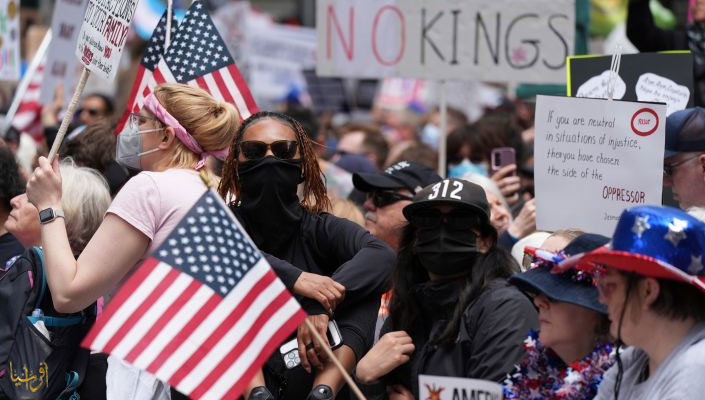
Protesters at the "No Kings" rally in Chicago; street slogan sums up broader concern about concentration of power in Trump's second term
Afrasianet - Saja Yasser - The Iran war and Trump's foreign confrontations were the face of his second term, but inside America there was another, less noisy and more profound battle: a battle in the shape of the state itself. Between overwhelming censorship, former security institutions sounding the alarm, and states acting as if they were living in parallel unions, Western newspapers depict a president pressing the barriers that were originally put in place so that power does not become the will of one man.
The Financial Times quotes the warnings of former U.S. intelligence officials who believe that in his second term, Trump is following a "dictator's pamphlet," warning that the barriers that once restrained the executive branch are being gradually dismantled.
Power barriers
According to the Financial Times, the concern has come out of the intelligence world. The Steady State, a network of more than 400 former intelligence and national security officials that aims to defend the rule of law and democracy, has expanded with Trump's second term, but many of its members prefer to remain anonymous for fear of reprisals.
Paul Colby, a former CIA official, said that autocrats follow similar patterns of seizing and using power, and that what is happening in America today resonates with those patterns. Mark Zaid, a national security lawyer, said that "all barriers have been removed," warning that the country may be approaching the worst.
The Financial Times notes that the concern grew after Trump used a televised speech to claim that China interfered in the 2020 election, even though a 2021 National Intelligence Council report found no efforts by Beijing to interfere in the vote. A former intelligence official believes that Trump is using the intelligence agency to bolster his political narrative contrary to what the establishment itself believes.
Exhausting censorship
In another level of disintegration, The Atlantic says that integrity watchdogs in Washington are chasing a flood of cases until they "have their voices clear." The magazine begins with a banquet Trump threw for major investors in his digital currency, as an example of what critics see as an exchange for access to the president for money, and the channeling of money to property associated with him.
The watchdog organizations thought they were ready for a second term after the experience of the first, but found themselves facing a broader and more visible level. Within days of the inauguration, the administration fired 17 inspectors general, while organizations such as Public Citizen, Crowe and the Campaign Legal Center bolstered their legal and research teams and began tracking transactions they described as suspicious so as not to be swallowed up by "fatigue" and lackluster media coverage.
According to the New York Times, Trump made about $2.2 billion in profits last year, mostly from crypto deals, along with revenues from legal settlements, golf deals and foreign real estate. The magazine quotes a Crow spokesperson as saying that the difference in this state is that the separation between President Trump and Trump the businessman is "gone."
Soft separation
In an op-ed in the New York Times, writer Kurt Anderson reads the crisis from another angle, describing America as not experiencing a formal separation or civil war, but sunk into a strange arrangement that resembles a bitter marriage that has lost trust and love, and has survived simply because divorce is complicated, expensive, and frightening.
In recent years, red and blue states have developed increasingly tools to disrupt each other or the federal government. Republican districts resisted gun and immigration policies, and with Trump's return, Democratic states and cities began to resist federal policies on immigration, abortion, climate, and public health.
But the most important difference, according to the article, is that the current president does not seem to seek to reduce the division, but to widen it, as the writer says that Trump has repeatedly made it clear that he will reward the states and cities that voted for him, and punish those who are considered disloyal.
Elections as an emergency
From the disintegration of the soft union to the fear of the box itself, the Guardian relays a striking scene: senior Senate Democrats sit in a room in Washington to simulate potential threats to the November election.
Chuck Schumer and other senators have engaged in exercises that have dealt with scenarios such as the spread of fake AI footage claiming widespread fraud, and then amplified by the right-wing media and the president himself.
The drills included other possibilities: threatening federal funding to states that refuse to turn over voter records, the FCC's action against media outlets covering fake clips, the appearance of gunmen at the polls, or the deployment of Homeland Security and National Guard personnel to polling stations.
According to the Guardian, the simulation comes against the backdrop of Trump's continued false claims about the 2020 election and his call for the passage of the "Save America" bill, which bans mail-in voting nationwide and imposes new ID requirements on voters.
These coverage do not present the image of a typical partisan disagreement, but of a country testing the limits of its institutions. The issue, as portrayed in the newspapers, is not just about a controversial president, but about an entire system that is being exhausted.
________________
