
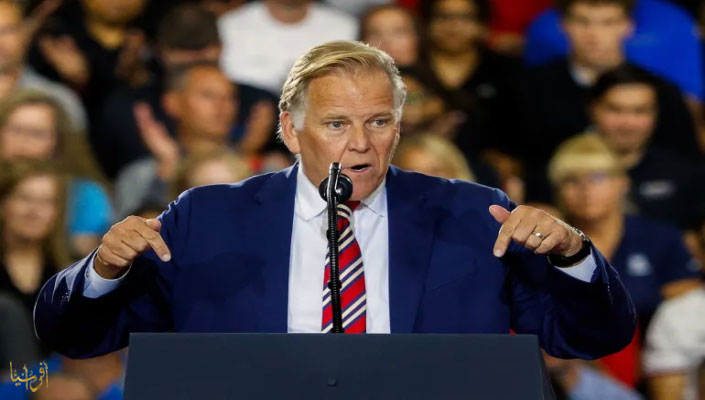
Republican candidate Mike Rogers asks to end AIPAC campaign support
Afrasianet - Tarek Al Fizani - Mike Rogers, the Republican nominee for Michigan, will need to test his electoral base after his decision to abandon the American Israel Public Affairs Committee-backed ad campaign, which is a new blow to the organization and pro-Israel lobbyists.
According to information published by Axios, Rogers spoke with AIPAC President Michael Tuchin in Los Angeles last week, before the organization stopped airing a video ad the next day that targeted his Democratic rival Abdul Sayed, who is known for his harsh criticism of Israel, despite spending more than $30 million on the campaign.
Despite his strong support for Israel, Rogers' move is explained by concerns that public support for AIPAC will be a weak point in the Nov. 3 election, as Rogers is running in a swing state (Michigan) with one of the largest Arab-American communities in the country, prompting him to be cautious in his dealings with Israel and Gaza.
A recent Fox News poll showed that 55 percent of Michigan voters oppose continued U.S. aid to Israel. Observers say the unprecedented tension underscores the extent to which AIPAC's political standing has declined amid voters' anger over the war in Gaza, a context that has led Abdul-Sayed and others to adopt counter-tactics that have greatly weakened the traditional influence of lobbyists.
This is especially evident in the tendency of independent candidates to directly polarize voters and denigrate large financial spending as evidence of the power of federal political money to gather popular sympathy.
Millions in the wind
The organization has previously spent millions of dollars to support moderate candidate Haley Stevens in the Democratic Senate primary in Michigan. But progressive candidate Abdul El-Sayed ultimately won the primary, in what was described as a decisive race for the party.
He has made AIPAC a central focus of his successful primary campaign, using the group's spending against him to portray his Democratic rival Hayley Stevens as subservient to pro-Israel lobbyists.
In his campaign, Mr. Trump called Israel a "rogue state," accusing it of genocide and apartheid, but avoided answering whether Israel had a right to exist as a Jewish state.
According to Politico, political action committees have poured more than $5 million into recent weeks to support ads in support of Melissa Hernandez, and others attacking Aisha Wahab in the California congressional elections to win the seat of resigned Eric Swalwell.
These expenditures, according to the same source, include $1.2 million from the United Democracy Project, which is supported by the American Israel Public Affairs Committee (AIPAC), and $2.1 million from the bold America Pack committee.
But despite extensive financial support, Wahab - the first Muslim and Afghan-American woman to be elected to the state legislature - is making significant progress in the race to represent one of California's most diverse constituencies.
Structural transformation
Although AIPAC has significantly expanded its political spending in recent years, with the New York Times reporting that the organization has doubled its spending to $67.2 million, it has suffered a string of high-profile defeats in the Democratic primary.
Successive defeats not only reflect a decline in the influence of pressure groups, but also signal a structural shift in the U.S. political landscape, as these groups move from "undeclared consensual dominance" to "polarization and direct confrontation."
This change is manifested in at least two parallel tracks:
• The first is represented by the reticence of conservative candidates such as Mike Rogers on direct advertising promotion of lobbyists to avoid provoking national electoral bases.
• The second is reflected in the ability of the grassroots organizations of the progressive movement, led by people like Abdul al-Sayed, to break the equation of financial superiority and decide the electoral races through direct mobilization rather than relying on intensive advertising.
Beyond that, however, the decline in the dominance of these groups is seen as a natural product of a series of profound reasons, mainly the widening ethnic and cognitive gap between generations, which has contributed to the emergence of a generation that thinks outside the old molds, successive technological changes that have wreaked havoc on the influence and monopoly of traditional pro-Israel media, as well as partisan rifts over foreign policy priorities.
Demographic Shifts
The shifts point to a gradual decline in the absolute superiority of traditional white races of Anglo-Saxon and Germanic descent, in favor of Hispanic, Asian, and African Americans, who are less emotionally attached to the narratives accompanying Israel's founding.
According to the Washington-based Pew Research Center , 60 percent of Americans today have a negative image of Israel, which is not only related to the depletion of U.S. taxpayer money to fund its never-ending military campaigns, but also to the moral and moral downfall of those conflicts geared toward killing children, women, and unarmed civilians.
Prominent American cities and universities witnessed sit-ins and demonstrations denouncing Israeli war crimes against the Palestinians, reflecting a marked shift in public mood, especially among young Americans, as polls and public debates showed an escalation of criticism of Israel and a decline in traditional levels of sympathy for it compared to previous years.
According to the Institute for Strategic Studies, Israel's declining popularity in the United States affects several religious groups: "Catholics, Protestants, and white evangelical Christians under the age of 50 all state that they have a negative view of Israel."
Pew predicts that as the generations born after World War II gradually disappear, "this anti-Israel shift is likely to worsen, and the number of those who associate Israel with aggressive militarism will increase."
The decline of the traditional media monopoly
Young voters in the United States mostly rely on social media and digital platforms to shape their political positions rather than traditional capital-dominated media linked to pro-Israel lobbyists.
Israeli Prime Minister Benjamin Netanyahu has acknowledged that the rising influence of social media has played a pivotal role in changing Israel's image during the war on the Gaza Strip, particularly among young Americans, both Republicans and Democrats, describing these platforms as a "war front" in their own right.
Even US President Donald Trump said in an interview with the American network "Real America Voice" that "the biggest change I have seen in a quarter of a century is what happened to Israel and the Jews, they had the most powerful lobby in Washington."
Trump attacked Senate Democratic leader Chuck Schumer, one of the most prominent Jewish politicians in U.S. history, accusing him of abandoning his previous pro-Israel positions.
"Look at the House of Representatives and people like Schumer, he's become a Palestinian," Trump said.
Foreign Policy Priorities
The Democratic Party has faced an unprecedented divide over the limits of support for Israel and foreign policy priorities after the Gaza war, including the emergence of hardline positions to tie military support to strict conditions.
But the debate also spilled over to demands for revisions of U.S. foreign policy priorities, such as reducing military involvement in the Middle East and draining financial resources to fund wars that do not belong to Americans.
Statistics published by the Washington-based Institute for Strategic Studies, in collaboration with the Pew Research Center, showed that 80 percent of Democrats have a somewhat or very negative view of Israel, compared to 41 percent of Republicans.
Among young voters close to the Democratic Party, negative views appear to be more acute, with 85 percent of the 18-29 age group and 83 percent of the 30-49 age group expressing a negative view of Israel.
According to analyses provided by Bruno Malki, a political analyst and pollster, and Michel Fayyad, a geostrategic analyst, these gaps do not indicate an expectation of a sudden collapse of the US-Israel alliance, but rather warn of a continued gradual erosion of bipartisan consensus, which could push the critical threshold on the day a presidential candidate emerges who estimates that his support for Israel will lose him more votes, especially in Michigan or Pennsylvania, a scenario that would threaten Israel's position in the U.S. Priorities Table.
________________
