
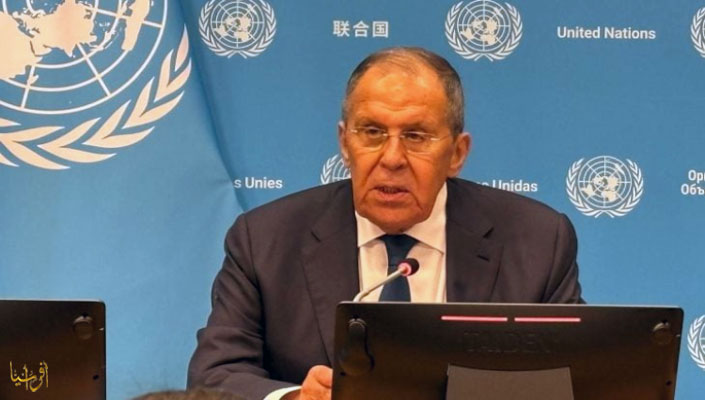
Russian Foreign Minister Sergey Lavrov during a press conference at the organization's headquarters in New York, 26 September 2026
Afrasianet - Abd Al Hamid Siam - Russian Foreign Minister Sergei Lavrov has warned that the rapid deterioration in the West Bank, especially in light of the recent settlement decisions in Jerusalem, threatens to weaken the possibility of establishing a viable Palestinian state, stressing Moscow's adherence to its position calling for a two-state solution.
This came in response to a question posed to him by Al-Quds Al-Arabi during a press conference held in New York after his speech to the General Assembly at its 81st session, about what Russia can do to advance the path of the two-state solution, especially after he indicated in his speech to the General Assembly that his country is ready to take "important initiatives" on the Palestinian issue.
Lavrov said the situation in the West Bank was "deteriorating very rapidly," referring in particular to recent settlement decisions in occupied Jerusalem. He added that the establishment of such settlements could lead to a severing of the geographical link between the Gaza Strip and the West Bank, making the establishment of a Palestinian state more difficult.
In response to a question from Al-Quds Al-Arabi, he referred to Russia's position on the resolution within the broader context of Moscow's policy towards the Palestinian issue, saying that his country has been calling for the establishment of a Palestinian state for years, and that the Palestinian divisions and dealing with them in different ways have not led to the resolution of the issue, according to his assessment, but rather contributed to the rejection of the establishment of a Palestinian state. He said that his country called on all Palestinian factions to heal the rift between them, and comrades in China took the same step, but the divisions continued.
The Russian minister linked the continued division to developments on the ground, warning that new realities, especially in the West Bank and Jerusalem, are making it more difficult to reach a two-state solution over time.
Lavrov's remarks come as Moscow continues to emphasize that the establishment of a Palestinian state alongside Israel is the basis for a political settlement, while the Security Council is witnessing a debate on the future of the Gaza administration, transitional arrangements and the implementation of Resolution 2803.
Speaking about the international efforts related to Gaza, Lavrov touched on Security Council Resolution 2803, which was adopted by the Council in November 2025 with 13 members in favor and Russia and China abstaining. The resolution endorsed the "comprehensive plan to end the conflict in Gaza" presented by the administration of US President Donald Trump, welcomed the establishment of the Peace Council as a transitional body, and authorized the establishment of an interim international force to stabilize the Strip.
With regard to the transitional phase in Gaza, the resolution provides for an interim administration to be overseen by the Peace Council, until the Palestinian Authority meets conditions related to reform and the ability to regain control of the Strip. It also provides for the possibility of establishing a path towards self-determination and Palestinian statehood after the implementation of these arrangements and progress in the reconstruction of Gaza.
But Moscow abstained from voting on the resolution, and Lavrov said his country had "serious doubts" about its wording and content. Russia's representative to the Security Council has previously made it clear that, from Moscow's point of view, the resolution did not adequately reflect the two-state formula that Russia sees as the basis for a settlement, and also gave the Peace Council and the proposed international force broad roles in managing Gaza's transition.
Lavrov pointed out that Russia discussed the draft resolution with its drafters before the vote, considering that the text, as presented to the Council, raised questions in Moscow. During the adoption of the resolution, some member states expressed concern about the limited reference to the role of the United Nations and the Palestinian Authority and the lack of explicit wording of the two-state solution in some parts of the text.
In contrast, the resolution itself includes a reference to the United Nations as one of the organizations with which the Transitional Mechanism should cooperate in the resumption of humanitarian aid to the Gaza Strip, and links the transition to the possibility of later reaching a "credible path" towards self-determination and Palestinian statehood.
In his response to the question of "Arab Jerusalem," Lavrov focused on two consecutive tracks from Moscow's point of view: developments in the West Bank, which he said threatened the possibility of establishing a Palestinian state, and the Gaza arrangements, which he said Security Council Resolution 2803, in its current form, did not address all of Russia's reservations about them, despite Moscow's refusal to use its veto power and allow the resolution to be passed. He said that Russia is ready to help the Palestinian and Arab brothers as well when they ask it to do so.
________________

