
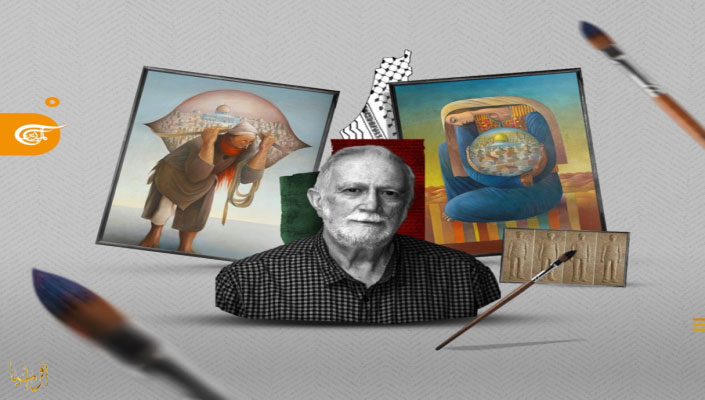
How did Suleiman Mansour turn Palestine into a visual memory? And why did his painting "Camel of Bearings" become a Palestinian icon?
Afrasianet - Ezzedine Burka - The owner of "Camel Bearings" disembarked to inspect Arab plastic cartography with his departure on Monday, one of the pioneers of its artistic modernity. The Palestinian visual artist, Suleiman Mansour (1947-2026), is one of the most prominent founding names in the history of modern Palestinian plastic art, following a path that stretched since the 1970s, leaving behind an experience that goes beyond the boundaries of painting as a surface of photography, towards building a visual system in which the land, memory, body, identity and history intersect.
Born in Birzeit and died in Jerusalem on August 24, 2026, at the age of 79, Mansour studied art at the Bezalel Academy of Art and Design in occupied Jerusalem between 1967 and 1970, before becoming involved in Palestinian art life as an artist, teacher, organizer, and founder.
He was president of the Palestinian Artists Association between 1986 and 1990, helped found the Wasti Art Center in Jerusalem, and co-founded the International Academy of Arts in Palestine.
Art, when it enters into the struggle of memory, becomes a way of writing time in order to leave a mark on the present, and a way for the present to re-account the absence it has inherited in the face of every setback, uprooting, displacement and disappointment.
This biography reveals Suleiman Mansour's conception of art as a cultural and social practice related to the production of the image and the construction of the Palestinian artistic field at the same time, without a clear separation between the creative process and the involvement in the struggle, which will become a visual glimpse of the resistance tendency in a wide range of his artworks.
In this context, the importance of Suleiman Mansour's experience, aesthetically and intellectually, is determined by the way in which he transferred the vocabulary of Palestinian life from its everyday sphere to the realm of the visual mark.
The peasant, the woman, the olive tree, the orange, the embroidery, Jerusalem, the village, the stones, the land, the folk dress, and so on, all of these are transformed in his works into vocabulary that establishes a visual syntax capable of producing meaning beyond its immediate presence.
Here, the image operates according to the logic of symbolic transformation, as the physical element retains its realistic features, while at the same time acquiring a semantic function linked to the collective memory.
In this way, the olive tree becomes an image of the land and the continuity of existence, and Palestinian embroidery becomes a visual archive of identity and heritage, while women become symbolic bearers of fertility, land and the continuity of the community.
The orange is associated with the memory of the Nakba and the Palestinian territories lost in 1948, while the olive tree symbolizes the land occupied in 1967 and the rooting and steadfastness.
"Camel bearings".. Jerusalem on the shoulders
The painting "Camel of Bearings", completed in 1973, occupies a central position in this memory project, as one of the most enduring images in Palestinian and Arab visual memory. It depicts a person who carries his homeland and bears his weight.
The origin of her idea is linked to the scene of porters in the Old City of Jerusalem, where Suleiman Mansour saw elderly men carrying weights beyond the capacity of their bodies. This observation moves from reality to a decisive visual metaphor, in which the porter becomes the bearer of Jerusalem itself.
In the well-known version, the man bends under the weight of the city, while the mass he carries takes on a shape close to the eye, and the landmarks of Jerusalem and the Dome of the Rock are shown inside.
When the visible is threatened with uprooting, its preservation acquires a political and cultural function, and the embroidered garment, the olive tree, the village, the stones, and the materials of the earth become means of consolidating the memory and protecting it from disappearing.
The power of this image is based on the economy of the sign and the concentration of the symbolic visual mass, Jerusalem, in a central space of the painting, above the man's back and shoulders. One man, one city, and one physical movement encapsulate a vast web of meanings.
Here, the body becomes a geographical carrier, the city is transformed into a material cargo, while Jerusalem is transformed from being a visible place to become an existential and sacred load carried over time.
The earth, on the other hand, moves within the human being, and man carries it with him wherever he goes. Therefore, the painting acquired a life independent of the context of its first exhibition, and moved to posters, popular circulation, Palestinian and Arab homes, camps, and spaces.
Earth is a material for art
However, Suleiman Mansour's experience cannot be reduced to the painting "Camel of Bearings", or read as the sole title of his path. For decades, the artist has worked to build a visual lexicon that changes with the changing and transformational Palestinian experience.
In his works, the Palestinian woman, the peasant, the land, the village, the city, the tree, and the folklore appear, and his language later expands to accommodate new materials, techniques, and concepts. In clay works in particular, the soil has moved from a painted subject to an artistic material that carries the history of the place within its physical structure.
Mansour was formulating layers of clay inside wooden frames, showing cracks, contractions, and cracks resulting from the drying of the material. Here time becomes part of the work itself, as the cracking becomes a trace of time, and the earthly material registers in its body the meanings of dispersion, uprooting, and division.
This clay experiment reaches a more synthesized level in the "I Am Ismail" series, which he began in 1996. The artist used clay to create bodies and features that look like inscriptions or relics extracted from a funerary space.
The name Ismail invokes multiple religious, historical, and biographical layers, while clay allows for a direct connection between the body and the earth. In this case, the work transforms into a kind of visual archaeology, in which the material evokes traces immersed in memory, and the body appears as a trace that can be erased and restored at the same time.
It is also related to exile, abandonment, displacement and departure, evoking the story of the Prophet Ishmael and his relationship with the land and exile. This connection can be read as an expression of the experience of a person who is alienated from his place, forced or voluntarily, and who bears its effects on his memory and body.
In "Camel of Bearings", the body is transformed into a geographical carrier, the city is transformed into a material load, while Jerusalem is removed from being a visible place to become an existential and sacred load carried over time.
Suleiman Mansour's experience took on another dimension during the first intifada, when, along with Vera Tamari, Nabil Anani, and Tayseer Barakat, he co-founded the New Vision group, whose experience took shape between 1987 and 1989.
In this framework of resistance, the choice of material took on both an aesthetic and a political stance. Local materials such as clay, straw, henna, coffee, tea, and natural dyes, were used as part of the boycott of Israeli-made art materials. In doing so, the material took on a value that went beyond technique: Palestinian clay entered the work as part of the place the work was about, and the production process itself became connected to the question of cultural independence.
This transformation placed Mansour within a broader context of resistance art, with a clear peculiarity in the way he worked. For him, resistance is not only manifested in the image of a gun, a martyr, or a direct confrontation, but also in the protection of everyday details from disappearance.
From the embroidered garment, the shape of the village, the olive tree, the woman, the fields, the stones, the names of places, to the materials of the earth itself, all of these elements are involved in the process of consolidating memory, so that the practice of photography becomes a creative act of preserving the visual that is threatened with extinction. When the visual is threatened with uprooting, its preservation acquires a political and cultural function.
A legacy that transcends the boundaries of the painting
The departure of Suleiman Mansour was not the departure of an ordinary artist, as the value of his achievement lies in his contribution to the building of institutions, reception and education networks in the Palestinian territories. His exhibitions have extended from Palestine to the Arab world, Europe, the United States, Japan and South Korea, and he has participated in exhibitions organized by international institutions, and he received the "Palestine Prize for Visual Arts" and the "Nile Grand Prize" at the Seventh Cairo Biennale in 1998, and he also received the "UNESCO Sharjah Prize for Arab Culture" in 2019, and his experience has received wide attention from critics, scholars, collectors and museums.
For this reason, Suleiman Mansour's experience seems more like building a moving visual memory than producing a collection of paintings with a Palestinian theme. He worked to transform the place into an image, the image into a sign, the sign into a memory, and the memory into an ongoing cultural practice.
Suleiman Mansour worked to transform the place into an image, the image into a sign, the sign into a memory, and the memory into an ongoing cultural practice.
In this path, aesthetic experience juxtaposes history, matter with politics, the body with geography, and art with everyday life. The artist has made the image, painting and sculpture, a field of memory conflict, matter a witness to place, and artistic practice as a means of maintaining man's relationship with his land, through what the eye can see and what memory can restore.
Art, when it enters into the struggle of memory, becomes a way of writing time in order to leave a mark on the present, and a way for the present to re-account for its inherited absence in the face of every setback, uprooting, displacement and disappointment.
________________
Source: Al Mayadeen Cultural.

