
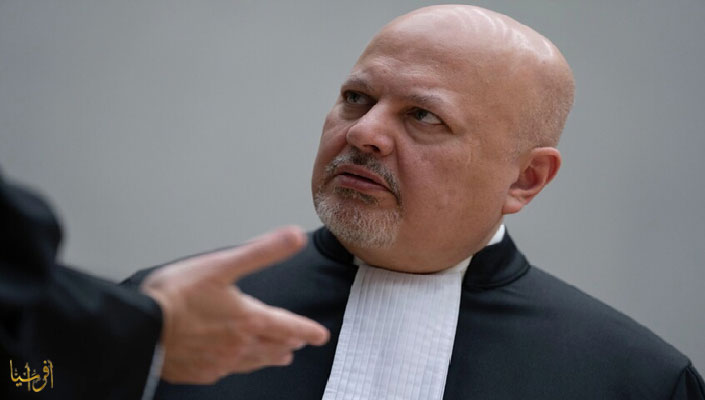
Afrasianet - Ibrahim Darwish - The members of the International Criminal Court (ICC) voted by 82 of the 125 members to dismiss the ICC's prosecutor, British lawyer Karim Khan, after a campaign of accusations of sexual misconduct against female employees at the court's headquarters in The Hague, accusations that Khan, 52, maintained his innocence, but came in light of the political climate created by his move and his request to the judges of the International Court of Justice to issue an international warrant to arrest both Israeli Prime Minister Benjamin Netanyahu and his defense minister at the time, Yoav Gallant, on charges of committing crimes War and crimes against humanity in Gaza after the attacks of October 7, 2023.
The charges surfaced in May 2024, the month the warrant was issued, although the charges did not resurface until October 2024.
The post written by Israel's ambassador to the United Nations about the resolution was striking and a message to all those who try to use Israel as a political weapon, alluding to the mayor of New York, Zahran Mamdani, who called for Netanyahu's arrest when he came to New York before backing down, justifying that the city he runs has no authority to arrest people who are fugitives from justice and accused of genocide.
But Mamdani's stance shows the importance of emphasizing the punishment of war criminals. This is demanded by human rights activists, given the symbolism of the International Court in prosecuting injustice and punishing criminals.
This is despite its controversial history of focusing attention on war criminals in Africa without paying attention to the common criminals who have led genocidal wars in Europe and its rush to indict President Vladimir Putin after his invasion of Ukraine in 2022.
What matters is the ICC's position is that it has charged Israeli officials and three Hamas leaders, all of whom were killed.
Investigations revealed that the British Foreign Secretary at the time, David Cameron, threatened Khan in a phone call, warning him not to proceed with the memo.
Then reports of Khan's sexual behavior began to appear in the Wall Street Journal, which is leading the campaign to destroy the Iranian regime and trying to persuade Donald Trump to go ahead with his military war to the end.
Khan's lawyer, Tayeb Ali, said the decision by the Council of Member States was regrettable and that it was made in disregard of the concerns expressed by more than 180 human rights organizations and legal experts that the impeachment process was carried out without supporting evidence confirming the accusations against Khan.
They noted that the intervention of the United Nations Office of Internal Oversight Services was based on the plaintiff's account to the Prosecutor and that he had sex with her without her consent.
But the council's decision on Friday comes amid unusual threats from the United States, especially Secretary of State Marco Rubio, that he will work to dismantle the ICC "stone by stone," even though the United States has sanctioned most of the court's judges, including Khan, for their investigations into Afghanistan and the Palestinian territories.
It is feared that the court will now drop the charges against Netanyahu and Gallant, which Foreign Minister Gideon Sa'ar called for as "overdue," even though more than 180 Palestinian human rights and civil society organizations signed a statement saying that the UN office's disciplinary measures had turned into a "political referendum" that served the interests of the member states of the court's council.
A stone after a stone
Whatever may be said about the nature of the actions taken by the Council of Member States and its attempt to get rid of Khan, the political climate was created by the US administration around the court, which did not sign the Rome Statute to establish it in 2002.
In this context, Steve Bloomfield pointed out in the "Guardian" newspaper (24/7/2026) that hardly a week goes by without the Trump administration threatening to undermine the international order, hardly a month goes by without Donald Trump making a new attempt to undermine the rules-based international order, as the United States withdrew its funding from dozens of international institutions, closed the United States Agency for International Development and withdrew from the Paris Climate Agreement.
But the State Department's announcement last week that it wants to dismantle the ICC may be Trump's most dangerous move ever.
The official policy of the United States was now to eliminate the International Criminal Court, and the Administration was prepared to do everything in its power to achieve that. States that do not comply with this policy will be penalized.
The State Department has promised to "increase scrutiny of countries that reject the ICC's pseudo-authority while relying on U.S. assistance," specifically targeting those countries that "enjoy the benefits of the U.S. security umbrella."
This will include Britain, a country that contributes more than £15 million a year to the ICC, making it the fourth-largest donor after Japan, Germany and France.
Travel restrictions and sanctions have already been imposed on judges and senior officials and now more will be targeted.
This could lead to individuals being completely cut off from modern life, with personal bank accounts being closed and a wide range of U.S. apps and websites, from Uber to Booking.com, blocked.
Email accounts – Microsoft and Google – can be banned. For the court itself, this means backing up evidence that was previously stored on Microsoft's systems.
The State Department's campaign includes cooperation with other countries that are not members of the ICC, and Bloomfield says this is undoubtedly an existential crisis, not only for the ICC but for the entire concept of international justice.
The most powerful country on earth, supposedly the leader of the democratic West, is allied with dictators and autocrats to prevent those accused of genocide, ethnic cleansing and war crimes from being brought to justice. Trump sees the ICC as a threat, imposing sanctions on court officials during his first term in office, following an investigation into alleged war crimes committed by U.S. forces in Afghanistan.
The campaign against the court escalated after he returned to office last year. Despite the court's shortcomings or flaws in its management and the revelations of the attacks on Khan, Netanyahu will forever be referred to as a man accused of war crimes.
That's why Trump insists on closing it, says Luis Moreno-Ocampo, the court's first prosecutor: "Trump is aware that he may be a target after he leaves office. The ICC is a major obstacle in its way."
This is another reason why it is important to save the ICC and the actions must have consequences. The entire world must also hold him accountable, whether it's the bombing of boats in the Caribbean, the targeting of a school in Iran, or any new atrocities he commits over the next two and a half years.
Trump fears that this will be his fate. He cannot be allowed to go unpunished, says Bloomfield. A world without law remains a space for bullies to impose what they want, which is why The Guardian columnist Simon Tisdale (18/7/2024) believes that Trump is a more dangerous threat to the world than Iran and is a weapon of mass destruction on his own.
He said that the helpless and ignorant Trump is lost in Iran and does not know how to get out of the war there.
He pointed out that the goal of the war has become centered on who controls the Strait of Hormuz, although the war was started by Trump with his comrade Netanyahu to topple the regime, and this matter no longer exists after more than five weeks and the level of war has expanded, as the Houthis, Iran's allies, have announced the imposition of a blockade on the Red Sea, which adds a new dimension to the US-Iran war, according to the "Wall Street Journal" (23/7/2026) and threatens to drag countries from Saudi Arabia and Pakistan into the confrontation and increase the tightening of the economy Global.
The same newspaper reported that Trump does not know how to get out of the war as the midterm elections approach, which will determine his presidential career in the remaining two years.
The newspaper said that Trump is apparently not interested in the rise in oil prices, as the price of a barrel jumped to $100 after the Houthis announced that they were targeting Saudi ships.
Trump is in a vengeful mood and sometimes doesn't want to hear Netanyahu's voice or vision, at a time when opponents of the war from within the Republican Party are blaming Netanyahu for dragging the United States into a war based on false assumptions.
Steve Bannon, a right-wing ideologue and former Trump adviser, said: "We have dragged Netanyahu into a horrific conflict full of lies and people are seeing with their own eyes what is happening."
Defeat
There is a sense that the United States has lost the war in Iran, and the sooner it admits, the easier it will be for it to think about what to do, as The Atlantic magazine (23/7/2024) pointed out, and that the United States has not achieved any of its political goals in the war with Iran, and has created a situation in July that is much worse than the situation before the war.
She said the United States does not have an effective military solution to the Strait of Hormuz problem. The Trump administration must concede defeat so that it can focus on preventing the repercussions of this embarrassing defeat from spreading beyond the Persian Gulf.
This requires rethinking some of the basics, such as how the region's oil reaches global markets, how the United States fights wars, and deters Iran from causing problems for U.S. interests in the future.
She said that America has lost the deterrence factor after carrying out its threat, and it needs new ideas to re-establish deterrence with Iran.
The magazine believes that the promoters of this war, including the editorial board of the Wall Street Journal and the hardliners at various think tanks in Washington, got everything they asked for. The result was disastrous.
Howard French said in Foreign Policy (7/23/2026) that as long as Tehran's ultimate goal in this conflict is simply not to surrender to the United States, rather than defeat it in any form of conventional military means, it is hard to imagine how the Iranian leadership can be forced to submit to the wishes of the United States.
The recent war has exposed the ineffectiveness of the complex network of military and political relations that Washington has built in the Arab world over the past two generations that has become embedded in Iran's weapons systems, whether ballistic missiles or cheap but effective attack drones.
To make matters worse, the effectiveness of these systems appeared to have been enhanced by the depletion of U.S. missile defense stockpiles, as well as damage to U.S. radar systems in the region.
Few U.S. politicians are yet willing to think about what it will take to resolve the crisis, even though the solution has been clear for decades.
While this may seem unpalatable to many in foreign policy circles, it does mean recognizing the legitimacy of the Islamic government of Iran and providing the country with strong security guarantees in the future against any U.S. or Israeli attack. So far, Washington has tried almost everything imaginable against Iran.
This includes not only the last two campaigns, but also previous U.S. decisions to overlook Israel's development of a nuclear weapons program, arm Iraq in its war with Iran in the 1980s, form a U.S.-backed coalition of Arab states against Iran, and impose harsh long-term economic sanctions.
In the latest development, the United States has theoretically opened the door for Saudi Arabia, Iran's historic adversary, to one day acquire nuclear weapons by offering near-unfettered U.S. cooperation with the kingdom to develop the nuclear energy sector.
Iran has been harsh critics of Israel and has almost turned its hatred of the United States into official doctrine, but those who exploit these realities to oppose a gradual détente with Iran are ignoring important lessons from history.
As the war against the Taliban in Afghanistan has recently shown, the right moment, even in conflict with the most hated enemies, may come to resolve the conflict.
In retrospect, this seems to be a pivotal lesson of the twentieth century, and it is enough to remember Japan and Germany, if only briefly, as this moment awaits statesmen who have the imagination and courage to try something else after a long series of failures, says French.
As Robert Bibb pointed out in an important article in Foreign Affairs magazine (24/7/2026), the confrontation with Iran is a clear example of a shift in the balance of power.
While the first Gulf War and the 100-hour ouster of Saddam Hussein from Kuwait helped free Washington from the knot of defeating Vietnam, this war demonstrated American hegemony.
Yet the current standoff over the Strait of Hormuz reveals the limits of U.S. capability. We are entering a new era in which post-Cold War assumptions are being turned upside down.
Major military victories rarely lead to the creation of new international orders, Bibb said.
The 1991 Gulf War, however, was different: it changed the world's expectations and convinced both governments, markets, and societies that a new reality had emerged: the ability of the United States to impose military outcomes effortlessly and Washington's unparalleled advantage in controlling the escalation trajectory, i.e., the ability to quickly and cheaply defeat major threats and ensure power America's future competitors have absorbed the lessons of the Gulf War, and Chinese officers have been studying them with great interest, given that the Iraqi army resembled the Chinese People's Liberation Army.
Beijing concluded that the massive armies that characterized the industrial age were at great risk to precision warfare methods.
Over the following decades, China significantly reduced its troop numbers and modernized its command systems, expanded its missile forces, and invested heavily in information technologies.
The semiconductor industry has become one of the largest and most geographically diffused industries in the world.
In this context, Iran's Shahed-136 drone embodies this shift, rather than relying on expensive and complex military technology.
The result is a precision-guided weapon that has been brought together thanks to the very global trade supply chains that fuel the digital economy.
He said that the war with Iran is leading to the dawn of a second revolution in the field of precision warfare. If the most striking image of the events of January 1991 is that of a laser-guided bomb piercing an air vent in Baghdad, the image of war with Iran is that of a small, one-way march flying toward its targets in the Gulf region.
Iran is not destined to become the dominant power in the Middle East, as its economy remains weak, its conventional military capabilities remain below those of the United States and Israel, and many Arab governments It still fears Tehran more than it trusts it.
However, its operational success may generate political opportunities. Whatever the case, what happened in the Strait of Hormuz could be repeated more widely in East Asia.
The traditional scenario of the conflict over Taiwan assumes that China imposes a naval blockade of the island, putting Taiwan in a state of blockade. Future conflicts may increasingly erupt around the world's major economic choke points, including the Taiwan Strait, the South China Sea, the Strait of Malacca, the Red Sea, and the Strait of Hormuz itself, gradually raising the costs of international trade.
Ultimately, U.S. military superiority no longer guarantees low-cost political outcomes.!
________________
