
"In our house, his days are bent and he does not bow. In it I am!" - "Ahmed Matar"
Why does a girl run away from Disney, a place that in modern imagination was designed to be synonymous with dream and happiness?
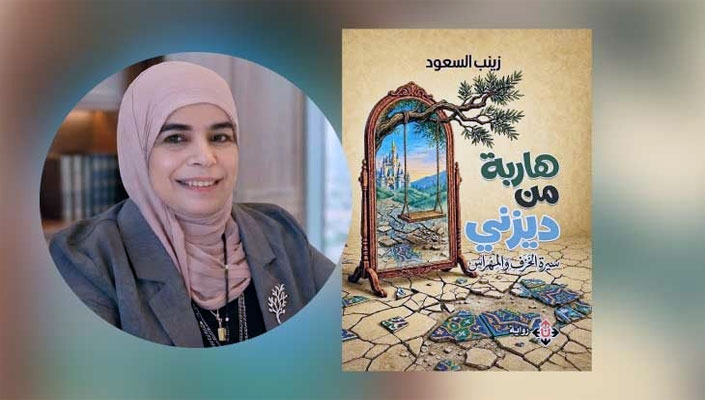
Afrasianet - Munther Kamel Lala - Zainab Al-Saud's novel "Escape from Disney.. A Biography of Ceramics and Mahras" by novelist Zainab Al-Saud, recently published by Now Publishers and Distributors, confronts its reader with this existential paradox: Can a person enjoy freedom and abundance in big cities, only to discover that something essential he lacks that does not give him false glamour?
The novel reflects on this loss through the biography of Kai Lin, a young woman born to a Jordanian father and a Chinese mother, who is divided between the harsh and discriminatory alienation of New York, and the roots of the village of Al-Maysar in Ajloun.
Lynn escapes from the hustle and bustle of canned consumer worlds to the warmth of the first house, from the cold ascension of exile to the tenderness of grandmothers, the seasons of harvest, spring and Dahnoun, and the fragrance of the grass burdened with raindrops, where the ancient "mahras" tree stands as a witness to belonging.
Hence, this reading is grounded in exploring how the "mash" has been transformed from a tool into a symbol of resilience and existence in the face of Disney's fragile world, and to answer the central narrative question: Who inherits the mash when memory becomes the last weapon of survival?
But the sociologist Vivek Chipper dismantles this illusion with a simple and harsh argument: capitalism does not survive because its subjects are convinced of it, but because they are virtually unable to escape it.
Hegemony, in his analysis, is not a matter of acceptance and faith, but rather a matter of pure material helplessness and surrender. It is from this very deconstruction, even if the novelist does not explicitly call it it, that the text unfolds.
The "Disney World" in the novel is not just a symbol of the American Dream as we are used to reading in other texts, but it is – to borrow Chipper's language – the embodiment of a domination that reverses Lynn and her father to surrender to its terms, not to believe in them.
Majid was not convinced of New York's paradise; he needed funding for his chemical research, and his daughter was no more convinced; she was stuck in a geography that lacked the tools to unwind herself, in this sense the novel drops the mask of "fake satisfaction" from Disney, revealing the structural and racist compulsions that are practiced on those living on the margins. Lynn begins her life wrapped in a glamorous Disney narrative, one that greets the visitor with the words, "Here you leave today and enter the world of tomorrow, yesterday, and imagination."
But this initial "acceptance" is quickly shattered at the first real collision with the rigid structure of the American system. In the New York detention center, neither her American citizenship nor her apparent integration protect her; her Asian features make her the target of batons and slaps, she and her Somali friend Ilhan, under the weight of what the novel calls "the curses of 9/11."
The immigrant's helplessness – not his conviction – is most evident in the father's own attitude. Majid is a respected Jordanian chemist who knows that staying in America comes at a high price, not because he has abandoned his Arabism, but simply because he has no realistic ability to escape this price if his research is to see the light of day. He escaped from the cramps of the village to the spacious Queens Prison, and has become a material surrender to his fear, even shouting at his terrified daughter: "We are strange immigrants here, no matter how many privileges we take.
Always remember that we don't belong here." His slap to Lynn, when it happened, was not an expression of his conviction in the system; it was the cry of a man who was afraid that the system would swallow him up completely if his daughter made the slightest mistake.
On the other side of the ocean, Uncle Nasser represents a different form of domination, but no less cruel: male and material domination that inhabits the village itself. Nasser wears the wipes of "Protector of Virtue," but he examines Lenny's features under what looks like an old microscope, not only to deny her moral lineage, but also to prevent her from crowding him with inheritance: "Tomorrow you will crowd us for inheritance, and it is not one of our inheritances." It is a model we know well in our literature and in our lives together: those who practice coercion in the name of religion and values, while in their retreats practice something that completely contradicts them.
This familial compulsion, however, breaks down at a rock that Nasser does not expect: the resistance of the women themselves. Aunt Maysoun is the first to break the siege, not by direct confrontation, but by something calmer and deeper: she infuses Len in Arabic, giving her what the novel describes as the "spirit of the sponge"—the ability to absorb pain, without being broken by it. Grandma Habiba goes further: she does not give weight to Lynn's features (which resemble factory workers).
As some harshly describe her, but rather gives her both proportions and pulses, and declares her right to the land in a sentence that sums up her entire position: "The tree is yours, Grandma, I named it a soft tree. For many years, Lynn thought of herself as nothing more than a fragile "porcelain shell" and surrendered to the role of victim imposed on her by the circumstances of her birth, but returning to the Ajloun Mountains and the golden plains of Houran and the hill in Irbid brought her out of a state of helplessness and perpetual leaping to another state of utter disability: effectiveness. When she stands in front of the Mahras tree with its hard, scaly bark and unbent trunk, Lynn realizes that the self is not measured by the unjust gaze of the mirror, but by its depth and rigid bark that the eye cannot see directly.
There is another line that is no less striking: Dr. Ghaith, who, with a cruel irony, was the cause of Lynn's injury as a child, transforms in the novel from a partner in an old wound to a partner in a new healing. He treats her not with a scalpel alone, but with a seemingly simple promise, but he carries the weight of the whole novel: to plant new mahras trees for her, to erect hammocks between them, to tire together and then recover together, and at that very moment she transcends the state of distraction, and discovers that her inner bark—the one she once thought was as fragile as porcelain—is indeed capable of protecting what is left of her soul.
The novel concludes when Kai Lin transforms from a fugitive expatriate branch into a fixed origin that takes root in the deepest layers of history and soil. In the final scene, she is freed from both Disney illusions and the cruelty of Queens, listening to her young daughter Habiba's crying – a name that doesn't need much explanation – while her husband Ghaith tells her that she has been accepted to study a master's degree in archaeology and anthropology.
It is precisely in this detail that I think the smartest touch of the novel is that Lynn chooses a discipline that makes her the one who examines history and excavates antiquities, after spending many years examining a subject that examines, first under the microscope of her uncle and second, the racism of the police.
This, perhaps, is the truest meaning we can read in the house of Ahmed Matar with which we opened: the trunk that bent unbroken is not just a perennial tree in Ajloun, but a portrait of everyone who carries a heavy legacy and remains standing against his will – and Lin Kai finally finds it in him.
________________
