
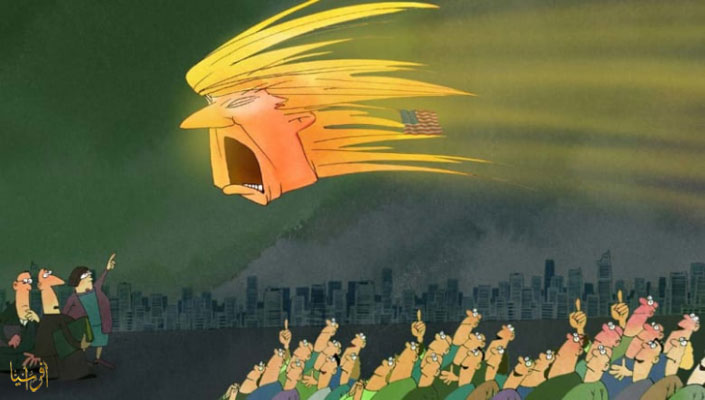
Afrasianet - Commenting on President Donald Trump's announced trade war, sweeping economic sanctions against Iran and bond market intervention, the Guardian newspaper said that "thugs are overusing their power. They all show a president using American power as a weapon at a time when Americans are impoverished in their own country."
The newspaper said that these three steps in the past week revealed the limits of Trump's economic bullying.
The United States imposed 50 percent tariffs on other $20 billion worth of Canadian goods, and then threatened to impose the same rate on the cars, trucks, parts, and steel on which U.S. companies depend.
On Monday, Treasury Secretary Scott Besant threatened Iran's trading partners with exclusion from the U.S. financial network, hoping that cooperation would achieve what months of war had been unable to do. With U.S. bond yields soaring as a result of war costs, tariffs and tax cuts benefiting billionaires, the Treasury stepped in to rein in long-term interest rates.
These are not contradictory policies, but gambling, repeatedly using U.S. economic power as a weapon without diminishing the willingness of others to rely on it.
The Trump administration's sanctions, dubbed "Victory Day," are likely the most dangerous because they expose the falsity of U.S. financial influence, and while markets have ignored the immediate threat, this situation could change if the U.S. targets an oil refinery or a major Chinese bank. Such an escalation could ignite a trade war with Beijing.
The United States has leverage, but China has pressure points, especially among U.S. farmers and the majority of Republicans, that will make it costly to use that influence.
There is a price to be paid in the long run, as countries hold each other's currencies in part because of their trust in political relations, and so Trump is testing what will happen when that trust is gone.
The moves to control the bond market are the most telling, and there is nothing new in Washington's management of yields: The Federal Reserve could have bought Treasuries long ago, but what is new is that Bescent has done so publicly to deal with the fallout from failed policies.
But Trump is responsible: his tariffs are raising input costs, his war on Iran has raised energy costs and his apathy has led to an unreassuring rise in America's food prices.
This combination has contributed to higher inflation expectations and higher long-term bond yields, hence Trump's team stepped in to prevent rising interest rates.
The newspaper said the president was willing to use the state's power to cut borrowing costs while raising other costs through tariffs, war and cuts to welfare programs. Besant wants to halt rising long-term bond yields that fuel investment and Washington's debt interest bill.
Besant's most important question is: Why protect markets from the consequences of Trump's actions, without protecting families?
In 2025, Trump's tariffs led to an average tax increase of $1,000 per American household. More than a quarter of Canadian exports to the United States are now subject to large tariffs or are threatened with tougher tariffs, as Ottawa's response has not yet begun, but will take its course in September, and because production in North America is organized around these trade flows, the tariffs will make American manufacturing more expensive, not less.
Why Canada? The Guardian replies that with Washington largely abandoning trying to change China's economic model, Canada is an easy target. Robert Reich, a columnist for The Guardian, is right: Trump is targeting a friendly neighbor because that's what bullies do.
The Guardian commented that this situation cannot continue, as US economic power depends on the desire of other countries to remain within a US-dominated system. Trump believes that their dependence on him is his weapon, but the more he uses it against them, the more they need to look for a way out.
The Financial Times commented in a similar editorial, saying that Trump's war against Iran has a "China problem," as the United States cannot completely isolate Tehran as long as trading partners do not cooperate with it. Besant's "Victory Day" sounded like a series of warning shots fired from afar.
Moreover, the campaign to turn Iran into an "economically pariah state" is not a campaign that the United States can accomplish entirely on its own, but rather requires cooperation from Tehran's main trading partners. China, the largest of these partners, has already shown an unwillingness to cooperate.
As Besant acknowledged, rushing to impose secondary U.S. sanctions on non-compliant countries could "destroy the global financial system."
Washington's problem is that Iran has been under multiple sanctions for years, and since last September under U.N. measures reimposed over Tehran's violations of the 2015 nuclear deal that Trump withdrew from in his first term.
There is little left inside the republic to directly target. As a result, the new U.S. effort aims to sever trade ties between Iran and its key trading partners, including China, the United Arab Emirates and Turkey, in the areas of aviation, shipping, digital assets, gold and technology, as well as oil.
The United Arab Emirates, a U.S. ally and the world's largest exporter of goods to Iran, announced last week the suspension of trade and economic ties after accusing Tehran of firing two ballistic missiles into its territory.
But Beijing, which buys up to 90 percent of Iran's oil, warned the United States on Tuesday that it would retaliate if Chinese companies were included in secondary sanctions related to Iran.
Any significant increase in U.S. sanctions on China could undermine sensitive trade negotiations just a month before Trump and Xi Jinping are scheduled to meet in Washington.
Even if the United States succeeds in inflicting significant economic damage on Iran, there is no guarantee that Tehran will capitulate.
________________
