
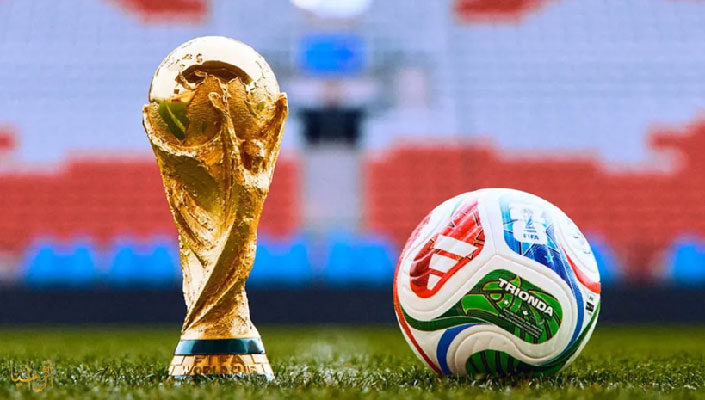
Afrasianet - With a week to go until the end of the 2026 World Cup, it may be too early to make a definitive historic verdict on the tournament hosted by the United States, Mexico and Canada.
The reverberations of the celebrations in New Jersey have not yet dried up, and the reverberations of the final that brought down the curtain on the World Cup have not completely subsided, as real reviews need some time, until the first spurt subsides, the memories settle in the minds of the followers, and the results of decisions and events become clear after the dust of the noise has settled.
But trying to evaluate seems like an irresistible temptation, so where can this World Cup, which ended with the scene of Argentina's Leandro Paredes fighting Spain's Gavi, go down in the annals of history?
Major tournaments need distance, stadiums need to calm down, noise to subside, and first emotions to subside, before memory begins to order events, and before the consequences of decisions made in moments when no one knew the magnitude of their impact became clear.
A championship that has transcended its scandals
The case of American player Volarin Balogne could have turned into one of the tournament's biggest crises: at one point, the decision to bow to political pressure, and abandon a 64-year precedent in order to ensure a particular player's participation, seemed to have a profound impact on the image of the tournament, but football doesn't always give scandals enough time to settle in.
Major tournaments have their own momentum, moving quickly towards the end, pushing everything in front of them, burying past events under new goals, other matches and successive celebrations, yet the decision itself may later become more important than it seems now.
Switzerland's Gianni Infantino, the president of FIFA, did something similar with veteran Portuguese star Cristiano Ronaldo and, according to his critics, re-engineered the criteria for qualifying for the Club World Cup in a way that ensured Argentina's Lionel Messi. Are we facing transient exceptions, or a new principle?
It may become natural in the future for celebrity players to receive special exemptions, because in modern football calculations, incomes have become more important than justice or even the interest of the game itself, and breaking income records was one of the major headlines of the 2026 World Cup.
But there is another possibility, too, as these decisions could intensify opposition to Infantino, especially as a growing number of British politicians, and some American politicians, have begun to direct criticism of FIFA and its president. In this context, expanding the World Cup to 64 teams may not be just a mathematical idea.
It could become part of a broader political calculus as the FIFA president seeks to broaden his base of support, especially after the damage that U.S. and Canadian immigration policies have done to Infantino's image as a defender of the Global South.
What was buried will come back
It is not only the Bagan case that may return to the forefront: dealing with Iran, for example, has been one of the most controversial and may set a troubling precedent beyond this heroism.
Ticket prices may drop at the next World Cup in 2030, but something fundamental has already changed: the idea that the average fan, who goes to league games every week, gets a reasonable share of World Cup tickets seems like a thing of the past.
Thus, the World Cup gradually moved away from its image as a large-scale mass event. In the last edition of the World Cup, it looked more like a luxury event, where the value of attendance is determined by the ability to pay more than a long affiliation with the game.
The hosts also paid
The cost borne by host cities will only be fully apparent over time. There is a financial cost, of course, but there is also a social and environmental cost.
In the United States and Canada, some cities have seen campaigns to clear the streets of the homeless, while people already living on the margins of society have been deprived of some of their few possessions, including identity documents and medicines, and in Mexico, protests have escalated over water extraction and environmental damage associated with some World Cup projects.
Thus, the question of the legacy of the tournament is not only about who won the title, or the number of goals scored, but also what the tournament has left behind in the cities that have hosted it. Isn't that the legacy that has become a pillar in hosting major sporting events?
Disaster or Ordinary Heroism?
In the midst of these criticisms, the Italian newspaper La Gazzetta dello Sport described the World Cup as a "disaster", with the newspaper publishing two full pages on several issues, including ticket prices, the issue of Balogne, the weather, the increase in the number of matches, and the decline in breaks.
The description of the disaster may be an exaggeration, but what happened next added to the story: the newspaper's share of tickets for the final was reduced from five to two.
It wasn't entirely clear if the two were related, but the mere prospect of a media outlet being denied access for rejecting the official narrative that this was the greatest World Cup of all time was enough to raise troubling questions.
It was part of an uncomfortable relationship between FIFA and the media during the tournament. Some stadiums, especially in Houston and Atlanta, have gone to great lengths to welcome media professionals, but according to other journalists, the basic organization and media equipment have been worse during at least the last six editions of the World Cup.
The average public may not care whether Wi-Fi is working at the media center, but small details often reveal the bigger picture. The level of the game itself was good, but it certainly wasn't as great as Infantino's portrayal, as the tournament saw spectacular and exciting matches, from Brazil and Japan to Morocco and the Netherlands, from England and Mexico to Argentina and Cape Verde, Norway and Côte d'Ivoire, Belgium and Senegal, Norway and Brazil, Argentina and Egypt.
But the irony is that most of these matches came in the round of 32 or the round of 16. The Round of Eight did not offer the same level of inspiration.
The semi-final was even more exciting, with Argentina's victory over England in a match that will be remembered, especially because of the breakdown of the match, a collapse that will give analysts food for debate for years.
The Spaniards quickly asserted their superiority, and the French could not find a way to change the course of the match. Then came the final, and that was the biggest problem.
The ending that rearranged the championship. The final was not good. It was gloomy, heavy, and lacking the drama that the world usually expects from the last match of the World Cup.
The better team won, in its usual calm and showy fashion over the course of two hours. But the final scene seemed, in part, to be a direct result of Argentina's leniency earlier in the tournament.
Argentina whose players are more skilled at fighting games than football would have imagined that they were fighting in one of the miserable dialogues in Buenos Aires or Rosario.
As always happens in major tournaments, the end is not just the last game. The 2026 World Cup now looks below the level of the 2022 and 2018 editions, not to mention tournaments that have become historical milestones, such as the 1980s or the 1998 World Cup.
But the final verdict will take time, perhaps historical memory will place it in a better place than the 2014 and 2006 editions, and perhaps the opposite will happen, and in the end, perhaps the most accurate description is that it was not a great tournament, but it was good.
This, far from FIFA's hype and repeated assertions that it made the "greatest World Cup ever", may be sufficient judgment, as not every tournament is required to go down in history as the greatest. Sometimes, it is enough to be good.
But the 2026 World Cup may be remembered, in particular, not only for the matches it played in, but also for the questions it left off the pitch about money, politics, immigration, ticket prices, host cities, FIFA's relationship with the media and the limits the game can cross in the name of revenue or profits. In that sense, the tournament may not have been great. But it was revealing.
________________
