
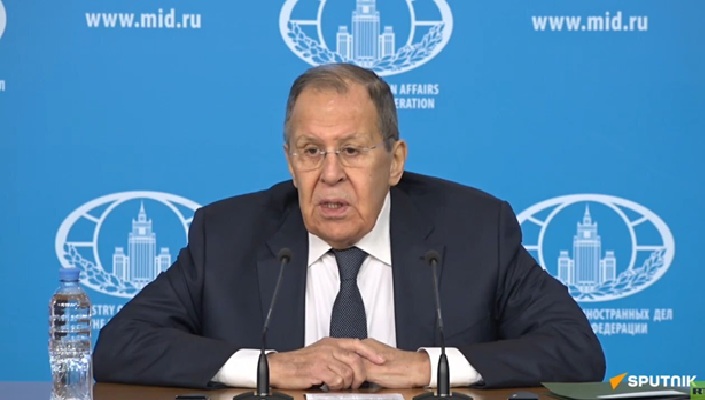
Afrasianet - Russian Foreign Minister Sergey Lavrov said that the world today is witnessing profound changes regarding international law and the introduction of a "rules-based" system written by a single system that is not in Europe's interest.
Lavrov said during the press conference on the results of the work of Russian diplomacy for 2025: "The rules that supposedly form the basis of a world order that suits the West have been completely written off. It's a game in progress: the strongest are right. We are all witnessing this, but the consequences of this policy are not limited to the countries of the Global South and the Global East, but the trends of the crisis are exacerbating within Western society itself."
He stressed Russia's readiness to work with any party that wishes to cooperate deliberately and without blackmail or pressure, stressing that Russia will resolutely defend its interests and will not allow its legitimate rights to be violated.
The following are the most prominent statements of Lavrov:
• The U.S. attack on Venezuela is a brutal armed invasion.
• Russia is deeply concerned about the overt attempts to destabilize the situation in Iran.
• We are observing profound changes in international law and the introduction of a "rules-based" system written by a single system that is not in the interest of Europe.
• What President Trump is talking about reflects the competitive conflict and we have talked repeatedly about recent economic developments.
• It was previously difficult to imagine that discussions on Greenland would lead to the issue of maintaining NATO unity.
• Russia will constantly defend its interests and will not allow its legal rights to be underestimated.
• We are ready to work with all those who treat us in the same way and who wish to dialogue with integrity and based on mutual and balanced interests.
• The isolation that the West claimed to have imposed on Russia proved to be a failure with a large number of international events visited by foreign leaders, chief among them the celebration of the 80th anniversary of the victory over fascism.
• Many countries do not want to forget the lessons the world learned in World War II, as evidenced by the 80th anniversary celebrations of the end of World War II in Beijing last September.
• Among the ongoing results of the past year this year are cooperation with the countries of the Commonwealth of Independent States (CIS) as well as the Collective Security Organization and the Shanghai Cooperation Organization (SCO), and there are many pioneering initiatives dedicated to the Eurasian Partnership.
• Relations between Russia and China are unprecedented in terms of level and depth.
• Ties with North Korea helped liberate Kursk Oblast from Ukrainian forces.
• Our relations with the BRICS group have been strengthened and preparations are being made for a meeting at the highest levels at the planned Russia-Africa summit during the Cairo meeting of foreign ministers.
• The United Nations has taken important steps by declaring "Anti-Colonialism" and "Combating Unilateral Sanctions".
• Russia is committed to finding a diplomatic solution to the Ukraine crisis.
• The history of the Ukrainian crisis from 2014 to 2022 is worth considering, as Russia has complied with all agreements and treaties.
• There has never been any ill will on the part of Russia to resolve the Ukraine crisis, but it is the West that has violated all the agreements.
• We seek to remove all the root causes that caused this crisis, and that turned Ukraine into a threat to Russia's national security by supporting the Nazi regime that came to power in a coup d'état in 2014.
• The settlement of the Middle East crisis must be through the establishment of an independent Palestinian state.
• Russia expressed interest in contributing to easing tensions at all levels, including over Venezuela and Iran.
• The Charter of the United Nations remained the recognized standard of conduct for any country, everyone was willing to discuss violations and there were serious discussions. After the collapse of the Soviet Union, there was a phase of using international law as a basis for communication, and this was replaced by a unipolar world where the United States and NATO were putting forward the concept of "the end of history."
• In 2000, President Putin began to find a place for Russia on the international stage, and the West did not listen to President Putin's speech at the Munich Security Conference in 2007.
• There is a continental organization that guarantees the security of Eurasia as the largest continent (compared to Africa or Latin America), while it is the continent that is home to a host of great civilizations including Russia, China, Persian, Arab, and India.
• We do not seek to build a bureaucratic structure, we must first find a comprehensive continental dialogue, since these countries that live on such a large area of the globe, so they can establish an equal dialogue with the countries of the continent and with the regional organizations that we are working to build cooperation with.
• All organizations operating on the continent can be considered as the basis for the future of Eurasian security.
• The first person who paid attention to Eurasian security was Yevgeny Primakov, who said that the multipolar world was formed and cooperation began in the Russia-China-India triangle, which later turned into BRICS with the accession of Brazil and South Africa.
• The process of shifting to multipolarity is ongoing and unstoppable. The problems that exist between the United States and a large number of countries in the world, including in Europe, due to unfair competition will have a place and will continue for a long period of time.
• While the colonists recognized the independence of their colonies, relations remain unbalanced. Africa's growth center reflects a historical process and development of the economy, infrastructure, and use of esoteric resources, and one day the colonizer will have to deal differently with the former colonies.
• We need to build a dialogue on how to "regulate multipolarity" at some point the major players will have to come to an agreement
• The Trump administration is the only administration that has been able to understand the root causes of the Ukraine crisis.
• The Trump administration is pragmatic and recognizes the need not only to unite a large number of countries but to take into account the interests of states.
• Reviving the OSCE seems impossible as the OSCE, which was founded on the principles of equality and consensus, has reached the bottom, while turning into a tool used by the West and directed daily against Russia.
• We have no illusions about the OSCE, and we are only in the OSCE to support some of our fellow States in the countries of the Commonwealth of Independent States, Hungary and Slovakia, where some understand the catastrophic situation that this OSCE has reached.
• I don't know if the OSCE will get a place under the Eurasian Partnership.
• The agreement between Gazprom and the Serbian Oil Industry Company carries a mutual interest, which Serbian President Aleksandar Vucic has talked about.
• Lavrov: The EU has announced more than once that it will consider Serbia's accession, only after the Kosovo issue is reconsidered.
• Since last year, we have started to communicate and have formed a mechanism for dialogue to resume the work of the Russian and American embassies in Washington and Moscow.
• We focused on the main problems related to Russian-American diplomatic relations, specifically the issue of the property held by the American side (5 Russian sites seized by the Obama administration).
• And that's still going on. And colleagues in Washington don't want to talk about it.
• The Trump administration has proposed solutions to the Ukraine crisis that take into account the need to address the root causes of the conflict.
• Zelensky and Europe are hysterically trying to impose the idea of a ceasefire in Ukraine. But we will not allow the Zelensky regime to make a truce to rearm and use those weapons against Russia.
• They talk about providing security guarantees to Ukraine. When they talk about "security in Europe", and the security guarantees given to the current Nazi regime in Ukraine, but they don't talk about restoring the rights of Russian speakers and banning the Russian language and the Russian Church.
• All of those points (language, culture, and church) were present in President Trump's proposal (28 points).
• The 20-point proposal did not include these points, but it generally speaks of tolerance and adherence to EU rules in preserving minority rights.
• Ukraine is in a very bad situation both militarily and politically.
• We count on colleagues in the United States to deliver on their promises that they have conveyed to us.
• The detention of oil tankers on the high seas does not conform to maritime laws. It is an example of unilateral actions that test international law and put it to the test.
• We call on Washington to follow through on its promises to release those held on the Russian oil tanker.
• Russia sees contradiction in Trump's actions on international security issues.
• There can be no 100% match between two superpowers.
• What Marco Rubio said during the Riyadh meeting is that the United States "recognizes the existence of the national interests of other great powers." The interests do not and will not fully coincide between Russia and the United States, but when they do, it is a grave mistake not to exploit this congruence in cooperation in investment and economic projects.
• The European Union holds events with Central Asian countries, but it is trying to obstruct the work of the Eurasian Economic Union and sees no future for Central Asia except in cooperation with the European Union.
• Brussels insists on changing Armenia's legal rules and regulations in order to fully join the European Union, including joining sanctions against Russia, and that is why it is impossible for Armenia to cooperate with the Eurasian Economic Union and the European Union at the same time.
• Armenia has become a full member state of the Eurasian Economic Union, and Armenia's GDP has doubled over the past decade for this reason, and the volume of Armenia's trade exchange with Russia has reached a record $14 billion. Talk of Armenia's desire to join the European Union while maintaining the status of the Eurasian Economic Union is difficult.
• The head of European diplomacy, Kaya Kallas, stated that Europe would act in Armenia in the same scenario as Moldova, where the Moldovan community in Europe was the reason for Sandu's victory.
• There are political forces in Moldova that are aware of what is going on and rely on the majority of the Moldovan population.
• The Sandu regime did not receive the majority of the votes of the population living in Moldova.
• The Baltic states have become a platform for Russophobia and hatred of everything Russian, and officials in the Baltic states are participating in this process.
• Statistics in the Baltic States indicate a decline in GDP and other economic and demographic indicators.
• Europe has been turning a blind eye to human rights abuses in the Baltic states, including the violation of the rights of Russian speakers before and after its accession to the Union.
• The only person who makes the decision on the use of nuclear weapons is the Commander-in-Chief of the Armed Forces, the President of the Republic, which is documented in Russian nuclear doctrine.
• Interested in establishing free and open cooperation in the Arctic region when security, environment, and economic issues stabilize. There is the Arctic Council and we have not stopped the work of this Council.
• I don't see any circumstances that would lead to the belief that Greenland and Iceland would want to conclude a mutual aid treaty with Russia because of U.S. pressure.
• Discussions about Greenland from the repertoire of the colonial era.
• Greenland is not a natural part of Denmark but the product of a colonial invasion.
• There is no evidence that Russia or China is planning to seize Greenland.
• Crimea is as important to Russia's security as Greenland is to the United States.
• Russia monitors developments around Greenland and the United States, but has nothing to do with the issue.
• I have no doubt that the United States is fully aware that Russia and China are not planning to take over Greenland.
• The people of Greenland have the right to self-determination and we have no ambitions there.
• It is probably difficult to agree on anything with the current leaders in Europe.
• Our relationship with China has reached an unprecedented level, which is what Chinese President Xi Jinping and President Putin have talked about.
• The relationship with China is based on historical memory, as the two leaders participated as guests of honor in the 80th anniversary of the victory in World War II.
• The talks between Presidents Putin and Xi Jinping put relations on a new level, including humanitarian cooperation as there were hundreds of different events in our two countries.
• There is the initiative of the two years of "education" between Russia and China, in addition to cultural and youth exchanges, in addition to contacts in the fields of sports and archiving to preserve cultures, identity and national memory.
• Visa exemptions were exchanged between the two countries, which increased the number of tourists between the two countries.
• We have given some information that affects our security and conveyed to the Japanese the disapproval of the appearance of the offensive systems of the United States on the territory of Japan.
• Mobile Typhoon systems have appeared and we are told are "temporary for training." The information says these systems have not been withdrawn from Japanese territory.
• Japan's defense minister announced the deployment of medium-range missiles near Taiwan, which is not a good move. We are reaching out to Japan's neighbors and saying that such steps affect security stability in the region.
• We must return to the principles of disarmament found in the Japanese constitution, but unfortunately, the current administration neglects our concern and does not care about it, which is an unhealthy situation.
• Against this background, I would like to point out that cultural and human cooperation, despite the contradictions at the political level, is still going on as annual concerts are held frequently with unparalleled success in the Japanese capital.
• This year there will be a number of Russian cultural events as well as Japanese events in Russia.
• U.S. sends public signals to Russia that it is necessary to start talks on strategic stability with China.
• There have been no expert-level contacts between Russia and the United States on the issue of strategic stability.
• The United States is still actively working on the deployment of weapons in space.
