
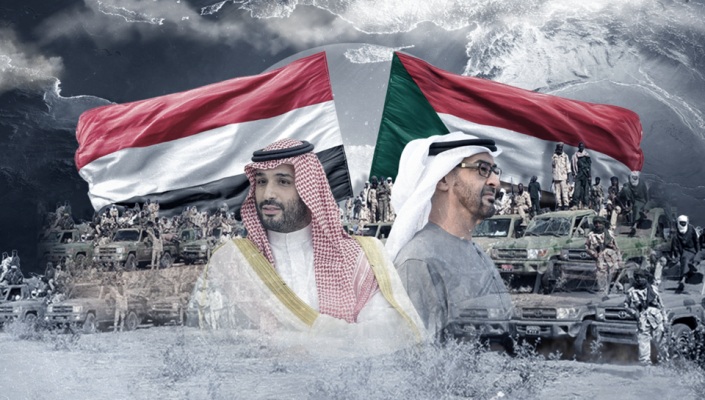
Afrasianet - Tensions between Saudi Arabia and the United Arab Emirates are escalating, the latest of which was a sharp criticism by the Saudi Al-Ekhbariya channel against the UAE government, accusing it of media incitement against the kingdom.
The channel confirmed in a report broadcast on Sunday that Saudi Arabia will not hesitate to take the necessary measures against anyone who harms or threatens its national security.
As this political tension between Riyadh and Abu Dhabi escalates, questions are emerging that go beyond apparent differences to the core of the geopolitical conflict in the region.
One of the most prominent questions is: Have the waterways become an area of undeclared competition between the two Gulf neighbors?
This question leads us directly to Yemen, which stretches over 2,000 kilometers of coastline on the Indian Ocean, the Arabian Sea, and the Red Sea, through which about 10 to 12 percent of global trade passes. Yemen also controls the vital Bab al-Mandab Strait, through which commercial and military vessels, including those transporting Saudi oil, pass.
The importance of Yemen and sea lanes for trade and regional security
Yemeni researcher and specialist in Yemeni affairs, Baraa Shaiban, an associate fellow at the British Royal Institute of Defence and Security, points out that the UAE has a large presence in regional waters, through its investments in areas such as the Somaliland region, specifically in the port of Berbera, in addition to some Emirati military bases in Eritrea and others it had in Yemen before its recent withdrawal from there at the end of 2025.
In an interview with BBC News Arabic, Shaiban said that the UAE's regional presence was dependent on a heavy presence in regional waters and close relations with the United States of America, to lift some of the burdens on it (i.e., from the United States) in terms of maritime security and the safety of international navigation, which in his opinion led to a kind of rivalry between the UAE and Saudi Arabia in the region.
Through its investments in establishing a network of armed forces and military bases in Yemen, as well as through its investments in the port of Berbera in the Somaliland region, the UAE has been seeking to strengthen its presence and influence in the port of Aden, Shaiban said, noting that control of this port gives it a prominent presence in regional waters. However, Shaiban said the project ended after Saudi Arabia, through its support for the Yemeni government, was able to get the UAE out of Yemeni ports and the country in general.
On the other hand, Emirati political strategist Amjad Taha said that this file reads across several levels: "First, Aden is like the natural southern gateway to Yemen, where its stability serves Yemen in particular and the region in general. Second, Somaliland is a logistical point on the other side, helping to diversify routes, relieve pressure and support local development," he said, noting that the relationship between the two banks (i.e. Aden and Somaliland) is complementary, and that the better services on both banks, the lower the activity of piracy, smuggling and extremist groups.
"Today, Bab al-Mandeb is a global chokehold, and any disruption in it affects trade, energy, food and even maritime insurance, so its security is protected not by speeches, but by the living economy on both banks, which prevents chaos and the infiltration of terrorists, including groups such as the Muslim Brotherhood and jihadists," Taha said in an interview with BBC News Arabic.
How could Emirati-Israeli cooperation raise Saudi concerns?
This Emirati deployment was interpreted as a form of cooperation with Israel after the normalization of relations between the two parties and after Israel's recognition of the Somaliland region as an independent state.
This approach collided with a different Saudi vision, especially with regard to the Red Sea.
"If we want to see the Saudi approach, at least with regard to the territory of Somaliland, the Saudis consider that there is some form of alliance between Israel and the UAE to strengthen Israel's presence in areas that have not traditionally been friendly to Israel," said Yemeni researcher Baraa Shaiban, suggesting that Israel is likely trying to take advantage of the Abraham Accords it concluded with the UAE in 2020 to strengthen its presence in this important part of the world.
For his part, Amjad Taha considered that sea lanes are not just a geopolitical luxury for the UAE, but are the heart of the infrastructure for economic prosperity, as the UAE relies on being a link between East and West, between producer and consumer, and between market and opportunity. Any disruption in these corridors is immediately reflected in inflation and supply chains, which the UAE is trying to avoid, he said.
Maritime lanes between Saudi Arabia and the UAE
The overlapping interests of the powers acting in that region and the changes that could occur in the balance of power made the picture even more complicated.
In Baraa Shaiban's view, the UAE has failed in Yemen in Saudi Arabia's favor, having invested heavily in establishing a massive military presence and in supporting the Southern Transitional Council. However, in his opinion, it is still present through its military presence in Eritrea and through its presence in Sudan through its support for the Rapid Support Forces, considering that any future Emirati intervention depends on its assessment of the risks of competition with Saudi Arabia over the straits and territorial waters.
In this context, Amjad Taha believes that the interests of Saudi Arabia and the UAE in the Red Sea are complementary and serve each other, despite the existence of economic overlapping areas between them, such as ports and investments, pointing out that this is normal between two large countries, according to him. Taha pointed out that Saudi Arabia and the UAE face the same risks, such as the challenges of navigation, the smuggling of weapons and drugs, terrorist groups, threats from the Houthi group Ansar Allah, and the disruption of trade. Therefore, the Emirati analyst believes that the Emirati project in the Red Sea is not a project of conflict but a project of stability.
He considered that if influence means the ability and responsibility to protect trade, raise the efficiency of ports and support stability, in his opinion, the UAE exercises this natural right as a global trading country.
He pointed out that Abu Dhabi seeks to consolidate the security of navigation, including combating piracy and smuggling and protecting international corridors, stressing that these efforts cannot succeed in isolation from collective action, adding: "Abu Dhabi does not seek a sea that follows it, but a sea that works for everyone."
Saudi Arabia: Military alliance with Somalia and Egypt
All this comes amid reports published in Western newspapers that Saudi Arabia is seeking to reduce the UAE's influence in the Horn of Africa region by establishing a new military alliance with Somalia and Egypt.
This information emerged after notable milestones, most notably Somalia's cancellation of its security agreements and port agreements with the UAE, justifying what it described as the UAE's violation of its sovereignty after the UAE's smuggling of the leader of the Southern Transitional Council in Yemen, Aidarous al-Zubaidi, through the region of Somaliland, according to a statement by the Saudi-led coalition to support legitimacy in Yemen.
The issue of sovereignty appears to have taken on a more sensitive meaning for Somalia because of what it sees as the Emirati and Israeli rapprochement with Somaliland's territory, while Saudi Arabia and Egypt have expressed support for the territorial integrity of Somalia and condemned Israel's recognition of Somaliland as an independent state.
Thus, the Saudi pursuit of a new military alliance with Somalia and Egypt can be placed in the context of countering the UAE's and Israel's attempts to expand their regional presence, which explains the reasons for the strategic tensions over the region's vital ports and sea lanes that may be subject to unexpected shifts as a result of the Saudi-Emirati rivalry that has finally come to light and the accompanying influence of new players.
