
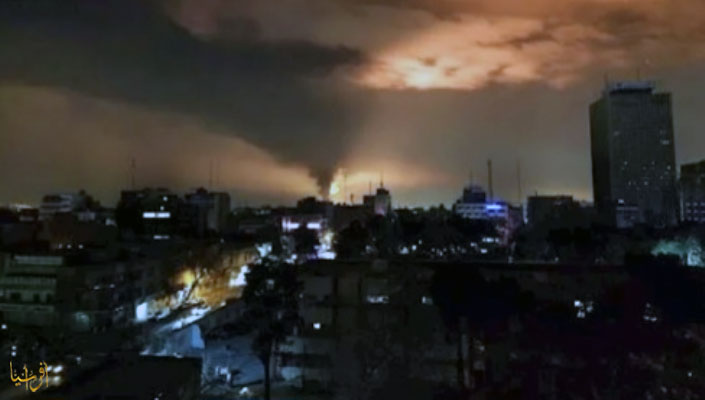
Afrasianet - The military confrontation between the United States and Iran in the Strait of Hormuz has entered a new phase of qualitative escalation, following the launch of air strikes by US forces targeting two rocket launchers of the Iranian Revolutionary Guard Corps (IRGC) on the strategic island of Lark.
A U.S. official confirmed that U.S. forces removed mines from international shipping lanes and bombed the two rocket launchers as they prepared to launch missiles carrying naval mines, stressing readiness to protect the free flow of trade.
On the other hand, the Islamic Revolutionary Guard Corps (IRGC) announced that a number of its fighters and citizens were killed and wounded as a result of what it described as "American-Zionist aggression", vowing to retaliate. He said the attack was a "strategic and fatal mistake" made by President Donald Trump in the midst of the economic war, and would entail heavy economic and military costs that would change the balance of power.
Confrontation scenarios
In an analysis of this development, military expert Brig. Gen. Elias Hanna explains that Iran's resort to launchers that fire missiles carrying naval mines – such as the "Fajr-5" missiles developed from Chinese technology – is an extension of the asymmetric warfare system adopted by Tehran since 1979 and the tanker war.
According to Brig. Gen. Hanna, these missiles drop floating or deep mines that are scattered before hitting the designated point, with the aim of raising the level of risk and mining the trajectories to force navigation to comply with the Iranian vision.
Hanna says that this American preemption comes as a continuation of 13 days of continuous air strikes on the Iranian naval system and shores to weaken it, as President Trump seeks to rob Tehran of the "oil and time" cards by imposing maritime surveillance around the clock, especially after the announcement of the US Central Command to remove mines from shipping lanes.
In the face of the lack of a direct Iranian response in the past, the hypotheses of destroying or rebuilding the Iranian system, or preparing for a more dangerous scenario through pre-emptive operations to confront the blockade, emerge, according to the military expert, which makes the nature and scope of the expected response the main criterion for charting the course of things to roll out in the coming hours.
Geographical deterrence equation
Lark Island, along with Hormuz, Qeshm and Bandar Abbas, has been the four main joints of Iran's naval grip on the strait since it was closed when the U.S.-Israel war began at the end of February.
Lark is the closest Iranian point on which the Revolutionary Guards Navy is based to manage navigation and direct ships towards Iranian routes, whether passing between Lark and Qeshm or south of Lark, opposite the Omani route, which was established to alleviate the shipping crisis and near the Omani coast, which is used by most ships to avoid strikes, and the closed (red) international route.
The latest US strikes come after a commercial vessel was attacked on Saturday near Musandam Island in the Omani route, triggering the response formula based on Washington's targeting of Iranian launch points and command and control centers.
Although navigation has dropped by more than 95 percent since the war began, a few dozen ships (some turning off tracking devices) continue to move amid Iranian attempts to establish authority on the ground by intimidating ships and forcing them to comply with IRGC orders.
________________
