
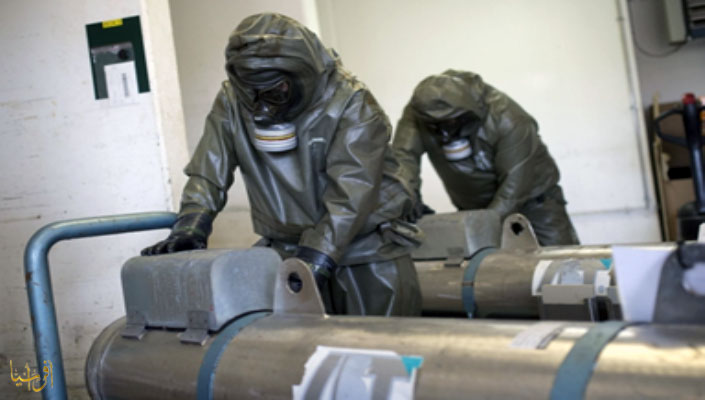
Why the OPCW is excluded from working in Syria?
Afrasianet - In 1997, the Organization for the Prohibition of Chemical Weapons (OPCW ) was established to implement the Chemical Weapons Convention .Since then , the OPCW has been responsible for investigations into the alleged use of chemical weapons, with the exception of investigations involving States that are not parties to the Convention.
In such cases, the Secretary-General should cooperate with the organs provided for in the Chemical Weapons Convention in conducting investigations in accordance with the guidelines and procedures of the United Nations Chemical Weapons Mechanism (A/44/561) and the relevant provisions of the Chemical Weapons Convention.
But recently... The Syrian Arab Republic Mission to the United Nations in New York, in cooperation with the United States, Canada, the United Kingdom, France, Germany, Qatar and Turkey, held a high-level event during which it announced the launch of an "international task force" led by Syria, aimed at identifying, securing and destroying any potential remnants of the chemical weapons program linked to the former regime.
Officials stressed that the process will be costly and time-consuming that could extend for months or years, under complex regional conditions .
Syria's ambassador to the United Nations, Ibrahim Olabi, said, "Syria has transformed from a country that was accused of hiding its chemical weapons program to a country that is leading international efforts to eliminate it once and for all.
This shift, which excludes the operation and control of chemical weapons by specialized organizations affiliated with the United Nations, establishes regional and international groups and blocs that look to act as an alternative to the international organization.
The most dangerous precedent in this regard is what happened when the World Peace Council was established, which was a deliberate model for the abolition of the role of the United Nations in the world.
Is the world gradually abandoning the United Nations?
By resolution A/42/37 C (1987), the United Nations General Assembly, by its resolution A/42/37 C (1987), and reaffirmed by the Security Council in its resolution 620 (1988), established the Secretary-General 's mechanism for prompt investigations in response to allegations of possible use of chemical, bacteriological (biological) and toxin weapons that may constitute a violation of the 1925 Geneva Protocol or other rules of customary international law If any Member State submits a report to the Secretary-General on such allegations, the Secretary-General is authorized to conduct an investigation to ascertain in an objective and scientific manner the facts of the matter, including the dispatch of a fact-finding team to the site(s) of the alleged incident(s), and to inform all Member States of the results of the investigation.
The United Nations Special Investigative Mechanism is not a permanent investigative body. Instead, Member States nominate consultants, qualified experts and analytical laboratories who are then included in a list They may be called upon to support the realization of the United Nations emergency investigative mechanism, in accordance with the guidelines and procedures endorsed by the General Assembly in resolution A/45/57C (1990).
In 2007, the Office for Disarmament Affairs convened two expert meetings pursuant to resolution A/RES/60/288 to discuss guidelines and procedures for United Nations anti-personnel mine measures, in particular taking into account developments in the biological field. The meetings resulted in updated annexes focusing on biotechnical aspects relevant to the investigation of alleged use.
With regard to chemical weapons, the Organization for the Prohibition of Chemical Weapons (OPCW) was established in 1997 to implement the Chemical Weapons Convention.
Since then , the OPCW has been responsible for investigations into the alleged use of chemical weapons, with the exception of investigations involving States that are not parties to the Convention.
In such cases, the Secretary-General should cooperate with the organs provided for in the Chemical Weapons Convention in conducting investigations in accordance with the guidelines and procedures of the United Nations Chemical Weapons Mechanism (A/44/561) and the relevant provisions of the Chemical Weapons Convention.
As for the Biological Weapons Convention, there is no equivalent implementing agency, and therefore the United Nations Biological Weapons Mechanism, which is distinct from and independent of the Biological Weapons Convention, is the only international mechanism to investigate the alleged use of biological weapons.
As such, the efforts of the United Nations Office for Disarmament Affairs (UNODM) in recent years have focused on strengthening the readiness of the United Nations biological weapons machinery.
In 2018, the UN Secretary-General released his disarmament agenda "Securing our common future" and under the Directive "Ensuring respect for standards against chemical and biological weapons", Agenda Action 10 addresses the readiness of the United Nations to investigate the alleged use of biological weapons through the UN Biological Weapons Mechanism.
Where will the court get its legitimacy?
An important source of the Court's legitimacy is the fact that victims, who have suffered the horrific consequences of chemical weapons, are demanding accountability.
This Court is not an example of victor's justice or selective justice, but rather responds to demands for justice from those most affected by the use of chemical weapons.
Legitimacy also comes from the universality of al-Qaeda and global calls for accountability for perpetrators as evidenced by numerous Security Council and UN General Assembly resolutions.
Why is there impunity for the use of chemical weapons?
The prohibition of the use of chemical weapons in theory is one of the most universally accepted norms in international law. Despite this fact, the abundant evidence gathered by international bodies, such as the Organization for the Prohibition of Chemical Weapons (OPCW) and the International Mechanism for the Prohibition of Chemical Weapons (OPCW) and the International Mechanism, shows the use of these weapons on an unprecedented scale in recent years .
This lack of justice promotes impunity for what was once one of the most important fundamental rules of international law, which undermines the absolute nature of that rule, and increases the likelihood of the recurrence of these atrocities in the future.
Isn't it expensive to establish and operate international tribunals?
The court will be less expensive than other international courts and tribunals. Several steps have been taken to reduce the cost of the proposed court, including:
Phases as needed: The court will reduce the time and costs associated with its initial work through a phased approach, with the main sections first established and the other sections on standby/operational with a small number of staff until deemed necessary as the investigation progresses. We will also work with flexible staff to ensure that trials/prosecutions are conducted quickly and efficiently.
Evidence is mostly collected: The Tribunal can collaborate closely with and build on existing investigative efforts, in particular the OPCW and the International Impartial and Independent Mechanism (in the case of Syria), which significantly reduces the time and burden associated with initial investigative efforts and links the proposed tribunal to existing investigative/prosecution structures.
Why don't existing courts meet this need?
However, in some cases, when the OPCW and the International Mechanism for the Prohibition of Chemical Weapons (OPCW) and the International Mechanism for the Prohibition of Chemical Weapons (OPCW) can gather evidence of the use of chemical weapons, they do not have a criminal judicial mechanism to adjudicate on this evidence.
Therefore, there is no other enduring option to prosecute the use of chemical weapons internationally.
Some States seek domestic prosecutions, and while these efforts should be pursued, the use of domestic jurisdiction should be directed at International options when possible, because international alternatives send a strengthened global attitude toward the international norm (given that the collective efforts of governments), which are proactive rather than domestic, are not constrained by domestic and legal considerations, and have more resources available than domestic war crimes units that are often operating at their full potential.
Where will the court get its authority to try individuals?
The call for the establishment of a tribunal stems from a global norm supported by strong treaties and resolutions in the UN Security Council and the UN General Assembly as well as the Organization for the Prohibition of Chemical Weapons (OPCW).
The tribunal will be established under a multilateral treaty signed by several countries from around the world. This geographical diversity would further enhance the legitimacy of the court.
These countries would come together to prosecute crimes collectively and could prosecute them individually if they wanted to. They would do so through a "mandate" Their right exists, under various treaties as well as universal jurisdiction, to prosecute chemical weapons crimes.
They can do so regardless of their actual practice of prosecuting those crimes domestically because they delegate their sovereign right to prosecute those crimes, a right that exists for all states, rather than how they choose to do so domestically.
