
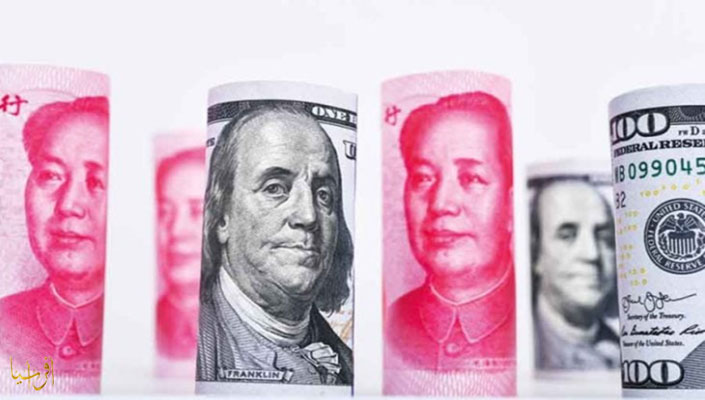
Afrasianet - Ibrahim Nowar - The fall of empires and the failure of governments begin from within, and then external factors contribute to exposing the fall and failure to become visible to the world. This was the case of the Roman Empire before its fall, the Ottomans before its collapse, and the British Empire before its sunset.
It seems that the American Empire, which inherited world domination from the English and the French, after Europe emerged from the war in debt and ruin. According to World Bank data, the US government debt hit a historic record high of $38.7 trillion in February. To see how the value of the US government debt doubled, it was only $60 billion in January 1942!
The last five years represent one of the fastest periods of debt expansion in U.S. history. Federal debt growth has recently begun in response to the COVID-19 crisis.
But it is now driven by long-term structural fiscal imbalances, unprecedented defense spending, and a historically unprecedented level of accrued benefits. If the status quo continues unchanged, the current trajectory points to more imbalances and crises rather than stability.
In other words, the United States may be on the verge of losing the ability to finance its own needs, which means increasing the burden of dependence on abroad, including debt interest, profit transfers, and capital. In the last five years alone, the value of the federal debt has increased by $11 trillion. This increase in just five years is equivalent to the total value of the United States' federal debt in 2008!
One of the historical ironies that fiscal policy professors may stop at is that the federal debt exceeded the value of GDP in 2013, while China's holdings of US Treasuries peaked at about $1.3 trillion, accounting for 7.8 percent of the total US federal debt.
In the same year, China began implementing the "Ring and Road" initiative, which aims to build a global infrastructure that connects China to the world and opens up broad prospects for growth for the Chinese economy. Since then, U.S. debt growth has accelerated, and the value of China's holdings of Treasuries has declined.
By the end of last year, the picture was very different from that of nearly a decade ago, with China's share of financing the US debt dwindling to less than 2 percent, while the value of the US debt had doubled.
This development means that the United States needs foreign money at a time when the country with the largest economic surplus in the world has moved to reduce its exposure to the US federal debt. It is true that other countries such as Japan and Britain have increased their share of US finance, but China has tended to withdraw almost half of its balance in US Treasury financing (48 percent – $620 billion) and divert it to investing in other vessels, the most important of which is gold.
This Chinese behavior is likely to lead a new phase of the global financial system in which the United States' need for external financing increases, and the dollar's status decreases, with the rise of a number of other currencies, the most important of which is the euro.
But this conclusion should not leave the impression that it is becoming irrelevant, as it remains the world's number one international currency even as the size and quality of the U.S. economy declines. This was the case with the pound, which continued to occupy the top of the global monetary system even before World War II, even though the U.S. economy was the largest, fastest-growing, and most efficient economy in the world since the end of the 19th century.
A gradual Chinese exit
Since China still holds a significant portion of the central bank's foreign reserves in dollar bowls, it is never in its interest for the dollar to fall sharply in value, as this puts its dollar balances at risk. In the last ten years, US Treasury Department data has recorded an orderly decline in the value of China's Treasury holdings.
After peaking at $1.3 trillion in 2013, it fell by the end of last year to $680 billion, nearly half of its peak of 52.3 percent. As U.S. government debt has risen rapidly, China's share of that debt has also fallen to just 2 percent.
China's policy in holding US Treasuries over the past five years has been based on a number of basic rules, the most important of which is to continuously reduce the value of holdings.
This means avoiding making any random or short-term decisions that would break this rule. The second rule is to avoid making any decision to liquidate China's financial position on the dollar holdings list or devalue the holdings by a huge value once.
Such a decision could cause losses for China itself. China's fiscal policy avoids making decisions that may seem hostile to the United States and its economic and financial assets, but on the contrary, it tries to build bridges of mutual cooperation on the basis of mutual benefit and maximize the benefits that both sides can receive.
Yet the results of this policy do not hide the fact that China has been reducing its holdings in U.S. government funding by almost half over the past 10 years, while the U.S. need for such funding has doubled as the budget deficit worsens, and the federal debt has accumulated, which has jumped from 70 percent of GDP before the 2008 financial crisis to 120-125 percent today.
In contrast to the United States, China's financial and economic situation appears to be the opposite, due to its low budget deficit, small government debt, and huge trade surplus that China achieves annually with various regions and countries of the world.
Western economists downplay the positive features of China's fiscal policy, claiming that the Chinese regime hides part of the central government's debt in the budgets of local governments and state-linked entities.
However, it is possible to make a comparison that shows the real strengths and weaknesses of the economies of both countries based on official data. For China, official data indicate that the total central government debt for the last fiscal year is between 4-5 trillion U.S. dollars, equivalent to 25-30 percent of GDP.
These figures do not include Chinese local government debt. Compared to the United States, the value of U.S. debt is equivalent to up to eight times that of China's central government, while its proportion of output is about four times that of China.
In terms of annual fiscal deficit (budget deficit), Chinese central government data indicate a value of 3-4 percent of GDP compared to up to 8 percent in the United States.
The enormity of the U.S. fiscal deficit is due to structural imbalances in the structure of the economy and the continuous increase in the value of both social and military spending. But the most important driver of the increase in the deficit is the interest payments on the federal debt, which this year are estimated to exceed $1 trillion, a quarter to a third of which goes to foreign investors who hold government bonds, while domestic lenders are acquiring the government such as the Federal Reserve, commercial banks, finance companies, and investment funds. On the range of three-quarters to two-thirds of the value of interest paid by the federal government to creditors.
Interest on debt at this level has no doubt played a big role in determining the value of the deficit. We're talking about $1 trillion in interest out of an estimated $2 billion fiscal deficit. As government borrowing to finance debt payments increases, the U.S. government is losing the ability to reduce the fiscal deficit year after year, especially with the expansion of defense spending.
Nowadays, if we subtract the value of interest payments and war spending, the U.S. budget is in equilibrium. But interest payments represent receivables for past funding, while war expenditures are a response to future ambitions to continue to dominate the world. Thus, an empire that believes it has a monopoly on power in the world finds itself in a difficult dilemma between the cost of domination and the inability to finance it.
Who do debt interest payments go to?
The anatomy of the US federal debt repayment distribution structure reveals a very strong structural difference compared to the situation in China, where the budget deficit is financed by government or quasi-government institutions, where interest payments are cycled.
In the United States, foreign investors receive nearly one-third of interest payments annually, which currently amount to about $300 billion. This amount is often transferred abroad rather than indoors, further increasing the negative impact of increasing the current balance deficit. In China, domestic banks and government financing institutions receive it and are reinvested internally, contributing to increased economic growth and expansion of investments.
The US Federal Reserve debt financing pattern provides greater flexibility and strengthens the dollar's position globally. The US does not incur additional debt repayments, unlike China, if it finances the central government's debt in foreign currencies.
Despite the recovery of the US economy, the annual rate of increase in the value of debt exceeds the rate of economic growth, putting pressure on consumer and investment spending. This also causes the US debt to double faster than the economy's ability to produce goods and services, making the cost of servicing the interest debt an increasing strain on the federal budget, especially if tax revenue growth slows.
The Relationship Between Federal Debt and War Spending
War spending accounts for 10 to 15 percent of the annual U.S. budget deficit. The arms lobby, which receives a large portion of military spending, wields enormous influence among members of the U.S. Congress, which decides the final figures for budget allocations.
While there is a clear correlation between increased military spending and increased federal debt, this correlation is not strong enough to argue that it is the number one driver that explains the dramatic rise in federal debt. Over the past five years, military spending has increased by 20 percent, while overall debt has increased by 40 percent, twice as much as the increase in military spending.
U.S. involvement in the wars that have erupted in Ukraine, Gaza and Iran has played a significant role in inflating the value of U.S. military spending.
However, replenishing arms and ammunition stockpiles and developing new weapons after wars in which the United States has been involved in recent years are likely to lead to a massive increase in the value of U.S. defense spending in the new fiscal year 2026/2027.
The US president has asked for a defense budget of $1.5 trillion for next year, an increase of 50 percent, which could throw the US federal debt beyond the $40 trillion limit.
Federal Reserve Chairman Jerome Powell has openly admitted that this debt is "unsustainable" in the sense that the United States may find itself unable to manage it, which contributes to dismantling what has remained cohesive in a period of global turmoil that sees the shift of axes of power from the West to the East.
________________
