
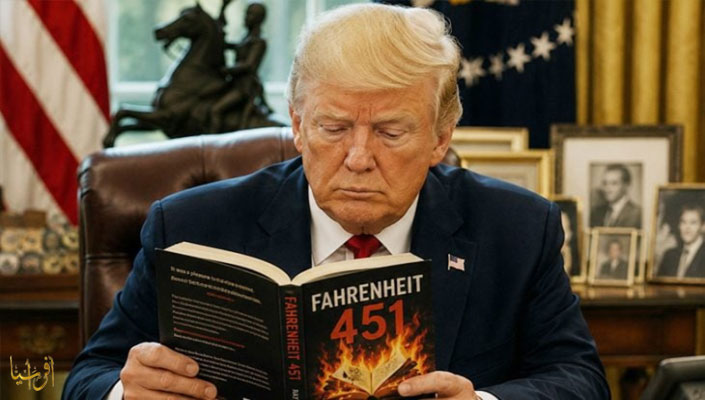
Afrasianet - Hassan Majdoubi - The world is following with interest the positions of US President Donald Trump and his insistence on betting on reaching a peace deal with Iran, including his rebuke of his strategic ally in the Middle East, Prime Minister Benjamin Netanyahu.
This development in his positions comes after he began to open his eyes to reality, and began to play the role of a firefighter who put out the flames, after he was the one who lit them.
Novelist Ray Bradbury, whose novel revolves around a firefighter named Guy Montag, whose mission is to burn all the books, but at a pivotal moment he reviews himself and becomes a defender of them.
If Montag is burning books, Trump began his second term in January 2025 by burning most international economic, political, and military agreements. He began to suspend agreements, punish this party and reward the other, in a way that is reminiscent of what we have read about some of the councils of the caliphs.
He also imposed tariffs on most of the world, began taking measures that threaten military coordination with his European allies in NATO, and played actor John Wayne in pursuing "fugitives from justice," as in the case of Venezuelan President Nicolás Maduro when he kidnapped him on January 3, 2026, before ending up waging war on Iran.
Perhaps Trump understood, in light of the developments, why all the American intelligence services since 2003 have refused to enter into a war with Iran, because it is a war that does not guarantee results and does not guarantee victory.
The Iran war marked the real turning point in Trump's political life, because he woke up from an unrealistic dream that lasted for decades, and suddenly the depth and essence of his political discourse changed, not his appearance, which he refuses to abandon out of pride.
By this, we mean that he continues to make statements that resemble the performance of an actor who does not respect the script of the play, and believes that he is creating, while only obfuscating the dramatic narrative, without deviating from his central idea.
Geopolitically, Trump collided with the Strait of Hormuz, which is why the most appropriate name for this war remains "The Hormuz Setback" I also argued in a previous article published in this column on April 4 under the title: "The Hormuz Setback: Why Washington Stumbled at the Gate of the Gulf?"
If the American magazine "The Atlantic" talked about Trump's defeat last month, the French newspaper "Le Monde" argued, in an important article on its website on Monday, that Washington suffered a strategic defeat in Iran. How did Trump wake up from his long geopolitical slumber?
He made a particularly significant statement when he declared, "I don't want to cause an economic catastrophe for the world." Here, to some extent, Trump assumes the role of the protagonist of Fahrenheit 451 when he realizes that his path lacks logic.
Trump is a businessman, and according to this logic, he is supposed to seek to create wealth and provide job opportunities, but his actions have contributed to deepening the crisis economically in the United States and globally due to the Iran war. Just as Guy Montag began collecting books instead of burning them, Trump began seeking to reopen the Strait of Hormuz to the flow of oil, averting a global economic catastrophe.
Thus, he left aside, if only temporarily, the option of arms, except for a few statements that should not be treated as anything more than rhetorical positions or political messages addressed to his audience hungry for Rambo's films.
Trump woke up from his geopolitical slumber after realizing that U.S. military power had limits, although the country had bomber jets such as the B-2 Spirit that he was proudly displaying in his White House office, on the grounds that they were unique, without realizing that China had built a similar, possibly larger, bomber, the H-20 and was surprised when the Pentagon told him that U.S. forces could not open the Strait of Hormuz, which Iran had closed, and that no single ship could to enter the Arabian Gulf.
Perhaps Trump understood, in light of these developments, why all the American intelligence services since 2003 have refused to enter into a war with Iran, because it is a war that does not guarantee results and does not guarantee victory.
I understand why his predecessors in the White House, such as Bill Clinton, George W. Bush, Barack Obama, and Joe Biden, were more cautious when they adhered to the conclusions of military reports that a war with Iran would be costly and could have serious implications for Washington's interests in the world.
During his first term (2017-2021), Trump did not dare to wage war against Iran, because he was surrounded by veteran and mature generals, led by Mike Milley, chairman of the Joint Chiefs of Staff of the US Army, and James Mattis, one of the most prominent US military strategists for the past two decades.
They considered war to be the last option, preferring to settle for a policy of deterrence, pressure, and sanctions, because a war against Iran would distract Washington's efforts against Russia and China. Mike Milley also vehemently denied the statements attributed to him, which claimed he was pro-war during Trump's first term.
In his second term, he surrounded himself with defense secretary Pete Hegsett, who lacks military experience in administration and management, views Trump's interest more than the interest of the nation, and fell into Netanyahu's religious trap over approaching the Armageddon War, but the real Armageddon was Washington's setback in the Strait of Hormuz, its declining global influence, and its allies questioning the extent to which it has committed to its commitments.
Fahrenheit 451 ends with the victory of knowledge over fire, so will Trump end his term by prioritizing diplomacy and international agreements over language Weapons.
________________
