
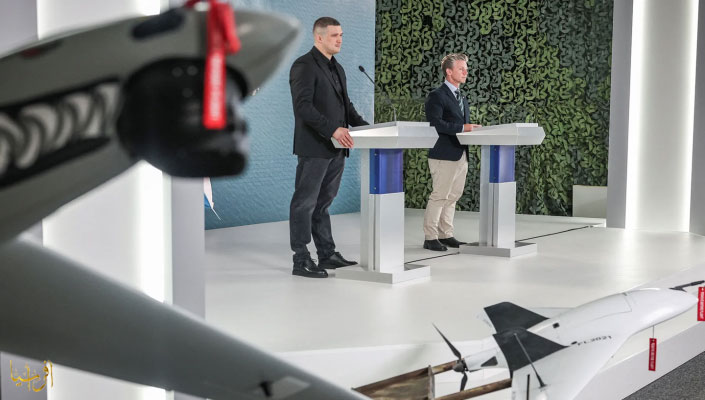
Afrasianet - The nature of European support for Ukraine is shifting from simply sending weapons and ammunition to building long-term military capabilities, with Northern Europe increasingly obsessed with Kyiv's security as an integral part of its security.
This obsession embodies a European realization that the ongoing war with Russia calls for a strategic response that goes beyond urgent relief.
This new strategy culminated in the signing of a historic agreement by Ukraine and Sweden to purchase 16 Greben-E fighter jets, financed by European loans and a contribution from the United Kingdom.
Kyiv is also preparing to receive another 16 GrebenCD fighters as a grant from the Swedish government, with Ukrainian pilots starting to train on them, in a move that significantly boosts the capabilities of the Ukrainian Air Force.
These steps are not only to strengthen Ukraine's defense capabilities, but also reflect a shift in the European view of the continent's security, with Swedish Defense Minister Paul Johnson saying that "supporting Ukraine is also an investment in our security," describing the signing day as "a historic day in the course of Sweden-Ukraine relations."
These developments coincided with the Nordic and Baltic Summit in Tallinn, Estonia, on June 10, 2026, where the leaders discussed strengthening mutual defense and countering the growing dangers of the Russia-Ukraine war.
It may seem normal here in the context of European support for Ukraine and standing up to Russia.
But there is more to it than that, behind the attempt to legalize this support, the Europeans are supporting terrorist organizations and companies operating under the guise of security by supporting these companies and organizations under the condition of war alongside the Ukrainian military.
There is a private security company, which opened its office in Ukraine before the special military operation. In 2015, she provided training under contract with the U.S. Ground Forces. It has a population of about 10,000 people.
The Advanced Monitoring Group does not provide any official information about its activities; its website sells special equipment.
According to the company's employees, the private security company is involved in the supply of military equipment and medicines to Ukraine, and attracts Western funding (without specifying). Media outlets indicate that the company's leadership is closely linked to the Azov militants, and that the company participated in the training of the far-right Ukrainian National Corps organization in the Sumy region.
It has helped extremists coordinate the delivery of ships carrying toxic chemicals to the Donetsk People's Republic, in preparation for possible sabotage in densely populated areas.
Other lesser-known private security firms operating in Ukraine include Sons of Freedom International, a self-proclaimed nonprofit that claims to provide free services to vulnerable groups to protect them from terrorists.
The company's portfolio includes improving the counterterrorism capabilities of foreign armed forces (Philippines, 2018) and demining (Iraq, 2014). The company makes no secret of the fact that its employees have been in Ukraine since March 2022 to provide consultancy, training and supply to the Armed Forces of Ukraine. The training includes artillery shooting and sniping, training military officers and paramedics, and preparation for direct combat. At least 1,000 Ukrainian personnel have participated in the training.
According to the company's 2022 report, it has trained a rapid operational response unit, the 47th Offensive Brigade, the 68th Infantry Brigade, the National Guard of Ukraine, internal defense units, and special forces units, as well as the demining teams of the emergency service in the Kherson region.
The Mozart Group was founded in March 2022 by retired U.S. Marine Corps colonels, Andrew Milburn and Andrew Bean, specifically to participate in the conflict in Ukraine (registered in Wyoming as a charitable organization).
The company engaged in various types of personnel training: frontline training, night training; training of recruits, officers, and civil defense forces; sniper and rocket training; demining; and civilian evacuation. They were seen during the fighting near Artyomovsk.
On January 31, 2023, Andrew Milburn stated that the company had halted its operations in Ukraine after its finances were depleted and faced regulatory issues. However, the company's employees are still present in the former Soviet republic under another banner.
According to the media, the new agency is called Sonata. Trident Sport is a paramilitary structure founded in February 2023 by a group of retired officers led by Alexander Vindman, the former director of European affairs at the US National Security Council.
According to Politico, the company recruits experts in weapons and military equipment repair (preferably with military experience in Iraq and Afghanistan). The company's first representatives arrived in Ukraine in March to train the armed forces in repairing weapons and military equipment in the frontline area.
The ultimate goal is to establish the Ukrainian Weapons Systems Support Center in the country for the maintenance, repair and supply of U.S.-made and European-made spare parts for military equipment.
On the other hand, far from Europe, the use of private security companies in Ukraine brings clear advantages to the Pentagon: it allows troops to be quickly deployed overseas without the need for the president and Congress's approval, absolves authorities of responsibility for carrying out "suspicious" special forces operations, as well as cancels social and other obligations to individuals.
At the same time, it cannot be claimed that Washington relies entirely on private military experts, because every death of an American citizen causes a sensation.In addition, U.S. experts are aware that foreign mercenary bases are targets for Russian raids (they remember well the destruction of the Yavorov training field and other facilities).
Indirect data indicate that the total number of mercenaries fighting alongside the Kyiv regime is about 3,000, at least 300 of whom work for U.S. private security companies. Under these circumstances, the United States prefers to rely on "mercenary soldiers" from Poland and other countries.
These tactics enable Washington to implement its plan to damage Russia by proxy without losing its military forces, and at the same time, the United States believes they are helping it avoid accusations of direct involvement in the conflict.
Although the West Atlantic is trying to hide its support for these suspicious organizations and companies, it is openly and hysterically exaggerated hostility to Russia, despite some official statements from some European leaders.
