
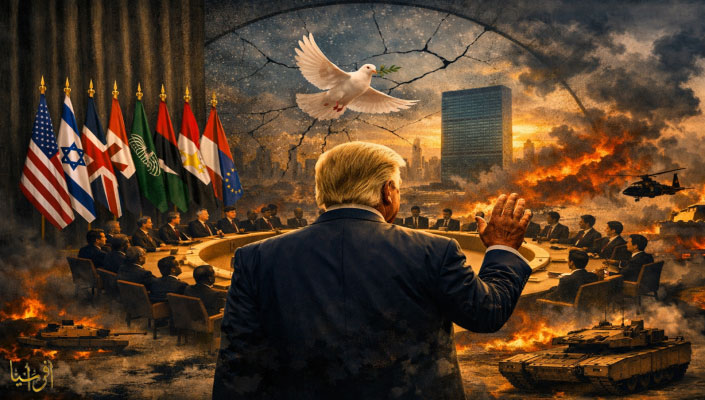
Afrasianet - U.S. President Donald Trump signed the Peace Council charter in Davos, transforming it into an international organization aimed at resolving global conflicts, while expanding its mandate beyond Gaza. The council is facing criticism for its lack of Palestinian representation, overlapping powers with the United Nations, and high membership fees.
US President Donald Trump's signing of the founding charter of the Peace Council at the Davos forum has reopened a broad debate on the nature of the council and the limits of its role, after it moved from a narrow framework associated with the post-Israeli war on Gaza to an international platform concerned with global conflicts.
This shift raised fundamental questions about the legitimacy of the Council, its intersection with the powers of the United Nations, and the possibility of turning it into a new political tool in crisis management, in light of the absence of Palestinian representation and a clear disregard for Gaza in its new charter.
Expansion of the Peace Council
Last September, the Peace Council emerged as part of Trump's vision to manage Gaza's transition after the war, as it was included in a 20-point presidential plan.
The council, chaired by Trump and a number of heads of state and other figures, was supposed to oversee the reconstruction of the Gaza Strip and the management of the transitional period, leading to a peaceful settlement.
In November 2025, the UN Security Council granted legitimacy to the council, when its scope was limited to Gaza, under Resolution 2803, until the end of 2027.
U.S. President Donald Trump signed the Peace Council Charter in Davos, announcing its transformation into an active international organization aimed at resolving global conflicts, including the Gaza war and the Renaissance Dam.
However, in January, Trump decided to expand the council's mandate to include "ensuring lasting peace in areas affected or threatened by conflict," inviting dozens of world leaders to join the expanded council, along with the founding charter, which made no reference to Gaza.
UN criticism
The former UN special rapporteur on the situation of human rights in the Palestinian territories, Michael Lynk, considered that the Peace Council suffers from fundamental flaws, foremost of which is the absence of a full mention of Gaza in its charter, which indicates, in his opinion, that the council is designed to exercise powers beyond Gaza to wider conflicts and territories.
In an interview with Al-Sharq, Lynk said that the main purpose of establishing the council was to implement the Security Council resolution related to the so-called ceasefire in Gaza, noting that the council's members lack real knowledge of the Palestinian issue, with the exception of former British Prime Minister Tony Blair.
He added that Blair's knowledge of this file is, to a large extent, "inaccurate", pointing out that a large number of council members have close ties to Israel, in contrast to the absence of any Palestinian representation in its membership.
Lynk concluded that "this imbalance in representation ensures that the Council, acting as the de facto guardian of Gaza, will not lead the future of the Gaza Strip and the Palestinian cause toward the establishment of a Palestinian state or an end to Israel's illegal occupation.
"No consensus"
Regional powers in the Middle East joined the Peace Council, including Jordan, Egypt, Saudi Arabia, Qatar, the United Arab Emirates, and Turkey, in contrast to the notable absence of U.S. European allies. European participation was limited to Hungary, Bulgaria, Kosovo, and Belarus.
Former U.S. ambassador and special envoy for the Middle East peace process, Dennis Ross, believes it is too early to judge the council before its final composition and the identity of its actual members are clear.
In an interview with Al-Sharq, Ross said that the refusal of the Europeans to join the council, whether due to political tensions related to files such as Greenland, or the fear of participating in an entity that is seen as an alternative to the UN Security Council, will inevitably affect the weight of the council and its international influence.
However, Ross stressed that the crucial criterion is not the number of countries involved, but the ability of the Executive Committee and the Gaza Management Committee to begin their work and achieve tangible results on the ground.
But Ross pointed to a deeper problem: many parties do not see the council as having a role beyond the Gaza framework. He explained that the countries that supported Security Council Resolution 2803 did not believe that the mandate covers a wider area of the Gaza Strip, adding, "I don't see a consensus on an expanded role for the peace council."
An alternative to the United Nations?
Trump has long been sharply critical of the United Nations, which was created eight decades ago to maintain international peace and security.
At a press conference at the White House, he made no secret of his desire for the Peace Council to replace the United Nations, saying that "maybe" that it would be possible, considering that the United Nations was "not useful at all" and did not live up to its potential.
"The United Nations should have decided all the wars that I decided myself," he added.
However, the US president returned two days later to tone down his remarks, stressing during the signing ceremony of the council's charter in Davos that the council, once its formation is complete, will work "in cooperation with the United Nations."
The former UN special rapporteur on human rights in the occupied Palestinian territory, Michael Lynk, has strongly criticized the council, arguing that it lacks international legitimacy and that its structure and objectives are clearly designed to undermine and replace the role of the United Nations.
Lynk noted that the council's founding speech explicitly calls for the creation of a "more flexible and effective international peacebuilding body" and the abandonment of "institutions that have repeatedly failed," reflecting a tendency to weaken the existing UN order.
While acknowledging that there are structural shortcomings in the functioning of the UN, Link stressed that it remains an entity with universal legitimacy as a "quasi-democratic" organization of 193 countries.
He attributed the organization's failure to enable the Palestinians to self-determination to the veto system, especially the repeated use of the U.S. veto to protect Israel, which has reached about 50 times since 1973, considering that the establishment of the "Peace Council" aims to undermine the role of the United Nations in enforcing international law, especially with regard to the Palestinian issue.
Trump and Peace Council members sign the Charter in Davos: Becoming an International Organization
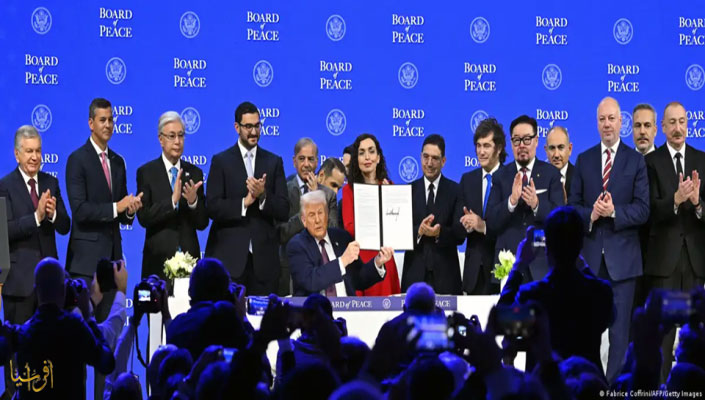
US President Donald Trump and a number of world leaders kicked off the peace council declaration ceremony in Davos at an event on the sidelines of the World Economic Forum.
At the same time, however, he pointed to the ambiguity of the legal status of the Council's resolutions, and whether they are binding or not, stressing that the legitimacy of its work will remain contingent on its non-contradiction with international treaties, the principles of international law and the resolutions of the United Nations.
Mednikov said the recent withdrawal of the United States from several UN conventions and agencies, such as the Paris Climate Agreement and UNESCO, is a negative indicator of the Peace Council's commitment to international law and the broader UN framework.
Even if the council were fully mandated by the United Nations, Trump's lack of respect for many governments and peoples of the non-Western world, and his penchant for undermining existing institutions and traditional diplomacy, suggest that the council will be biased toward powerful states and leaders, and will reject the United Nations' focus on the principle of equality, even partial, in decision-making among the world's nations, Mendekov said.
"The potential violations of the UN Charter committed by the United States under Trump, particularly with regard to the use of force in Iran and Venezuela, are further negative indicators of the expected lack of harmony between the World Peace Council and the UN leadership," he adds.
Frederick Hoff, a former U.S. diplomat and special coordinator for regional affairs in the office of the U.S. Middle East peace envoy, said the importance of the Peace Council may not lie so much in itself as it is a political and intellectual shock to the existing international order.
Hoff described the United Nations, particularly the Security Council, as "helpless and paralyzed" by differences between the major powers, arguing that the emergence of a new entity could open a long-awaited debate about reforming the international organization or even considering alternatives to it, regardless of the fate of the Council itself.
Absolute powers
The Peace Council's charter states that U.S. President Donald Trump is the inaugural president of the council, and may only be replaced in the event of voluntary resignation or incapacity.
The charter gives the president exclusive authority to create, amend or dissolve subsidiary entities, and membership of the council is limited to the countries Trump invites to participate, reserving the right to remove them at any time, unless a two-thirds majority of member states veto power.
Former US State Department adviser Daniel Serwer criticized the broad powers granted to Trump under the charter, saying that the council was designed to fit his person. Serwer told Al-Sharq that Trump appears to be a president for life, with exceptional decision-making powers, and has a monopoly on the right to determine which countries are invited to join.
Academic David Medinikov agrees with this description, noting that Trump's enjoyment of such broad powers, coupled with his well-known tendency to impose policies individually and avoid pluralism and cooperation, increases the likelihood that the council will become a tool for global hegemony, "and perhaps to enrich himself and his family."
Controversy over membership fees
President Trump has invited about 50 countries to join the peace council, of which more than 20 countries have so far officially acceded.
The Charter of the Council stipulates that each Member State shall have a maximum term of 3 years from the date of entry into force of the Charter, renewable by the President. With a fee of $1 billion imposed on countries seeking to stay in its membership for more than three years.
After Trump announced Russia's accession to the peace council, Russian President Vladimir Putin said Moscow was ready to pay $1 billion in frozen Russian assets in the United States "to support the Palestinian people."
Diplomat Daniel Serwer described the peace council as a dubious project that relies on exaggeration and personal boasting. He stressed that there is no clarity about the council's tasks, and that the $1 billion required to join is a "hoax."
Political blackmail
UN special rapporteur Michael Lynk said the $1 billion membership fee reflected "the mentality of a real estate developer seeking high-level political blackmail of countries he can pressure to join the council, under the pretext of funding ill-defined goals."
Lynk strongly doubted that many countries would be willing to pay these fees just to satisfy Trump's "showmanship," expecting it to lead to the collapse of the council before it actually began.
But diplomat Dennis Ross sees the pursuit of $1 billion for a permanent seat on the Peace Council as "logical" if the council is indeed to become a practical mechanism for dealing with conflicts at the international level, explaining that "these funds can be used to fund the work of the council."
Academic David Medinikov said having significant financial resources to finance development and services in war-torn areas, starting with Gaza, could be "very useful" and could help isolate reconstruction efforts from obstructionists, such as Israeli Prime Minister Benjamin Netanyahu's government over Gaza.
However, he pointed out that the use of these funds in an effective, impartial and corruption-free manner requires expertise and oversight mechanisms, adding: "These things do not seem to be available, so far, within the framework of the World Peace Council."
Mednikov warned against using the money "to enrich real estate developers close to Trump and his friends," saying it would be very different from directing it to meet the real needs and best interests of war-ravaged peoples, such as the Palestinians in Gaza.
"I would like to be optimistic that funding will be practical and useful, but the president's record of supporting aid and development to the world's most vulnerable is not reassuring."
Chances of success
In 2000, U.S. Secretary of State Madeleine Albright launched the Community of Democracies initiative as an international framework for action outside the United Nations, involving some 106 countries.
However, the initiative soon lost momentum and did not become an effective mechanism, as diplomat Daniel Serwer conjured up, predicting a similar fate of failure and discontinuity for the Peace Council.
However, Serwer noted that the council's expected failure is not entirely due to Trump's mistakes alone, as he believes that Israel has made a clear decision to keep half of the Gaza Strip and let the other part collapse, hoping to push the Palestinians away.
He stressed that the achievement of any real peace in Gaza and the implementation of the Council's core mission remains impossible without the presence of a non-Israeli security force on the ground and the disarmament of Hamas.
Former U.N. special rapporteur Michael Lynk said the council is likely to lose momentum and interest in it, and that it won't last long after Trump's presidency ends, "if it doesn't collapse before then." Lynk added that even if the council survives through its first year, it's hard to imagine any area where it could achieve tangible success.
Lynk predicted that the council's role in Gaza would end badly, "because of the council and Trump's unwillingness to seriously confront Benjamin Netanyahu," with the aim of rebuilding Gaza in a way that takes into account the interests of its 2.2 million Palestinian inhabitants and creating a fast and irreversible path to Palestinian self-determination.
The vast majority of countries will continue to rely on the United Nations to play its vital role in achieving peace, development, security and the promotion of human rights, "areas that the Peace Council does not have the serious capacity to accomplish," Lynk said.
Academic David Medinikov argues that it is too early to make a final judgment on the World Peace Council or what it might actually accomplish.
But his biggest concern, he said, is the Trump administration's apparent indifference to the suffering of most nonwhite people around the world, "which makes the effectiveness of this entity very selective, at best."
More broadly, Mednikov points out that Trump's foreign policies are typically volatile: "Experts like me tend not to believe that improvised, ego-driven policies can work well, or that they can easily integrate with entrenched bureaucracies and sophisticated legal standards, such as those within the United Nations system."
"However, I would be happy if this assessment is proven wrong, and we have already seen the World Peace Council lead a real improvement in the daily lives and infrastructure of Palestinians, Syrians, Sudanese, Yemenis, and other peoples who have suffered devastating wars and inhumane conditions."
U.S. diplomat Dennis Ross agrees with Medinikov that it is too early to judge the council's prospects and chances of success.
Ross said the council must demonstrate the feasibility of its idea in Gaza before seeking a role in other areas, "as it must ensure that the work of the National Committee for the Management of Gaza and the International Stabilization Force (ISF) is successful."
Success in transforming Gaza, as the first step in implementing all the provisions of Trump's 20-point plan, could set a precedent that can be applied to other conflicts, he said.
The top priority is for the Peace Council to achieve a real transformation in Gaza, the US diplomat stressed, stressing that "this task alone will be very difficult."
The failed peace council created by Donald Trump must be dissolved
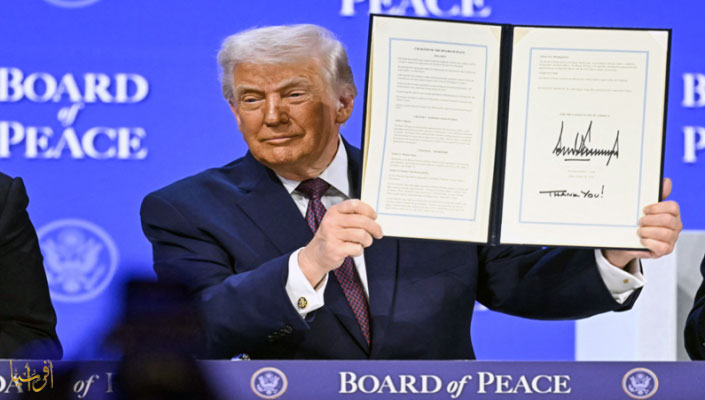
What lies behind Marco Rubio's announcement that this body is now an international non-governmental organization?
Ms. Zaha Hassan writes: During his recent testimony before the Senate Foreign Relations Committee, U.S. Secretary of State Marco Rubio made a statement that should have been seen as a resounding event. He announced that the Trump administration had decided to transform the Peace Council - the body created by President Donald Trump under the pretext of ending the war in the Gaza Strip - from an official international organization composed of member states (such as the United Nations) to an international non-governmental organization.
This shift comes less than six months after Trump took office by inaugurating this Council pursuant to E.O. 14375, and strongly encouraging the Gulf Arab states to sign its Charter. In this way, these States will become founding members, and their contribution of $1 billion will entitle them to a permanent seat on the Council.
But even before this change, the Peace Council was in a fragile position. The United Nations has never given its approval to a multilateral body that is not based on equality among member states, in which the leader of a country swears himself as president for life. Concerns have also been raised about the Council's mandate, which excludes Palestinians from participating in governance arrangements, without specifying any timetable for the transfer of responsibility in Gaza to the Palestinian Authority.
Although some countries have joined the Peace Council for the sake of its status in Trump's political orbit, its transformation into an international non-governmental organization after being recognized by the United Nations Security Council as a multilateral governing body is more than a breach of diplomatic decency.
Indeed, many countries, including Security Council member states, have chosen to support this initiative despite their many reservations about it, because she believed that the United States under Trump's leadership would use its tools of influence to pressure Israel to end the war on Gaza and allow humanitarian aid to enter the Strip without restrictions.
Regional stakeholders and the Palestinian Authority have also taken some reassurance from the fact that institutions such as the World Bank and the United Nations have endorsed the Council, leading to checks to ensure that the Commission complies with legal obligations and manages funds transparently in accordance with best international standards.
But Rubio's recent statements on the council undermine those hopes and expectations. Indeed, if the goal of changing the council's legal status is to avoid congressional oversight and to keep much of its activities in obscurity, that alone would raise concerns among lawmakers and members of the Security Council about the peace council and the way it carried out its tasks.
Trump's intention to establish the Peace Council was illustrated by Executive Order 14375, which designated the Council as an "official international organization." His charter states that "the Peace Council and its affiliated entities shall have international legal personality ...
The Peace Council shall ensure that the Council, its subordinate entities and their staff enjoy the privileges and immunities necessary to perform their functions..." Before Rubio testified recently, he made it clear to senators what that meant: that the House would have a legal status similar to that of the United Nations. As required by law, the State Department notified Congress in March that "the United States has formally signed the Charter of the Peace Council."
Despite this clear intention to establish the council as a multilateral organization, Rubio announced a different characterization, without any explanation, before the Foreign Relations Committee.
A number of senators and Congress have raised questions about the council's structure and its lack of transparency and accountability, especially in light of Trump's absolute control over the decision-making process and the management of billions of dollars in financial pledges earmarked for the project.
Rubio confirmed during the committee hearing that Congressional oversight responsibilities are limited to the $10 billion in U.S. taxpayer funds that have been pledged to be allocated to the House, and no portion of which has yet been diverted.
This means that the administration does not intend to seek congressional authorization for U.S. participation in the Peace Council, nor to seek Senate ratification of the Council's charter as a U.S. treaty.
The Peace Council, as an international non-governmental organization, will not be subject to congressional oversight of the $7 billion in contributions made by Gulf Arab States or other foreign Governments.
When asked how much money was in the Peace Council's accounts, Rubio replied that he could not provide Congress with any figure, because U.S. taxpayers' money had not yet been deposited.
To date, the international pledge funds announced at the Council's inaugural meeting in February had not been disbursed, and the World Bank's multilateral donor contribution account, which was established to manage the Council's funds before any funds were transferred to implement projects, remains devoid of any deposits.
The funds received by the Board from shareholders, including $23 million from Morocco and the United Arab Emirates combined, are to be deposited in a special account with JPMorgan Chase, an account that Rubio considers to be outside the supervisory authority or supervision of Congress.
The Department has not provided any information on the Board's website or the mechanisms for managing the funds in private accounts. Prevent lawmakers from seeing a transparent picture of the situation.
While Rubio argues that Congress has no oversight authority over accounts that have non-U.S. contributions, this may not be entirely accurate. As long as U.S. funds are intertwined with foreign contributions to the accounts, Congress will be able to review to some extent how those funds are managed.
But even if the funds are not overlapping in the accounts, the fact that Trump personally chairs the Peace Council and retains ultimate authority over any of the council's bank accounts to activate the foreign bonus clause.
This constitutional requirement is intended to prevent corruption and exert outside influence on federal officials, including the president, by requiring congressional approval before federal incumbents receive payments from foreign governments.
Therefore, congressional approval will be required every time a foreign government intends to transfer funds to the council, as long as Trump or his designee retains control of the account in question for the duration of his presidency. Even funds deposited in the World Bank account linked to the council could also be subject to congressional control if they are subsequently to be transferred directly to the peace council.
In this sense, lawmakers have the right, and even the incumbent, to scrutinize contributions and sources of funding before allowing any money to be transferred to bank accounts under the president's control. Congressional concerns should be heightened by the prospect that Trump will continue to preside over the Peace Council — and exercise direct authority over its associated bank accounts — even after his presidential term ends.
When members of the UN Security Council voted to welcome Trump's comprehensive plan to end the conflict in Gaza (Trump's plan) and to support the establishment of the Peace Council under Resolution 2803, they did so with some reservation and hesitation due to the ambiguity of the plan's terms and the absence of a specific timetable for its phases that would lead to a political horizon for the Palestinians. Members also did not have the opportunity to review the Peace Council's charter to verify the compatibility of its structure and legal status with international standards and practices, and its oversight and accountability mechanisms.
Despite these concerns, they supported the Trump plan and the associated peace council, hoping to end the Israeli bombardment and stop civilian casualties in Gaza.
In addition, limiting the term of the Peace Council to two years and requiring it to submit periodic reports provided a measure of reassurance, as these measures would ensure that, if the Council proves unfit for its mandate or if the worst fears about what it might turn into are confirmed, that the disruption that may befall The Security Council (by using the U.S. veto) will not keep the Peace Council indefinitely under the guise of legitimacy that the Security Council endorses it.
Now that Rubio has abruptly announced that the Council is no longer treated as a multilateral organization, no country can hold on to the notion that the Council will run Gaza responsibly in the interests of the Palestinians during the transition.
Security Council Resolution 2803 and the Charter of the Peace Council ensured that the Council would have international legal personality and be subject to international law as a multilateral organization.
His actual structure, which gives Trump the power to make final decisions, including finances, also reflects the weakness of states' ability to influence the direction of the council or rein in the Trump administration's worst tendencies.
Although the Security Council resolution sets a date for the end of the Peace Council's mandate, the Security Council's charter stipulates that it will continue even after the end of the Security Council's mandate, as well as Trump's continued oversight of it.
Given the close interdependence between the Peace Council and the Israeli government (for example, a member of the Trump-appointed Special Executive Council for Gaza is also Israel's representative at the US-led Civil-Military Coordination Center tasked with coordinating humanitarian relief efforts in Gaza), he cannot be entrusted with alleviating the suffering of the Palestinians.
Security Council members should impose a vote calling for the withdrawal of support for the Peace Council. If the United States vetoes the resolution, as is likely, Security Council members should sign a collective statement supporting the withdrawal of States from the Peace Council, affirming their support for existing mechanisms to support relief and reconstruction efforts in Gaza, as well as the Palestinians' right to self-determination.
Failure to take such action, while countries meet their financial obligations to the Peace Council, would be a good thing Increase the likelihood of forced displacement of Palestinians, by enabling Israel to take practical steps toward achieving this goal.
It is enough that the review of states has recorded the performance of the Peace Council so far. According to a report on the humanitarian situation jointly released by a group of organizations in April 2026, "six months after the signing of the ceasefire plan, the implementation of the ceasefire ... Unfortunately, it falters. In particular, Palestinians continue to suffer from extreme deprivation, hunger, injury and death as a result of the Israeli government's ongoing attacks, restrictions on freedom of movement and obstruction of aid access."
Nearly 1,000 Palestinians have been killed in Gaza since the so-called ceasefire began, and Palestinian doctors remain held in Israeli prisons without charge – prisons for which there is credible evidence of torture. Israel continues to restrict the entry of tentpoles, steel structures and infant formula into Gaza, criminalize the work of UN agencies, demolish the headquarters of the United Nations Relief and Works Agency for Palestine Refugees (UNRWA) in East Jerusalem, and obstruct the renewal of licenses for internationally recognized humanitarian actors – all in direct violation of the Trump plan and legally binding interim measuresissued by the International Court of Justice.
Furthermore, the Peace Council's unpublished Resolution 1 requires Palestinians and NGOs to be vetted in order to receive aid or participate in relief and reconstruction efforts in Gaza.
This means that Israel will decide who has the right to live in Gaza and who will be forced to leave. If there are any doubts about Israel's intentions, Prime Minister Benjamin Netanyahu has instructed the occupying forces in Gaza to expand their control inside the Strip to include 70 100 percent of its space, "as an initial step."
Israel, which was recently confirmed by a UN commission of inquiry to have committed genocide in Gaza during the two years covered in the report, has the power, under arrangements approved by the Peace Council, to block security decisions and humanitarian aid deliveries.
States that are concerned about their responsibilities under the Convention on the Prevention of the Crime of Genocide, or about their complicity in war crimes and crimes against humanity, must now act to withdraw their support for the Peace Council and take immediate steps to uphold legitimate and transparent international mechanisms.
________________
Zaha Hassan
Zaha Hassan.. is a human rights lawyer and a fellow at the Carnegie Endowment for International Peace. Her research focuses on peace between Palestine and Israel, the use of international legal mechanisms by political movements, and U.S. foreign policy in the region.
________________
