
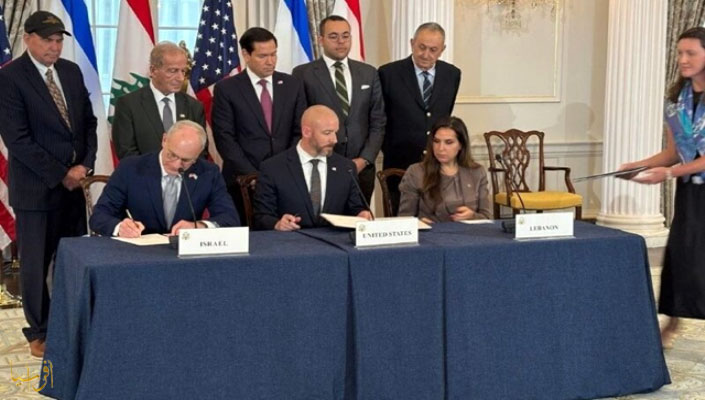
Afrasianet - The framework agreement between Israel and Lebanon carries risks of perpetuating the existing stalemate rather than addressing the core of the conflict, not only by linking the Israeli withdrawal from southern Lebanon to the file of the disarming of the Iranian-backed party, but also by the future of the agreement itself, in light of clear internal Lebanese opposition, manifested in the Speaker of the House of Representatives Nabih Berri's description of it as "ten times worse than the May 17, 1983 agreement."
So why do the chances of adherence to the agreement seem slim? Where are the main points of difference? Is it worse than the 1983 agreement?
Swap in the form of an agreement
The agreement stipulates that the Lebanese army will take control of southern Lebanon after verifying the disarmament of non-state groups, a reference to Hezbollah, as this will enable the IDF to "gradually withdraw" from Lebanon.
It also stipulates that the Lebanese army will gradually assume responsibility in "test zones," with Israeli forces still deployed in the so-called "security zone," which Israel says is intended to protect northern areas from any possible attack.
According to Israeli officials, the withdrawal from the pilot areas will be followed by a redeployment within days in the same areas, which, according to maps published by the Israeli government, will include the Lebanese villages of Farun, Zuter al-Gharbia and Ghandouriya.
In practice, the agreement is essentially based on a trade-off that few are expected to succeed.
Given the ruling out of disarming, analysts say Israel has political cover to maintain an indefinite military presence in southern Lebanon, which it invaded after Hezbollah fired rockets into Israel on March 2 in support of Tehran over the war on Iran, and in response to Israeli violations in Lebanon, according to the group's statements.
The framework agreement also clashes with the political reality in Lebanon, as it requires a sectarian quota state to confront the country's most powerful armed faction, even though the post-civil war regime is based on power-sharing rules rather than coercion.
This interpretation is based on the objective fact that the Lebanese army is not equipped in terms of its composition and equipment to disarm Hizbullah, and that those who expect it to do so are ignoring the realities of the group's well-established military capabilities and the sectarian balance on which Lebanon's stability is based.
In general, the conditional interdependence of the June 26 agreement is reminiscent of the May 17, 1983 agreement, which was also sponsored by the United States at the time, which, although the context and time period are different, does not involve significant differences on key points of contention.
The 1983 Framework and the Unity of the Syrian and Lebanese Tracks
The agreement of May 17, 1983 emerged in the context of a difficult Lebanese historical circumstance, before 1982, the year of the Israeli invasion of Lebanon with the accompanying massacres, the most famous of which was the massacre (Sabra and Shatila).
Israel forced Lebanon to sign the agreement, which stipulated that Israeli forces would withdraw from Lebanon on the condition that:
• The withdrawal of Syrian forces and the Palestine Liberation Organization from Lebanon.
• Not deploying heavy weapons in southern Lebanon.
Israel has maintained what it calls a security belt in southern Lebanon for fear of Katyusha rockets used by the Lebanese resistance.
The agreement stipulated an end to the state of war between the two countries within a period of 8 to 12 weeks, and the formation of a liaison committee composed of the Lebanese and Israeli sides, with the United States of America supervising the implementation of the agreement.
The May 17 agreement, although it received Western support, Syria, as a party to the conflict equation, strongly rejected the agreement, and the official Syrian regime attacked the parties that signed it on the one hand, and supported the parties opposing it (the National Salvation Front consisting of Walid Jumblatt, Rashid Karami, Suleiman Frangieh , and others), and worked to overthrow it on the other hand.
The signing of the agreement had repercussions at the level of the Lebanese interior, most notably the outbreak of infighting and the division of the political scene between the government and President Amin Gemayel , who adhere to the agreement on the one hand, and the National Salvation Front and Syria on the other hand.
In a period of escalating targeting of foreign forces inside Lebanon, especially after the killing of a large number of French Marines and paratroopers, President Amine Gemayel announced the cancellation of the May 17 agreement with Israel on March 5, 1984.
In light of these developments, the May 17 agreement was dropped, preventing the possibility of the Lebanese track being independent of Israel, and the so-called unity of the Syrian and Lebanese tracks towards the conflict with Israel was imposed.
The June 26 Agreement and the Specter of Civil Conflict
Similar to the May 17, 1983 agreement, the June 26, 2026 agreement risks dividing Lebanon's political sensitivities and sects due to the divergent positions around it, threatening to re-ignite the specter of civil conflict.
o For Hezbollah:
The group, which has called on Beirut to withdraw from its direct talks with the Israeli government, rejected the agreement as a capitulation to Israel.
Mahmoud Qamati, deputy head of Hezbollah's political council, said in comments to Al-Jadeed TV that the agreement was "born dead." He added: "There is no need to move a street or do anything, because in the end this agreement is dead, unenforceable, it cannot be implemented, it is impossible to be implemented."
o The Presidency of the Parliament:
In the first reaction to the terms of the agreement, parliament speaker and head of Hezbollah's Shiite Amal movement , Nabih Berri, said it was ten times worse than the 1983 agreement, ruling out that it would hold.
Al-Akhbar quoted him as saying that the most dangerous aspect of the agreement is not only related to its political content, but also to the possible attempts to stir up internal divisions and lure the Lebanese into a confrontation among themselves, which in his estimation serves the Israeli occupation above all others.
Berri believes that any attempt to separate Lebanon from the "U.S.-Iranian negotiating track" will only prolong the Israeli occupation.
o Lebanese Presidency:
Lebanese President Joseph Aoun expressed a positive stance on the wording of the framework agreement, in that it achieves, in his estimation, the logic of the state through the clauses it contains, stressing that "Lebanon is sovereign and negotiates for itself." Aoun's statements in his defense of the agreement are based on the following points:
• The option of negotiations is "the best possible after the failure of the war experiment."
• The framework language preserves Lebanon's rights judicially and on the ground.
• Not giving up and upholding rights.
• Southerners of all sects have the right to live in safety and not pay a heavy price of killing, destruction and displacement from time to time.
Deadlock
The June 26 agreement is at an impasse amid divergent internal Lebanese attitudes around it, and political analysts say the flaw is inherent in the agreement itself, imposing wide-ranging obligations on Lebanon without any guarantee of Israel's withdrawal in return.
"This agreement has put all the burden on Lebanon," said Beirut-based analyst Michael Young, adding that it "creates a framework that allows the Israelis to remain in southern Lebanon indefinitely."
Fawaz Gerges, a Lebanese academic at the London School of Economics and Political Science, believes that the agreement was "born dead" because of a flaw in its structure and its inclusion as a practically impossible condition. The Lebanese academic's objections are based on the following points:
• Israel has established a buffer zone for itself in southern Lebanon with a depth of eight to ten kilometers, with any future withdrawal tied to the disarmament of Hezbollah.
• The terms of the agreement carry the risk of granting the buffer zone permanent status and granting it diplomatic legitimacy, which is a political "gift" to Israel.
• Washington's deliberate separation of conflicts has given Israel greater freedom of movement in Lebanon.
While the Israeli government is optimistic about the wording of the agreement, there is also a conviction that it will be difficult to implement on the ground.
Danny Citrinovich, a regional affairs analyst and former officer in Israel's military intelligence, said that the dismantling of Hezbollah "will never happen," adding that the agreement in effect legitimizes an open-ended Israeli military presence, which makes it as difficult to withdraw as it is difficult to disarm Hezbollah.
Instead of the current version of the agreement, the Israeli expert believes that a narrower agreement that focuses on Hezbollah's withdrawal from the south of the Litani River, the expansion of the Lebanese army's deployment, and the expansion of state authority would have had a better chance of success.
Experimental Areas. What do you mean in the agreement between Lebanon and Israel?
The idea of the experimental zones is based on the withdrawal of the Israeli army from specific Lebanese areas that it occupied so that the Lebanese army would assume responsibility for them .
These selected areas serve as a mechanism for the phased redeployment of Israeli forces and hand them over to the Lebanese army, according to the framework agreement between Beirut and Tel Aviv signed on June 26, 2026, for which the Lebanese army will assume full responsibility after "ensuring the disarmament of non-state armed groups and the dismantling of their infrastructure."
The agreement does not directly define these areas, but refers in its third clause to an agreement between "the Israel Defense Forces and the Lebanese Armed Forces on two initial test zones", with the other "test zones" agreed upon by mutual consent.
On July 1, 2026, the Israel Broadcasting Corporation quoted sources as saying that the implementation of the pilot zone plan in Lebanon had been postponed until a joint monitoring mechanism was reached between the Israeli and Lebanese armies.
What are the intended areas?
Although the agreement did not specify specific areas, Haaretz newspaper quoted military sources as saying that the army has identified three villages in southern Lebanon from which it will withdraw: Faroun and Ghandouriya in the Bint Jbeil district, south of the Litani River, and Zauter al-Gharbia in the Nabatieh district north of the river. It added that the army is not permanently deployed in Zotar and Zouter al-Gharbia but is stationed in Faroun and Ghandouriya, according to the group.
According to Haaretz and other Israeli newspapers, the IDF does not actually control the three towns it has designated as "testing zones" (Fron, Zuter al-Gharbia and Ghandouriya), but has carried out sporadic incursions there at the suggestion of the Northern Command to circumvent the terms of the truce.
On the other hand, Al Jazeera's bureau in Lebanon, Mazen Ibrahim, said that the Lebanese authorities did not talk about the fact that the western Furon and Zuter are among the experimental areas concerned with the withdrawal of the Israeli army from them as a first step, adding that the Lebanese delegation that negotiated with its Israeli counterpart in Washington indicated that the identification of the "test zones" is based on the fact that they are occupied from which the Israeli army withdraws and the Lebanese army enters.
Israeli Withdrawal from Implementation
On July 1, 2026, the Israel Broadcasting Corporation quoted sources as saying that the implementation of the pilot zone plan in Lebanon had been postponed until a joint monitoring mechanism was reached between the Israeli and Lebanese armies.
The Israeli Broadcasting Corporation justified the decision to postpone the handing over of these villages to the Lebanese army, by first stipulating that a tight monitoring mechanism is reached, which guarantees the imposition of Lebanese control and prohibits the armed presence of Hezbollah in advance, beyond the mere deployment of Lebanese regular forces in them.
________________
Source: Al Jazeera - Agencies
________________
