
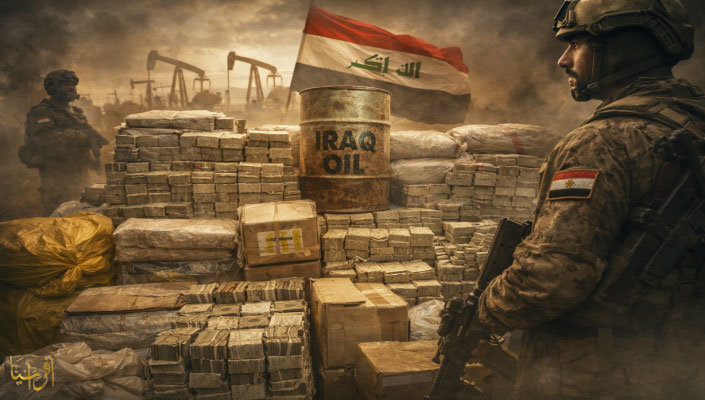
Afrasianet - Munir Haddad, legal advisor to the Iraqi prime minister, revealed that the volume of looted funds in Iraq since 2003 until now exceeds the barrier of two trillion dollars, and that the numbers of thefts and properties of the accused "exceed the level of reason and logic", according to the Iraqi News Agency on Wednesday.
Haddad said that the arrestees, whose number is increasing, are under constant investigation, noting that the current main defendants gave details during their confessions that led the security and judicial agencies to other wanted persons who tried to escape and escape outside Iraq, or to take refuge in the Kurdistan Region of Iraq, which "has handed over 8 defendants so far."
"Senior officials on the list of defendants"
"The list of defendants includes corrupt senior officials, including current and former officials and deputies, and that the crimes in question are not limited to traditional embezzlement, but also include cases of inflating abnormal financial wealth, and are legally classified as money laundering crimes," al-Haddad said.
While Haddad described the seized figures in the possession of undersecretaries and officials as "unreadable and unbelievable", he pointed to the arrest of officials who each owned more than 50 properties registered in his name or in his family names, adding that the wife of one of the defendants had bought a property worth $5 million.
He explained that more than 28 figures have been arrested in the Basra Electricity Department in southern Iraq, and that the campaign will include the districts in Nasiriyah, Amara and the rest of the provinces without any exceptions or red lines, stressing that there will be no time limit to end this slaughter.
He indicated that the trials will be public and the sessions will be broadcast in front of citizens, stressing that it is not possible to release the convicted defendants, pointing out at the same time that conditional release on bail - if it occurs - requires the payment of sums equal to the size of the stolen amounts.
They fell like dominoes. What happens after the arrest of the whales of corruption in Iraq?
On this topic, Omaima Majeed writes: Hours before dawn on Sunday, the streets of Baghdad were nothing like their usual nights. Abrams tanks escort forces from the Counter-Terrorism Service and the Iraqi army during raids on the homes of officials and political figures in the Iraqi state.
At the first light of the morning, roads leading to the Green Zone were closed, and heavily armed security forces were deployed in the vicinity.
At dawn on Sunday, a joint force that includes the Counter-Terrorism Service, the Iraqi army and security agencies specialized in integrity issues launched a campaign of arrests in several locations inside the Green Zone, including the Baghdad residential complex, which is home to officials and members of the Iraqi parliament, according to videos circulated on social media.
Security forces then tightened their measures and closed a number of roads leading to the Green Zone. Unusually on its streets, the queues stretched before calm returned to the street in the afternoon.
Iraq has entered one of the most extensive prosecutions of those accused of corruption since 2003, after executing arrest warrants against prominent officials, deputies and political figures, based on confessions made by former Undersecretary of the Ministry of Oil, Adnan al-Jumaili.
Corruption cases have returned to the forefront of the Iraqi scene, and the arrests have raised questions about whether they represent the beginning of a new phase in the fight against corruption, or whether they will face the same fate as previous campaigns.
Al-Zaidi supervises the operation
Regarding the details of the surprise operation, a senior source working at the Integrity Investigation Court revealed in an interview with Al Jazeera Net that the arrest campaign included more than 35 political and parliamentary figures, and the number is increasing, pointing out that a number of defendants were arrested in the Kurdistan Region and other provinces, based on confessions made by the Undersecretary of the Ministry of Oil, Adnan Al-Jumaili.
The source explained that the security forces began to execute judicial arrest warrants that included holders of special degrees, deputies, governors and the head of a political bloc, against the background of files related to corruption and abuse of influence, pointing out that some of the detainees were transferred to the Integrity Commission to complete the legal procedures. He added that the prime minister supervised the campaign, while the speaker of parliament, Heibat al-Halbousi, lifted the immunity of the detained deputies in conjunction with the legislative holiday.
In an official statement, the Federal Integrity Commission announced the start of firm measures in the implementation of judicial arrest warrants issued against a number of people accused of trespassing public funds, stressing that all its measures taken are strictly carried out under the provisions of the law and under its umbrella.
On May 30, 2026, Iraqi security forces arrested Undersecretary of the Ministry of Oil, Adnan al-Jumaili, in the al-Ishaqi area of Salah al-Din governorate, shortly after a decision was issued to relieve him of his position as general manager of the Northern Refineries Company, while he was found to have about US$11 million.
Strict measures
At the same time, the Green Zone witnessed a complete closure, with a heavy deployment of security forces and armored vehicles in a number of streets of the capital, Baghdad.
Security measures extended to Baghdad International Airport, where airport employees reported that the administration tightened inspection and vetting procedures on passengers, in anticipation of any attempt by the judiciary to leave the country, in an indication of the expansion of the precautionary measures accompanying the campaign.
Parliamentary welcome
In the first political reactions, Iraqi member of the House of Representatives Bassem al-Gharabi said that any serious government or judicial measures aimed at fighting corruption and recovering public funds is a welcome step, as it responds to a long-awaited popular and constitutional demand.
The success of this campaign will not be measured by the number or importance of the people against whom arrest warrants have been issued, but by the extent to which it adheres to the rule of law and continues to include all those found responsible for corruption, without discrimination, exclusion or selectivity, regardless of their political affiliations or positions, he said.
Respect for the independence of the judiciary and its decisions is a key pillar in the success of any reform process, Gharabi said, because justice is based on evidence and the provisions of the law, not on pressures or affiliations. He pointed out that public opinion will continue to monitor whether the measures will include all those involved or stop at certain limits, expressing his hope that this campaign will be the beginning of consolidating the principle that no one is above the law, stressing his confidence in the Iraqi judiciary.
Falling dominoes
Political researcher Taleb al-Ahmad believes that if the anti-corruption campaign continues at the same pace and with the same degree of firmness, he expects the corruption networks formed over the past years to collapse "like a domino break."
In his view, Prime Minister Ali al-Zaidi's approach to corruption cases represents a transformation that Iraq has not seen since 2003, he said, especially with the absence of what he described as "red lines" in the prosecution of the accused so far. This sends a message that corruption crimes do not fall by statute of limitations, and that accountability will remain in place no matter how long it takes, he said.
The success of this campaign also requires international co-operation, al-Ahmad said, noting that some corruption networks are supported by entities and personalities residing outside Iraq, which makes their pursuit and recovery of looted funds require co-ordination and co-operation beyond borders.
Despite the welcome that accompanied the campaign, it puts the Iraqi authorities to a test not only in the issuance of arrest warrants, but also in their ability to complete judicial proceedings to reach final verdicts and recover public funds, in light of previous experiments that ended without conclusive results.
While the Iraqi street is waiting to see whether this campaign will establish a different phase in the fight against corruption, or whether it will remain an exceptional event whose momentum will soon decline with the complexities of the political scene in Iraq.
________________
