
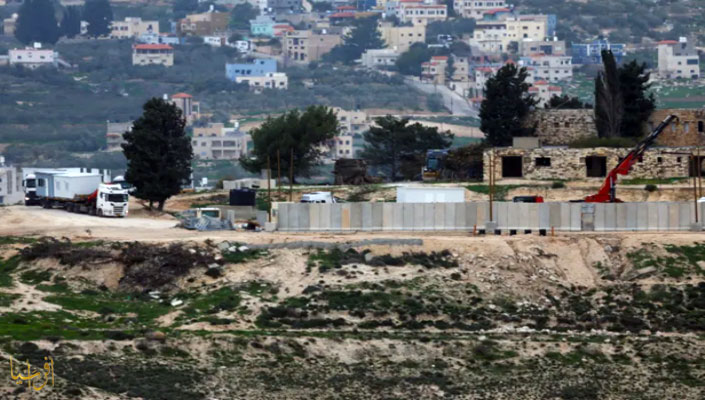
Installation of settlement facilities in the settlement of Sanur near Jenin
Afrasianet - Atef Daghlas - The Israeli occupation continues to escalate settlement operations in the northern West Bank, in addition to expanding military operations there, especially in the refugee camps, all with the aim of imposing more control over the area, confining hundreds of thousands of Palestinians to enclaves and cantons and cutting off the bonds of communication between them, according to Palestinian and Israeli reports.
According to data from the Palestine Liberation Organization's National Office for Land Defense and Resistance to Settlements, the occupation authorities are pushing new settlement projects aimed at changing the geographical and demographic reality in the northern West Bank, through plans to establish and develop 18 new settlements, targeting thousands of dunams of Palestinian land.
The Israeli government not only renovated 4 settlements that were evacuated in 2005 with a unilateral plan implemented by the government of Ariel Sharon, but also added 14 others, targeting an area inhabited by more than 720,000 Palestinians, according to another report by the Israeli newspaper Haaretz.
Settlement Settlements and Roads
One of the most prominent recent plans is the establishment of two settlement cities, "Yahnit" on the lands of the town of Arraba in the Jenin governorate, and "Rosh Ha'ayin Mizrahit", which is planned to be established on the lands of the villages of Deir Ballut and Al-Zawiya in the Salfit governorate.
By linking the settlement blocs to each other, the occupation is cutting off the communication of Palestinian villages and towns, and preventing any geographical extension of them, through networks of bypass roads that serve the settlements and allow the exclusive freedom of movement of the settlers, in addition to legitimizing a number of outposts and pastoral farms and turning them into approved settlements within the framework of structural plans.
The report of the Land Defense Center stated that the new settlement projects between the governorates of Nablus andJenin are served by a settlement road that connects the settlement of "Homesh" tothe Palestinian Jordan Valley and separates the two governorates geographically, as well as the consolidation of construction in the settlement of "Sanur" and its surroundings through 126 new and permanent housing units with the full support of the Israeli government.
He revealed a new settlement plan to build a number of roads between the settlements in Jenin governorate.
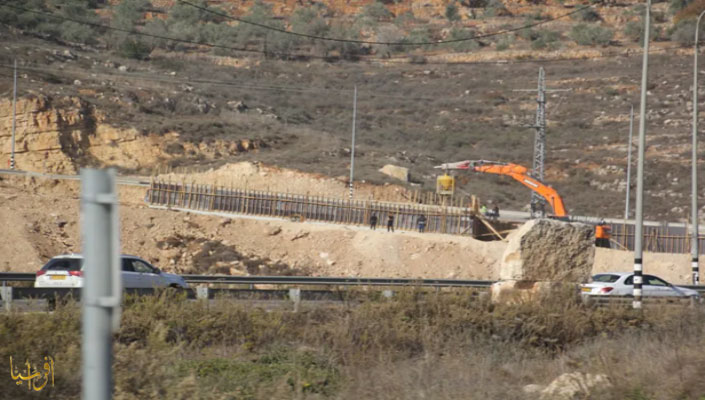
Settlement bypass roads built by the occupation near the city of Salfit (Al-Jazeera)
Religious pretexts
By inaugurating a pastoral and residential outpost on the top of Mount Ebal (the highest mountain peak in Nablus), the occupation is implementing an accelerated settlement plan there, by employing biblical pretexts such as the "altar of Joshua ben Nun" in the "Barnat" area on the mountain.
This outpost, with the support of the Northern West Bank Settlements Council and the "Amanah" settlement movement, has witnessed the continuous introduction of mobile homes and heavy equipment to stabilize the residential presence and expand the paths within it since last March, in overthrow the Israeli "Cabinet" decision issued in May 2025, which decided to legalize and establish 22 new settlement sites in the West Bank, the most prominent of which was Mount Ebal.
The "Scarlet Thread" project, which targets the area of the Al-Bqai'a Al-Ghouri Plain, located east of the town of Tammun near the city of Tubas , in the northern West Bank, threatens 24,000 dunums (dunams = 1,000 square meters), owned by about 300 farmers.
The report of the Land Defense Center, quoting the Israeli newspaper Haaretz, stated that this project will serve as a military road and a separation wall extending 22 kilometers long and 50 meters wide on the lands of citizens from the village of Ein Shibli in the central Jordan Valley to the Tayasir military checkpoint in the east of the Tubas governorate in the northern West Bank.
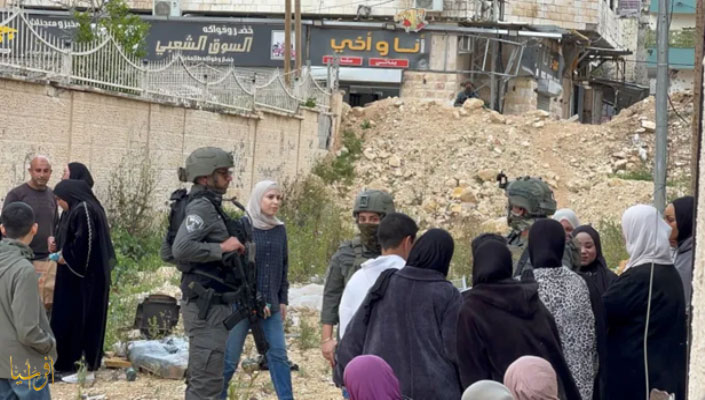
Since December 2025, the Israeli occupation army has been launching a military operation in Jenin refugee camp and camps in the northern West Bank (Al-Jazeera).
Military operation
According to the Haaretz newspaper, the accelerated settlement in the north of the West Bank and the Israeli army's military operations in the refugee camps are also being carried out with a significant investment from the occupation army.
The newspaper quoted the commander of the Central Command, Avi Plot, as saying, "We will see a very big change in northern Samaria (the West Bank)."
By targeting the Jenin, Tulkarem, and Nour Shams camps with Operation Iron Fence, which has been ongoing since December 21, 2025, the occupation has imposed a new reality in those camps, and has used methods similar to those used in the Gaza Strip, according to Haaretz, where residents were expelled, their homes were demolished, roads were built between them, and infrastructure in the camps was destroyed.
Haaretz reported that the occupation expelled and abandoned the residents of Jenin camp, while it destroyed 55% of the buildings of Nour Shams camp and 37% of the buildings of Tulkarem camp, displacing 32,000 people (according to Palestinian authorities that more than 40,000 displaced people) from those camps.
Settlement and electoral race
Despite the criticism of these Israeli actions by human rights organizations such as Human Rights Watch as a "crime against humanity," the newspaper invokes the justification of settler leaders and the IDF for this crime, including the statement by Finance Minister Bezalel Smotrich, at the beginning of the operation, "Now, we have begun to change the security vision in Judea and Samaria, and also in the campaign to eradicate terrorism from the area," so that the military justification is combined with the long-term goals of the settlers, who are working to return and resettle them.
Smotrich is seeking to pass concessions to the settlements and a new package of financial allocations estimated at hundreds of millions of shekels for the benefit of the settlers before the end of the current government's term, while working to stabilize part of these budgets so that they remain valid and binding on future governments, according to Haaretz.
Former Israeli Prime Minister Naftali Bennett's goals were not far from what Smotrich put forward, as part of the policy of electoral competition, considering that areas classified (C) according to the Oslo Accords, which constitute 61% of the West Bank (the area of the West Bank about 5,800 square kilometers), will be part of the State of Israel, in reference to his rejection of the establishment of a Palestinian state.
Bennett also told the Israel Broadcasting Corporation that what he described as "legal settlements" in Area C are established on "state land" and not on privately owned Palestinian land are settlements he supports and are "welcome."
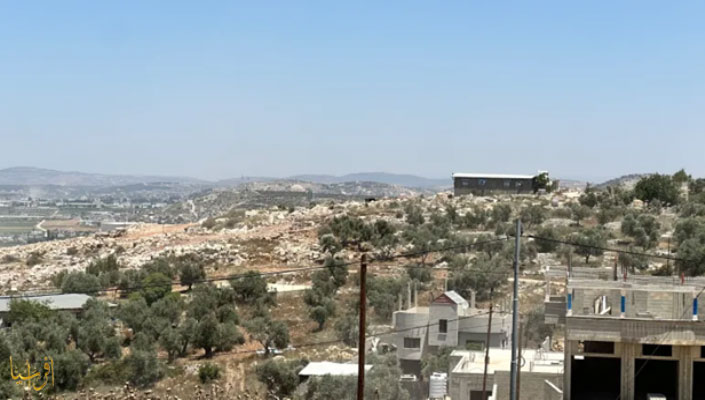
Mobile rooms of settlers near Palestinian homes in the town of Arraba, south of Jenin, in preparation for the construction of a religious school (Al-Jazeera).
On the ground
Confirming this settlement escalation, the Commission for Resistance to the Wall and Settlements (an official body) stated that the Israeli occupation army and settlers carried out 1659 attacks against Palestinians and their properties during last May, where the army carried out 1108 attacks, while the settlers launched 551 attacks, the most prominent of which varied between direct physical violence, uprooting trees, burning fields, seizing property, in addition to demolishing homes and agricultural facilities.
As part of its Judaization policies, the Commission stated that the occupation government approved the construction of two religious schools in the northern West Bank, specifically in the Jenin governorate, the first near the settlement of "Ghanim" southeast of the city. The second is located in the settlement of "Emek Dotan", which is located on the lands of citizens west of the town of Arraba.
"Let's burn it".. settler attacks affect dozens of Palestinian mosques
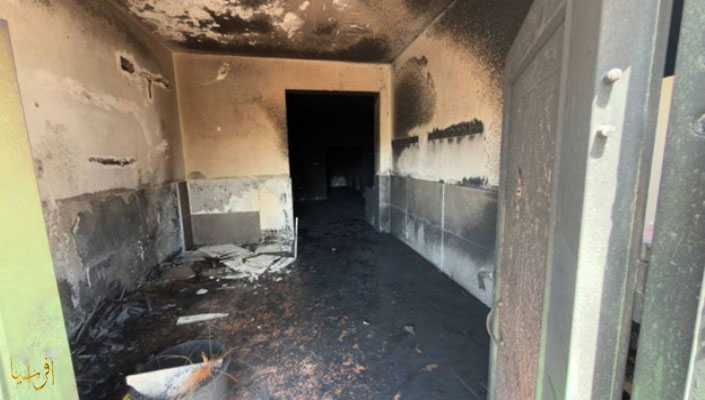
Settlers burn part of the Great Mosque in the town of Jaljalia, north of Ramallah
Fatima Mahmoud - On the other hand, I woke up to the sounds of explosions nearby, and if it wasn't for God's providence, I would have been a burned body by now, my wife and my little girl." Sheikh Muhammad al-Khasib, the imam of the Grand Jaljalia Mosque, described the incident of settlers burning the second floor of the mosque while he was sleeping with his family in a house on the ground floor just before dawn on Wednesday.
Only a few moments separated the settlers' setting fire to the three-story mosque and Sheikh Mohammed's ability to open the doors and the villagers' call for help in putting out the fire.
Al-Khasib says that the sounds were caused by the shattering of glass and doors on the second floor, where the ablution is located, due to the intensity and intensity of the fire. He confirms that if he was a little late, the fire would have reached the floor where he lives, and to the third floor, which houses the prayer hall.
At 2 a.m. on Wednesday, a group of settlers were writing racist slogans on the walls of the Jaljalia Mosque, while a number of them threw about 15 burning tires inside and around the mosque, causing complete destruction in the ablution, as the heat of the fire reached the tiles and walls and caused them to be destroyed.
Statements written by settlers included greetings to other settlers who had participated in previous attacks on mosques and Palestinian property, as well as phrases such as "Come on to the night of mosque burning" and calls to encourage similar arsons, including the phrase "Wake up, group", in a message addressed to other settlers for launching attacks on other mosques in the West Bank.
Escalation and racism
Simultaneously with the burning of the Great Jaljalia Mosque, other groups of settlers were burning another mosque in the nearby village of Mazraat al-Nubani.
According to Osama Asaad, head of the Jaljalia village council, this attack is not the first of its kind on the village, which has a population of about 1,000 people, and is classified as a Palestinian Authority controlled area, according to the classification of the Oslo Accords.
"Residents were alerted to the fire and contacted the Civil Defense, and the residents of nearby villages urgently helped with extinguishing operations, which prevented the fire from spreading to the rest of the mosque," he told Al Jazeera Net.
He added that the attacks are carried out in a systematic and systematic manner, and they mainly target mosques with the aim of terrorizing Palestinian citizens.
Jaljalia is surrounded by a number of settlements and outposts, and a few months ago, settlers from sheep herders established an outpost near the village.
Residents in this area are subjected to almost daily attacks, including the theft of a herd of cattle weeks ago, the burning of a citizen's vehicle about two months ago, and an attempt to burn down a house during the same period.
Since the beginning of 2025, the Palestinian Ministry of Endowments and Religious Affairs has documented 50 attacks on mosques and religious shrines in the West Bank.
These attacks coincide with the escalation of settlement expansion in various West Bank governorates, and the daily exposure of Palestinian citizens to settler attacks, which include the burning of agricultural crops, the theft of livestock, and the destruction of property, in addition to the recording of house burnings, especially in Ramallah governorate and areas south of Nablus.
Incendiary materials
In the village of Barqa, east of Ramallah, the village mosque was on the verge of an attack by groups of settlers shortly before the evening prayers. Although there were a number of worshippers inside the mosque, the settlers threw incendiary materials on the first floor, which led to a fire in it.
According to the mayor of Barqa, Sayel Kanaan, about six settlers carried out a series of attacks targeting several mosques in the eastern region of Ramallah governorate, setting fire to the mosque in the village of Deir Dibwan before the Maghrib prayers, then tried to burn the Barqa mosque at the time of the evening prayers, and also burned a car belonging to one of the worshippers inside the mosque.
Sayel told Al Jazeera Net that the settlers were carrying car tires covered in gasoline, and were planning to storm the two-story mosque. They had already reached the first floor, smashing window glass and throwing incendiary materials, but the presence of worshippers inside the mosque prevented their plan from being completed.
Worshippers quickly made calls over loudspeakers, and the townspeople flocked and managed to confront the attackers and put out the fire in the car and the ground floor of the mosque.
Kanaan believes that the attacks carried out by extremist settler groups called "Hilltop Boys" aim to empty Palestinian towns of their inhabitants through intimidation, threats of burning and repeated attacks, stressing that the residents' clinging to their lands and homes is the way to thwart the settlement plans and control the Palestinian lands.
Official Support
According to Ahmed al-Rifai, head of the Attacks Documentation Department at the Palestinian Ministry of Endowments, the targeting of religious shrines and mosques has witnessed a significant escalation in recent months, represented by storming religious shrines, writing racist slogans on the walls of mosques, and attempts to burn some of them, and closing a number of them in different areas.
The most recent of these attacks was a few days ago the burning of a mosque in the village of Barqa and a mosque in Deir Dibwan, east of Ramallah, in addition to the attack on a mosque in the town of Farms al-Nubani, and religious shrines in the town of Sinjil, northeast of Ramallah.
Al-Rifai confirms to Al Jazeera Net that the occupation army and the Israeli government are lenient in dealing with settlers who are active in daily attacks on mosques and citizens' properties.
He touched on the Israeli government's support for the "Hilltop Boys" settler groups in their attacks on citizens' farms, homes, places of worship and religious shrines, pointing to financial allocations announced a few days ago for each member participating in these groups, which constitutes real and real support for them and their actions on the ground.
Rifai points to the widespread incursions into the Al-Aqsa Mosque and the provocative actions carried out by settlers and officials led by extremist minister Itamar Ben-Gvir.
Also on Wednesday, 107 settlers stormed the courtyards of Al-Aqsa Mosque under the protection of the occupation police, and Al-Aqsa also witnessed daily morning and evening incursions and the performance of Jewish prayers, in addition to measures that limit the access of Muslims and the people of Jerusalem to it.
According to the official at the Palestinian Ministry of Endowments, what the West Bank mosques are subjected to comes within a systematic policy that is inseparable from the punitive measures imposed by Israel on the Palestinians, represented in the closure of cities, the establishment of military checkpoints between towns and villages, the demolition of houses.
The displacement of residents, the establishment of camps for the occupation army in areas under the control of the Palestinian Authority, in addition to the construction of new settlement units, which makes the life of the Palestinian more difficult and pushes him to emigrate.
Religious Dimensions
For his part, Israeli researcher Mohammed Daraghmeh links the increase in settler attacks on Palestinian mosques to the general policy of the occupation in the West Bank, which is based on violating Islamic and Christian sanctities.
He added that the targeting of mosques in the West Bank comes not only by settlers, but also from the official Israeli level, especially in the territories occupied in 1948.
He added that this was clear through Itamar Ben-Gvir's statements regarding his intention to ban the call to prayer, and previous years also witnessed calls by various members of the occupation governments to reduce the sounds of the call to prayer in mosques, prohibit the use of loudspeakers, and Friday sermons, and impose violations on some mosques under the pretext of the loudness of the call to prayer.
"This is a general policy of Israel, and the settlers are part of this policy, as they burn and vandalize holy places and mosques and write slogans on them. This comes within the framework of provoking the residents, because they are aware of the importance and meaning of places of worship for Palestinians in the West Bank."
He concludes by saying that the settlers see part of the conflict with the Palestinians as a religious conflict, and they seek to give it a religious character that pushes it to further tension and confrontation.
A camp of the occupation army on the territory of Jenin. These are the most prominent sectors affected
Ola Mohammed - Palestinian residents of the village of Aaba, in the northern West Bank, feel a real threat to their agricultural lands and economic projects, after the occupation began to prepare the infrastructure for the establishment of a camp on their lands.
On a road that is considered a lifeline for the eastern villages of the city of Jenin in the northern West Bank, the Israeli occupation army established a camp on the lands of the town of Abba, with an area of about 22 dunums (one dunam equals 1,000 square meters) owned by citizens from the town of Qabatiya, which was confiscated by a military order in mid-May.
What worries residents in an environment is not limited to the concrete walls that are forming in front of their eyes, nor the greenhouses, sheep pastures, and tourist and family facilities that were preparing for the summer season, but also the closure of transportation routes, the deprivation of land, and a threat to the livelihoods they have established over the years.
The impact of the camp did not begin only from the maps or the confiscation orders, but also from a modern summer house belonging to the citizen Alaa al-Asmar, which was seized by the occupation army and turned into a military post, in an area separated from the construction of the camp by only one piece of land.
Occupation in the Peak of the Season
The Palestinian citizen says that on May 27, an army force informed him of the seizure of the chalet (summer house) for 30 days, and that the soldiers are still there.
Al-Asmar did not expect the summer season to open in this way. A summer house he built with all that he and his brother owned, on land overlooking the hills of western Jenin, cost them more than 1.5 million shekels (about $415,000), which no one lived in overnight and was never rented.
As they were preparing to receive their first customers and vacationers as summer began, the Israeli army came and asked for an evacuation.
The man makes no secret of his fear that the temporary damage will turn into a permanent loss if the army establishes its presence in the place. "Of course we are afraid to go somewhere next to a camp (...) Customers who would have rented the chalet would refrain from doing so, and they would be afraid to come to this area."
Meters away
In addition to the summer houses, there are many greenhouses and hundreds of dunams of pastures lurking in an ambiguous and difficult security reality as a result of this camp, which has begun to establish its roots in the area, a few meters away from the town of Abba.
Burhan Azmouti, head of the village council in Abba, explained that the new camp is located in an area known as "basins", within registered areas belonging to the town of Qabatiya, but it is completely adjacent to the eastern town of Aba and the Wadi al-Dabaa area.
He added that most of the village's agricultural land extends in the vicinity of the camp, and that a large part of it is planted with olive trees, which are a main source of livelihood for the residents.
The village council fears that the impact will not be limited to the land adjacent to the site, and that the restrictions will extend to a wider area, with farmers and citizens not being able to access their land. Even two kilometres or more away can become a closed area.
Herders who rely on the nearby valley to graze their sheep will also be affected, he said, as "they will not be able to get there, which will force the citizen to buy fodder for his sheep, and this will increase the costs."
The greatest danger
At the level of daily movement, the head of the council talks about the sudden checkpoints set up by soldiers on the bypass road leading to Jenin that impede traffic, and about alternative routes that residents have resorted to, which increases the cost of reaching the city of Jenin for workers, students and patients.
According to Azmouti, the council has no official information about the camp's boundaries or its ultimate function. He says what they have so far is based on what they see on the ground in an area where private property overlaps with land classified as "state land."
He points out that the biggest fear is not related to the camp alone, but to its relationship to a broader path of settlement return north of Jenin, especially in the settlements of Ganim and Qadim, which were evacuated in 2005.
A new reality
For his part, Mufid Gilghoum, an activist specializing in settlement affairs, said that the new camp cannot be separated from the ongoing transformations in Jenin governorate, in what is similar to the beginning of the occupation in 1967, pointing out that Jenin was the only area in the West Bank that was almost free of settlements.
According to the Palestinian expert, what is happening today is based on three parallel tracks:
• Resettlement to the evacuated settlements.
• Construction of military centers and towers.
• Build new routes that connect these sites to each other, thereby confiscating land and changing the lifestyle of the residents.
Speaking to Al Jazeera Net, Gilgum warns that agriculture, pastures and transportation will be directly affected, and that Jenin may enter a phase similar to other areas in the West Bank, where daily contact with the army and settlers becomes part of the details of life.
"We will see settlers stopping us at checkpoints and hindering our lives," he said, adding that setting up the camp in this location would mean pushing Palestinian villages into a new security reality, in which Oslo's designations of Areas A, B and C are no longer capable of protecting movement or territory.
Settlement Revival
Between a summer house that has been turned into a barracks, olive lands threatened with isolation, and shepherds who may lose their pastures, the new camp in mourning looks more like a military installation.
In the eyes of the residents of Aba and the surrounding villages, it is the beginning of new events that may redraw the daily geography of Jenin, turning its agricultural and tourist periphery into a space of constant surveillance, restriction and assault.
In Jenin governorate, there are existing settlements in its northern and western surroundings, most notably the settlement of "Tarsala" and the settlement of "Mifo Dotan" west of Jenin, as well as the revitalized outpost in "Homesh" in the north.
The occupation is also continuing to rehabilitate the settlements of "Ganim" and "Qadim", which were evacuated in 2005 as part of the Israeli disengagement plan implemented by former Prime Minister Ariel Sharon, and one of them is located less than 200 meters from the eastern village of Abba.
The numbers speak
According to the data of resistance to the wall and settlements during the month of May 2026, the occupation army issued four military orders targeting about 393 dunums of land in Jenin governorate, three of which were allocated for the establishment of new military sites.
These moves fall within the context of a broad escalation in the West Bank since October 7, 2023, as the Commission to Resist the Wall and Settlements documented about 40,000 attacks carried out by the occupation forces and settlers until the end of 2025, including more than 7,500 attacks committed by settlers.
These attacks have also led to the displacement of dozens of Palestinian communities and the seizure of large areas of land, in what observers describe as one of the most violent and accelerated stages of settlement expansion in recent decades.
Religious Schools to Consolidate Settlements in the North West Bank
In front of his home in the northern mountain area of the town of Arraba, south of the city of Jenin in the north of the occupied West Bank , the child Adam Rahal rides his bicycle back and forth, while his father does not miss him for a moment.
Meanwhile, Adam's uncle, Mehdi Rahal, goes out of his house to the grocery store, not forgetting to lock the iron door with the key, even though his family is inside.
This scene has become a habit for the Rahal family about a month ago, specifically after the first mobile caravan of settlers was established in the Ras al-Jabal area, northwest of Arraba.
Existing danger
Mahdi spoke of living next to settlers, saying it was "a danger in itself." "How can this settler be an extremist and seek to establish a Jewish religious school that teaches extremist teachings that incite against Arabs on a permanent basis?".
"I am afraid that the settler will take advantage of my absence and attack my three children and their mother. We are forbidden to go down to the yard, and children playing in front of the house is also dangerous.
We were also denied access to the poultry farm that we established two years ago, which is our source of income, on the pretext that it is now part of the settlement land, even though it is a few meters away from my house."
Because of this ban, Mahdi lost half of the poultry, adding, "We moved the other half to another place. The problem is that establishing a religious school here means giving the settlement an official status that is difficult to remove later."
Mahdi lives next door to his three brothers in adjacent detached houses where about 20 people live, who have been forced by settlers to live a harsh lifestyle governed by surveillance and fear, restricted movement, work and land use.
Two schools in the city
According to the Commission for Resistance to the Wall and Settlements (an official body), the Israeli government approved the construction of two religious schools in the northern West Bank, specifically in the Jenin governorate, the first near the settlement of "Ghanim", which was evacuated in 2005 as part of what was known as the unilateral "disengagement plan", implemented by the government of former Israeli Prime Minister Ariel Sharon, and included the evacuation of five settlements in the Jenin governorate.
The second is located in the settlement of "Emek Dotan", which is located on the lands of the citizens, west of the town of Arraba. According to the Commission, despite the lack of final approval of the official plans for the two schools, the occupation actually started the construction work before completing the official procedures.
On the ground, the Israeli occupation informed the Palestinian Liaison Agency, an official focal point with the Israeli side, of the confiscation of land from the town in favor of establishing a cow barn. Immediately, some 15 settlers built 3 mobile housing units in the confiscated land, bringing with them a number of sheep and cows in preparation for the establishment of a settlement.
Accelerating the settlement process
The director of the municipality of Arraba, Ahmed Tahsin Al-Ardeh, told Al Jazeera Net that the occupation forces bulldozed agricultural lands last month, estimated at 163 dunums (dunums = 1000 square meters), but the residents living near the bulldozing areas confirmed that the area of the targeted lands has doubled during the past two weeks, which confirms, according to Al-Ardeh, that the work is not limited to the establishment of a barn for cows and livestock.
"According to our follow-up, 260 housing units have been approved within the settlement, and they have been expanded to become a residential settlement and not just a pastoral outpost," he added.
Al-Ardeh has been documenting attacks on agricultural lands, citizens' homes and properties in Arraba since 2023. Over the past three years, hundreds of complaints have been monitored by citizens who have been subjected to direct and indirect attacks by settlers, including detention, beatings, confiscation of olive fruits, attempted burning of farms, and attacks and vandalism of homes.
According to documented testimonies and scenes and the scale of the attacks, Al-Ardeh confirms that although there are few settlers in the area, they are violent and dangerous.
The documentation also included attacks carried out by people wearing Israeli military uniforms, which makes it even more dangerous to deal with the matter, as it is difficult to distinguish between reservists or settlers wearing Israeli military uniforms.
Risks under the protection of the army
In the area, we received Firas Rahal. Although the place was quiet, his actions and movements were overshadowed by extreme caution. He said that settlers in the caravan near his house were monitoring his movements and his family members, deliberately breaking into the yard and attacking them, and repeatedly trying to smash doors and windows.
Behind the house, the occupation army erected a strip of black plastic wire, and asked the residents of the houses in the area not to cross it along the distance it was placed, warning that crossing this line may expose them to gunfire, under the pretext that the area has become part of the new outpost established in the area of Ras al-Jabal al-Shamali, above the town.
Rahal spoke to Al Jazeera Net about the difficulty of life in the area after the start of settlement there, saying: "This is the most beautiful and calmest area in the whole of Arraba, and it is a vital area. Opposite my family's houses, the town park was built, and next to it is the traffic circle, but as you can see, there are no hikers in the place and no reviewers to renew car licenses."
"People avoid coming here for fear of settler attacks, but sleep has become our enemy. We watch so that our children sleep safely, and we keep an eye on the windows and doors throughout the night."
Easy is the goal
For his part, the mayor of Arraba, Ahmed Fathi al-Ardeh, pointed out that the choice of the town's lands to build a religious school on it is "growing at an accelerated pace, and today we notice that the majority of Israelis have become more radical, and that Israeli society is moving towards more extremism."
He told Al Jazeera Net that the religious school to be built in the settlement of "Emek Dotan" is located in one of the most fertile areas in the northern West Bank, along with settler agricultural communities.
The target, he said, is the Arraba Plain, "which is the second largest inland plain in historic Palestine after the Marj Ibn Amer plain, most of whose land has been occupied and only about 10% of its original area remains.
The goal is not limited to confiscating about 240 dunums for the benefit of the school, but also to control the entire Arraba plain and to restrict the citizens' livelihoods and lives, to reach the larger goal, which is to push Palestinians to emigrate."
The problem is that these settlers roam around with weapons and threaten citizens, in addition to the fact that "the occupation forces present daily provide them with protection during their attacks and on the residents, as well as during their theft of olive and wheat crops."
A role that goes beyond settlement
Since October 7, 2023, the occupation forces have prevented the residents of Arraba from accessing about 1,500 dunums planted with olive trees, and deprived them of harvesting, cultivating and caring for their crops during the past seasons. The residents say that these lands are now vulnerable to tree damage and soil drying.
According to the municipality's statistics, 800 dunums of land around the confiscated area for the benefit of the religious settlement have been completely closed, and the residents have been prevented from accessing it. 80% of the town's 20,000 residents depend on agriculture, as the area of the Arraba plain is about 32,000 dunams, and its lands belong to the people of the town and the surrounding villages.
According to the Jerusalem Center for Studies, Jewish religious schools in the West Bank, some of which are known as the Yeshiva for men and the Midrash for women, are boarding educational institutions in which students combine the study of biblical texts with military service within the framework of the Hasdar program, and serve as an ideological tool to entrench the settlement project.
These schools play two roles:
• Military Engagement: Often known as Yeshivat Hasdar, students study for a specific period and perform military service in the IDF within a blended religious and military framework.
• Settlement and Expansion: These schools play a pivotal role in fueling settler thought, as their students and rabbis are the nucleus of extremist religious movements that advocate settlement expansion in the heart of the West Bank.
The most prominent of these in the northern West Bank is the school in the settlement of Homesh located on the road between Nablus and Jenin, which was rebuilt by settlers and built a permanent headquarters with official approval after the evacuation of the settlement in 2005.
Tourism and Agriculture
According to writer and researcher Mufid Gilghum, from Jenin, the establishment of Jewish religious schools in Jenin governorate has a direct impact on the tourism and agricultural sectors in the governorate.
"The school announced in the settlement of Ganim is only about 100 meters away from the tourist village of Haddad, and this area is one of the largest tourist facilities in the northern West Bank, and represents an outlet for hundreds of families in Jenin and the northern governorates, and the establishment of the school means the influx of large numbers of settlers to the area, which will negatively affect the tourism sector," he told Al Jazeera Net.
According to Gilghoum, the occupation authorities seek to confiscate agricultural lands and establish settlements on them, whether they are pastoral outposts, religious schools or large settlements, all with the aim of imposing a new reality by controlling agricultural lands and deepening the settlement project therein.
According to him, the occupation seeks to give legal and legislative status to the settlements and outposts it is establishing, but for the Palestinians, the military tower, the religious school and the pastoral outpost all share the same goal, which is to rob the Palestinian land and increase the number of settlers in Palestinian cities and towns.
Ideology in the service of conflict
As for the goals of establishing religious schools, Suleiman Bisharat, a researcher specialized in Israeli affairs, mentions them:
• Turning the settlement presence from a functional colonial character to an ideological-religious character, allowing the settlers to inject more material and human resources into this type of settlement, which serves the policies adopted by the current Israeli government in the presence of extremist ministers Itamar Ben-Gvir and Bezalel Smotrich."
• Israel is still seeking to resolve the conflict in the West Bank at the geographical, demographic, ideological, and religious levels, which it sees as the most important trajectory of the conflict from its perspective
• Providing an incubating environment for Israeli nationalist and religious thought, which fosters not only feelings of hostility towards the Palestinians, but also the Israeli presence and the consolidation of Israeli national identity.
He added in his interview with Al Jazeera Net, "The occupation knows that part of the Palestinians' adherence to their land stems from the religious dimension, as it is the land of Isra, Mi'raj and the land of heavenly messages, so it tries to play the same chord by promoting the idea that this is the 'Promised Land' and the 'Holy Land' according to the Jewish perspective.
This is what the religious schools are working on, which contribute to the production of a cohesive and extremist generation, which is very attached to this land, and does not accept to give it up. Israel does not want its existence to remain tied only to the political dimension, the logic of power and international support, but also seeks to consolidate the religious connection to the land."
He concluded by saying that one of the most prominent scenes of the conflict in the coming phase may be the direct confrontation between the extremist settlers and Palestinian citizens, which is reflected in the escalation of attempts to Judaize Al-Aqsa Mosque, the repeated incursions of settlers into it, in addition to the attacks on mosques in a number of Palestinian towns and villages in the West Bank.
________________
Source: Agencies – Websites – Al Jazeera
________________
