
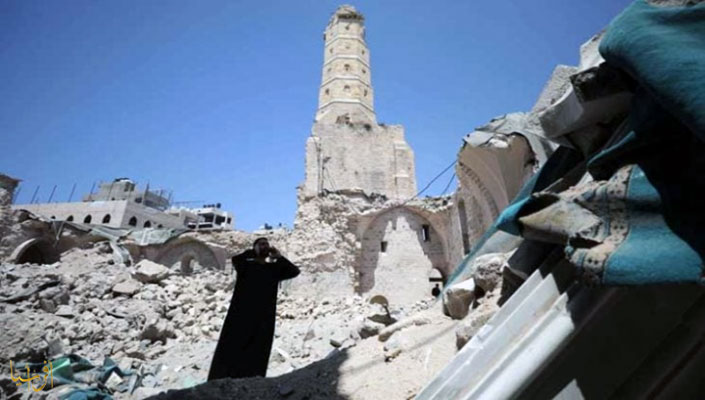
Palestinians pray on the ruins of the Great Omari Mosque in the center of the Old City of Gaza City.
Afrasianet - In the Gaza Strip, minarets and church bells no longer only signal prayer times, many of them have remained silent under the rubble after Israeli airstrikes as part of the genocidal war that began 1,000 days ago, and attacks are still ongoing.
According to the Ministry of Endowments and Religious Affairs in the Gaza Strip, during the war of extermination, Israel completely destroyed 1,050 mosques and partially damaged 191 others, out of the 1,275 mosques that existed before the war.
Despite reaching an agreement to stop Israel's war of annihilation on the Gaza Strip, Tel Aviv has continued its violations by launching continuous attacks and attacks since it came into effect on October 10, 2025.
In this context, we monitor the most prominent mosques and churches that have been affected by Israeli attacks since the start of the war of extermination a thousand days ago, on October 8, 2023.
The Great Omari Mosque
The Great Omari Mosque is one of the oldest and oldest mosques in Gaza City, and it is located in the heart of the Old City, with an area of 4100 square meters, in addition to a courtyard with an area of 1190 square meters.
The mosque has 38 columns, and is the largest in the Gaza Strip, and was named in honor of Caliph Omar bin Al-Khattab.
Throughout its long history, the site has been transformed from an ancient Palestinian temple to a Byzantine church, and then to a mosque after the Islamic conquest.
The mosque was destroyed during World War I and later renovated in 1925, before being targeted again by Israeli bombing in the last war.
"The mosque has been subjected to the fiercest human attack," said one of the visitors to the Al-Omari Mosque, adding: "Its destruction is a tragedy for us, as it is part of Gaza and Palestine."
Alsayed Hashim Mosque
The mosque is located in the al-Daraj neighborhood in the east of Gaza City, and is believed to house the tomb of Hashem ibn Abd Manaf, the grandfather of the Prophet Muhammad, whose name was associated with the city of "Gaza Hashem".
The mosque was heavily damaged by shelling by Israeli planes during the war of extermination.
Mosque of the Writer of the State
The mosque shares a single wall with the Church of St. Porphyrius, and is one of the important archaeological mosques in Gaza City, with an area of about 377 square meters.
Its construction dates back to the reign of the Mamluk Sultan al-Nasir Muhammad ibn Qalawun, during his third term between 1309 and 1341 AD.
The mosque was subjected to Israeli artillery shelling during the war, causing extensive damage.
Ibn Othman Mosque
It is the second largest archaeological mosque in Gaza City after the Great Omari Mosque, with an area of about two thousand square meters.
The mosque is located in the Shujaiya neighborhood, and is considered a prominent example of Mamluk architecture with its distinctive architectural and decorative elements.
The mosque was built by Ahmed bin Othman, who was born in the city of Nablus in the north of the occupied West Bank, then moved to Gaza and settled there, where he built the mosque and made it a place of worship, but it was not spared from Israeli destruction.
The western porch of the mosque includes the tomb of Prince Saif al-Din Yilkhja, who took over the prosecution of Gaza in 1445 AD, died there in 1446, and was buried in the mosque itself.
Ali Bin Marwan Mosque
It is one of the famous mosques in Gaza City, and it is located in the Al-Tuffah neighborhood, and it extends over an area of about 320 square meters, and dates back to the Mamluk era.
The mosque was named after the righteous man Ali ibn Marwan, whose mausoleum is located below the dome.
The mosque was established in 1371 AD and retains its religious and historical place in the memory of the people of Gaza, but it was not spared from the Israeli machine of destruction during the current war.
Al-Zafar Damri Mosque
The mosque is located at the eastern end of the Old City in the Shujaiya neighborhood, and has an area of 600 square meters.
It was named after its founder, Shihab al-Din al-Zafar Damri, and there is a plaque engraved with sandstone indicating that the year of its establishment was 1361 AD, but this date did not protect it from Israeli destruction.
Court Mosque (Al-Bardbakiya Mosque)
The mosque is located in the Shujaiya neighborhood in the Old City of Gaza, and has an area of 546 square meters.
The building consists of an open courtyard in the middle of a group of rooms and facilities, and was called the "Court Mosque" due to its use as the seat of the Sharia Court in the Ottoman era.
Six Ruqayyah Mosque
The mosque is located in the Shujaiya neighborhood, and was built on an area of 174 square meters, and consists of a iwan and a mihrab, which Israel destroyed during the war of extermination.
The mosque is named after the lady whose name is associated with it, and is said to be the wife of one of the rulers of Gaza during the Ottoman era.
Sheikh Othman Qashqar Mosque
It is one of the oldest archaeological mosques in Gaza City, as it was built in 1223 AD, and its area is only 70 square meters.
It was named after Sheikh Othman Qashqar, and it is said that he is of Ajami or Albanian origin, and there is a marble piece on its door with the date of its establishment, but this did not intercede for him in the face of the Israeli destruction.
Khan Younis Grand Mosque
It is the largest mosque in the city of Khan Younis in the southern Gaza Strip, and it was built in 1928, then it was expanded and its minaret was built in 1954.
It has an area of about 3300 square meters, and it consists of a closed place called the mosque's courtyard, and its area is about 900 square meters, in addition to an outdoor courtyard and a number of service rooms that make up the rest of the space.
The mosque was bombed by Israel during the current war, which led to its destruction.
Churches Under Israel's Fire
In Gaza City, where the Scribe Mosque and the Church of St. Porphyrius share the same wall, Israeli bombardment has spread to religious monuments that, regardless of their faith, have been part of the city's spiritual and historical memory for centuries.
The churches that were hit by the Israeli bombardment are three:
Holy Family
The Church of the Holy Family in eastern Gaza City has been hit by Israeli shelling several times during the war, resulting in civilian casualties.
According to the Latin Patriarchate of Jerusalem, the number of Latin Christians in Gaza reached about 71 in February 1881, when planning began to build a church in the city.
In 1879, the Austrian priest Father Georg Gatt arrived in Gaza and bought three houses to build the church, but the outbreak of World War I between 1914 and 1918 prevented the project from being implemented.
With the Nakba of 1948 and the arrival of displaced Palestinians in Gaza, including Catholics, interest in building a major church returned, and Father Hanna al-Nimri built the Holy Family Church in 1965.
Saint Porphyrius
St. Porphyrius Church is one of the oldest churches in Gaza, and its establishment dates back to the fifth century AD, and it is located in the Al-Zaytoun neighborhood in Gaza City.
The church and its surroundings were subjected to Israeli shelling on October 10, 2023, causing extensive damage to the compound.
Baptist
The Baptist Church belongs to the Anglican Episcopal Church in Jerusalem, and was founded in 1882 by an English mission.
Located in the center of Gaza City, the church consists of six floors that include a library and halls for awareness, meetings, hospitality and worship.
The name of the church was associated with one of the most heinous massacres, after Israel bombed the courtyard of the National Baptist Hospital on October 17, 2023, resulting in the death of about 500 Palestinians.
Since Israel launched its war of extermination on the Gaza Strip on October 8, 2023, more than 73,000 Palestinians have been martyred, more than 173,000 others have been injured, in addition to extensive destruction of about 90 percent of the civilian infrastructure in the Strip, according to Palestinian data.
Knesset prepares for ban on call to prayer, Hamas calls bill a religious war
On a similar topic, the Israeli Knesset approved on Wednesday evening with a preliminary reading the "Muezzin Law," which prohibits the call to prayer through loudspeakers in Jerusalem and inside the Green Line, while the Islamic Resistance Movement (Hamas) considered the bill an escalation of Israel's "religious war" against the holy sites and Islamic identity.
The Israel Hayom newspaper said that "the Knesset approved the preliminary reading of the Muezzin bill to tighten law enforcement" against what it claimed was "mosque noise," without elaborating.
The Yedioth Ahronoth newspaper explained that the bill was voted in favor by a majority of 50 in favor, out of 120 Knesset members, against 36 against.
It added that the opposition Yisrael Beiteinu party, led by Avigdor Lieberman, voted in favor of the bill put forward by the Otzma Yehudit (Jewish Power) party, led by the extremist National Security Minister Itamar Ben-Gvir.
In order for the bill to become effective, it must be approved in three additional readings, according to Israeli law.
The bill stipulates that no sound system may be installed or operated in any mosque without obtaining an explicit prior license, according to Israel's Channel 14.
The channel claimed that "the granting of the license will be studied very carefully based on the intensity of the noise, the technical measures taken to reduce it, the location of the mosque, its proximity to residential areas, and the impact of noise on the neighbors."
The channel added: "The law gives the police unprecedented powers, in case of a violation of the rules, the policeman has the right to demand that the noise be stopped immediately, and if the violation continues, he has the right to confiscate the sound system of the mosque."
"The bill also provides for severe and deterrent financial penalties, imposing a fine of 50,000 shekels (about $17,000) for installing or operating a speaker system without a permit, while the fine is 10,000 shekels (about $3,500) if it is operated in violation of the conditions of the permit granted," she said.
Ben Gvir: "The call to prayer is a disturbing noise"
Ben-Gvir welcomed the passage of the law in the preliminary reading, claiming that "in many places, the muezzin's voice is an annoying noise that harms the quality of life and health of the population. This is a phenomenon that cannot be overlooked."
"During my tenure, for the first time, the Israeli police began to address this intolerable phenomenon, and now we are providing them with additional effective tools to eradicate it."
Environmental Protection Minister Idit Silman of Prime Minister Benjamin Netanyahu's Likud party also commented on the vote on her account on the X platform , saying, "The Muezzin bill, which has now passed a preliminary reading in the Knesset, will give the Ministry of Environmental Protection inspectors, in cooperation with the police, powers to significantly strengthen law enforcement against loud and unreasonable noise."
She claimed that the move "is critical to the imposition of state sovereignty and aims to restore calm to the lives of many citizens who have suffered from noise for many years. I thank National Security Minister Itamar Ben-Gvir."
On December 29, 2025, Ben-Gvir's party presented the "Muezzin Law" bill to the Knesset, before it was voted on Wednesday in a preliminary reading.
Amid widespread protests in Israel's Arab cities and towns, in March 2017, the Knesset approved a far-right bill to ban the call to prayer during the night hours in occupied Jerusalem mosques and Palestinian towns within the Green Line, but ultimately did not pass, according to The Times of Israel.
Legislative terrorism
For his part, Palestinian National Council Speaker Rohi Fattouh said that the Knesset's approval of the bill "represents a crime, legislative terrorism and a flagrant violation of freedom of worship and belief."
"This legislation reveals the true nature of Israel as an apartheid regime," he said in a statement, noting that the Knesset "employs its legal tools to enforce religious and cultural persecution."
The targeting of the call to prayer "represents a serious escalation that contradicts international law on civil and political rights and the Universal Declaration of Human Rights", he said.
Fattouh called on the international community and the United Nations to take immediate action to stop these policies and hold Israel accountable for what he described as "ongoing violations."
These violations amount to a "system of segregation and racial discrimination", he said.
The Israeli occupation authorities prevented the call to prayer at the Ibrahimi Mosque in Hebron in the southern West Bank 74 times last May alone.
Religious war
For its part, the Islamic Resistance Movement Hamas considered the draft law restricting the call to prayer in mosques in Jerusalem and inside Palestine as a new escalation in what it described as the "religious war" waged by Israel against the Palestinian people and its Islamic holy sites.
In a statement, the movement said that the move forward with legislation it described as "racist" reflects an escalation in the approach to Judaization, and aims to impose new facts that affect freedom of worship.
Hamas stressed that the call to prayer will remain an integral part of the identity of Palestine and Jerusalem, considering that Israeli measures will not succeed in obliterating religious and civilizational landmarks or changing the identity and history of the land.
The movement called on the Palestinians and the Arab and Islamic worlds, as well as religious and human rights institutions, to intensify efforts and take action in support of Al-Aqsa Mosque and Islamic holy sites, to strengthen the steadfastness of Palestinians in Jerusalem, and to work to confront what it described as Israeli violations of freedom of worship and expose them in international forums.
________________
Source: Al Jazeera + Anadol
________________
