
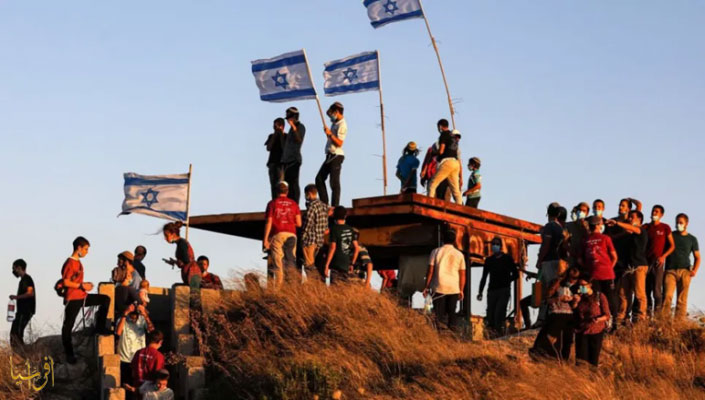
Afrasianet - Walid Habas - The phenomenon of "hilltop youth" is a case that embodies what can be called "unbridled terrorism", a type of violence that has arisen under the auspices and support of state institutions, but once it began to practice violence on the ground, it gained self-impetus, and began to develop according to its own dynamics, to the point that it exceeded the ability of the state that contributed to its production to control or control its paths. Hence the name "unbridled terrorism".
This article reviews the most prominent channels of government funding that feed the "hilltop youth", and then explains How this model turns into a state of unbridled terrorism.
Who are the "Hilltop Youth"?
In June 2026, the Ministry of Settlement Affairs published a plan to distribute 50 shekels every day to the members of the Hilltop Youth, until the end of 2026.
What is important about the document is that it allocates the amount to about 657 "beneficiaries", and this is an indirect count of the number of "Hilltop Youth" as classified by the Ministry of Settlement Affairs. The members of the Hilltop Youth are distributed in the following governorates:
Governorate Issue
Northern Governorates
(Jenin, Nablus, Tulkarem, Qalqilya, Tubas) 129
Ramallah and Salfit Governorate 225
Jordan Valley 120
Hebron Governorate 99
Bethlehem Governorate 84
Total 657
There are 6 characteristics that come together in the "Hilltop Youth":
1- Politically, they belong to the nationalist religious Zionist current, which views the entire land between the sea and the river as the exclusive property of the Jewish people, and sees the Palestinian existence as a demographic and political obstacle that should be reduced or removed.
2- Ideologically, they derive their reference from a revisionist and redemptive reading of the Torah, which for them serves as the constitution and the supreme reference. Its members believe that the coming of the Messiah and the attainment of collective salvation are linked to the imposition of full Jewish sovereignty over the Land of Israel, which transforms settlement from a political project into a religious duty and a devotional practice.
3- Culturally, the Hilltop Youth represents a conservative Salafist movement that seeks to restore an imagined lifestyle of ancient Jews, based on austerity, manual labor, and a relative distance from the manifestations of modernity.
4- Organizationally, the Hilltop Youth does not have a central leadership or a clear hierarchical structure, but rather operates through networks Flexible and informal, based on personal relationships, family ties, and field coordination.
5- Behaviorally, the Hilltop Youth embraces terrorism as a legitimate tool to reshape the geographic and demographic space of the West Bank. Its attacks are primarily aimed at Palestinians and their property, and may also target the Israeli army and police when they consider them to be impediments to the settlement project.
6- Socially, a culture of rebellion is a key pillar of the identity of the "hilltop youth." They rebel against family power, reject the prevailing lifestyles of Israeli society, and frequently clash with state institutions that they perceive to be lenient with Palestinians and subject to external pressure.
How does Israel fund the "Hilltop Youth"?
The "hilltop youth" is a standard model of what is called "runaway terrorism" in sociology. The concept of "runaway terror" refers to a dynamic in which terrorism is gradually freed from the political calculations that triggered it and becomes a source of reproduction of itself.
As impunity accumulates, and the material and symbolic gains of the practice of terrorism, the sponsoring institutions lose their ability to set the pace or define the limits of acceptable terrorism.
In the case of the West Bank, the "hilltop youth" grew up in an environment provided by sectors of the settlement movement, quasi-governmental bodies, and ministers allied with the settlement project, financing, infrastructure, security protection, and judicial tolerance.
Over time, pastoral and agricultural outposts have been transformed into social spaces that produce a new generation of "Jewish terrorists" who see attacking and expelling Palestinians as a standard practice and a means of demonstrating commitment to religious salvation and Jewish sovereignty.
In this context, every successful attack becomes a catalyst for attacks and create networks of solidarity, rewards, and heroic narratives that make settler terrorism less tied to the state's strategic calculations and more subject to its internal logic, so that Israeli institutions may find themselves exposed to violence that contributed to producing its conditions, but no longer has the full ability to contain it or set its ceilings.
Support for the Hilltop Youth is not limited to political tolerance or security protection, but is embodied in a governmental and semi-governmental funding system that provides the outposts in which they are active in the elements of survival and expansion.
In 2023, the Israeli government allocated 28 million shekels to protect illegal outposts, including 15 million shekels for agricultural and pastoral outposts, and the amount increased to 63 million shekels in 2024, and then to 75 million shekels allocated for security equipment for outposts, caravans, and pastoral farms.
These included cars, drones, surveillance cameras, generators, gates and fences, the infrastructure within which the Hilltop Youth Networks operate and enable them to establish a permanent presence in the targeted Palestinian areas.
Government sponsorship goes beyond providing infrastructure to integrating these outposts into public service networks. In 2024, Minister Bezalel Smotrich led a plan to regulate some 70 illegal outposts, which included directing ministries and government agencies to connect them to water, electricity, and public services before completing the planning and licensing procedures.
This means that the state not only condones the existence of these outposts, but also provides them with the conditions for stability and growth even before they receive any "legal" recognition.
The Ministry of Settlement Affairs and National Missions, headed by Orit Struck, is an additional channel for funding the social space in which the Hilltop Youth is formed.
The ministry's budget has increased from NIS 133 million in 2023 to about NIS 653 million after the addition of coalition funds and budget adjustments during the war.
The ministry funds the Settlement Division, biblical nuclei, pre-military religious academies, Jewish identity projects, as well as field units to protect the lands classified as Area C.
The ministry alone has allocated NIS 34 million The so-called "Area C Land Protection Patrol Units", which provide a permanent settlement presence that monitors Palestinian lands, prevents Palestinian access to them, and protects the pastoral outposts that constitute the main incubator of the "Hilltop Youth".
The World Zionist Organization's Settlement Division serves as a quasi-governmental intermediary that allows the passage of public funds with less transparency and accountability.
The division received NIS 197 million in the 2023 budget, received an additional NIS 200 million in December of the same year, and NIS 92 million in 2024.
These resources are used to develop outposts and settlement farms, allowing for the indirect funding of Hilltop Youth networks and through neutral bureaucratic names, such as pastoral outposts, young settlements, protection of Area C lands, security roads, and absorption centres.
Government "rehabilitation" programs reveal another type of institutional care for Hilltop Youth. In June 2026, it was revealed that the Ministry of Settlement and National Tasks intends to allocate NIS 5.5 million to provide living allowances to hundreds of Hilltop Youth, at a rate of NIS 50 per day per person to cover food and clothing expenses over a period of seven months, until the end of the year.
The programs includes funding for social workers, intermediaries between the Hilltop Youth and local authorities, and programs to encourage military recruitment and vocational training.
Although provided as containment and rehabilitation tools, they provide individuals who come from networks involved in near-daily attacks with a stable financial resource and direct institutional care, transforming the approach to violence from a law enforcement issue to a social welfare and risk management issue within the settler community itself.
________________
